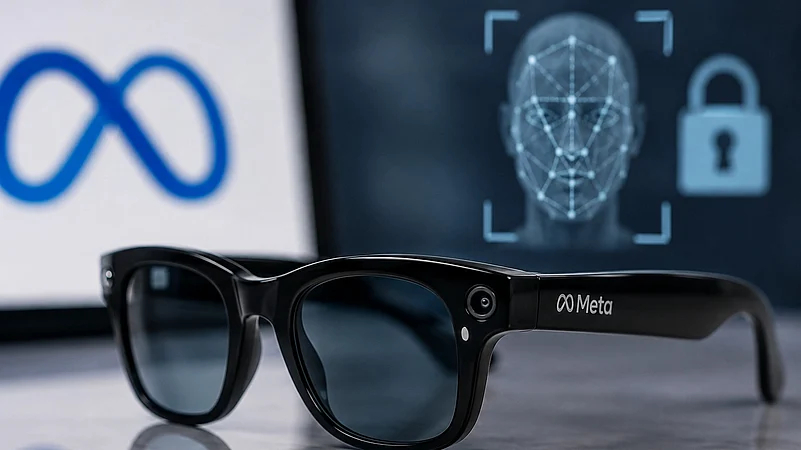

Meta's AI glasses are evolving from wearable cameras into AI assistants capable of recognising objects, translating conversations and understanding their surroundings.
At the same time, the Delhi Police's reported use of AI-enabled smart glasses during a recent protest has intensified concerns around surveillance, bystander privacy and consent.
While Meta says privacy safeguards are built into its devices, experts believe regulations may need to evolve as AI-powered wearables become more capable.
A pair of sunglasses has rarely generated as much debate as Meta's AI-powered smart glasses. Designed to translate conversations, identify objects and answer questions about the world around their wearer, the glasses are being positioned as one of the first mainstream consumer AI devices. But as the technology becomes more capable, so do concerns about what it means for everyone else who may be caught in its field of view.
The debate has gained fresh relevance in India following reports that the Delhi Police deployed AI-enabled smart glasses during a recent protest at Delhi's Jantar Mantar. According to The New Indian Express, police used AI-enabled smart glasses equipped with facial recognition, video analytics and thermal imaging capabilities, alongside facial recognition-enabled CCTV footage and social media videos, to identify people present during the demonstration.

1 September 2026
Get the latest issue of Outlook Business

Separately, Brut reported that the issue is now before the Delhi High Court after a Public Interest Litigation questioned the alleged surveillance of protesters. The Delhi Police has denied conducting unlawful surveillance, maintaining that photography and videography at protest sites are routine policing measures to maintain law and order.
Advertisement
Although Meta's consumer smart glasses and the Delhi Police's reported use of AI-enabled wearables are unrelated, together they have pushed a broader question into the spotlight: are existing privacy laws prepared for a future where AI-powered glasses can quietly observe, analyse and understand the world around them?
What Can Meta's AI Glasses Do?
Meta's Ray-Ban smart glasses already function as far more than wearable cameras. According to The Indian Express, they allow users to capture photos and videos, make calls, listen to music, translate conversations in real time and interact with Meta AI through voice commands. They can also recognise objects, describe landmarks and answer questions based on what the wearer is looking at.
Advertisement
The company is now working to make the devices even more capable. Citing a Financial Times report, The Indian Express said Meta is developing prototype glasses with "always-on sensing" features. Rather than continuously recording video, the experimental technology would periodically capture images and audio so that Meta AI can better understand a user's surroundings and provide more contextual assistance. The feature remains under development.
That represents a significant shift from today's smartphones. Mobile phones generally capture photos, videos or audio only when users deliberately activate the camera or microphone. AI-powered glasses, however, are being designed to continuously interpret their surroundings so they can provide more useful assistance. That changes the privacy debate from recording individual moments to constantly understanding the environment around the wearer—bringing everyone nearby into the equation.
Meta has defended its approach, saying it has "built privacy into the camera from the ground up." In a recent blog post, the company said "photos and videos captured with the glasses remain private unless users choose to share them," while also highlighting several built-in privacy safeguards.

Why Are Privacy Experts Worried?
The concerns surrounding AI glasses extend far beyond the possibility of someone secretly recording a video. Privacy advocates say the bigger issue is that these devices are being designed to constantly understand the world around their users, making it difficult for people nearby to know when information about them may be collected or analysed.
Those concerns are no longer theoretical. According to Fortune, Instagram recently began removing videos secretly recorded using Meta's Ray-Ban smart glasses after prank videos and clips of pickup artists filming women without their knowledge spread across social media. The controversy has even earned the devices the nickname "pervert glasses" online.
Privacy campaigners say smart glasses change long-standing social cues around photography. Thorin Klosowski, a security and privacy activist at the Electronic Frontier Foundation (EFF), told Fortune that unlike smartphones, wearable cameras are far less visible. "Unless you're literally in front of them, you don't know whether it's recording or whether they're taking photos," he said, arguing that smart glasses fundamentally alter people's expectations of privacy in public spaces.
The debate could become even more intense if future versions include facial recognition. Fortune reported that more than 75 civil liberties organisations, including the American Civil Liberties Union (ACLU) and the Electronic Privacy Information Center (EPIC), have urged Meta not to add facial recognition to its smart glasses, warning that such technology could make stalking, harassment and mass surveillance easier.
What Data Do the Glasses Collect?
Meta's AI glasses process much more than photos and videos. They also rely on voice commands, microphones and visual inputs to power features such as object recognition, live translation and conversational AI assistance.
According to The Indian Express, Meta's proposed "always-on sensing" technology would periodically capture audio and images to help its AI assistant better understand a user's surroundings. The company has said these features are intended to improve AI assistance rather than continuously record people's activities.
However, privacy experts argue that bystanders may have little idea what information is being processed. NL Times reported that Dutch privacy lawyer Charlotte Meindersma believes many users underestimate how much data AI-powered wearables could potentially handle, particularly when photos, videos and AI services work together.
The debate is not just about what is recorded but also what AI can infer from that information. As these systems become more sophisticated, experts say questions around data storage, retention and AI-generated insights will become just as important as the images themselves.

How Are Bystanders Affected?
Perhaps the biggest challenge posed by AI glasses is that they collect information about people who are not using the device.
That concern has become particularly relevant in India following the reported deployment of AI-enabled smart glasses by the Delhi Police. According to The New Indian Express, the devices were used alongside facial recognition-enabled CCTV footage and existing criminal databases to identify people present during a protest. Brut also reported that the Delhi High Court has sought details on whether the police has a Standard Operating Procedure (SOP) governing surveillance at protest sites, while the Delhi Police has maintained that it was following routine policing practices.
Sundeep Agarwal, Senior Vice President, Quality & Regulatory Affairs at Remidio, believes India's legal framework offers a strong starting point but was drafted before always-on AI wearables became a realistic possibility.
"The core challenge is that these devices don't just gather data about the person wearing them, they also pick up images, audio and even biometric cues from people nearby who have no relationship whatsoever with the company processing that data," he told Outlook Business.
Agarwal said this creates a meaningful gap because such bystanders fall outside the existing relationship between a data fiduciary and a data principal under the Digital Personal Data Protection (DPDP) Act.

Are Current Privacy Laws Enough?
India's DPDP Act lays down important principles around consent, accountability and data protection. But experts believe AI-powered wearables introduce challenges that lawmakers did not fully anticipate when the legislation was drafted.
Agarwal said future regulations may need to move beyond general privacy principles and introduce safeguards tailored specifically for AI wearables. These could include visible recording indicators, stronger cybersecurity requirements, privacy-by-design standards, limits on data retention and greater transparency around what AI systems infer from the information they collect.
He also said bystanders should have meaningful ways to object to or request deletion of data collected about them, backed by a consistent national regulatory framework that can evolve alongside the technology.
Similar conversations are already underway overseas. According to NL Times, European regulators are examining the privacy implications of AI-powered smart glasses, while Britain's data protection watchdog has also opened inquiries into the technology. Several venues and event organisers have begun restricting wearable recording devices over concerns about covert filming.

What Safeguards Has Meta Introduced?
Meta says privacy protections have been built into its smart glasses from the start. According to Fortune, every pair includes a white LED indicator that flashes whenever the camera records photos or videos, making it easier for bystanders to know when recording is taking place.
The company has also updated the glasses so that the camera automatically stops functioning if it detects that the recording indicator has been physically tampered with, The Indian Express reported. Meta has further said it seeks users' permission before reviewing photos or videos to improve AI features and does not want its products to be used to secretly record or harass people.
Even with these safeguards, the debate is unlikely to fade. AI-powered glasses promise to make computing more natural by allowing people to interact with technology without constantly looking at a phone. But they also blur the line between convenience and surveillance in ways that existing privacy norms were never designed to address.




As AI wearables become more common, the central question is no longer whether they can see, hear and understand the world around them. It is whether governments, companies and regulators can build rules that protect innovation without eroding the privacy of everyone else.