Chinese tech giant Alibaba on Monday launched its largest and most capable artificial intelligence model to date, sending its shares surging 7% in Hong Kong trade. The model, Qwen3.8-Max, is not far behind in size when compared with an offering from rival Moonshot AI launched last month.
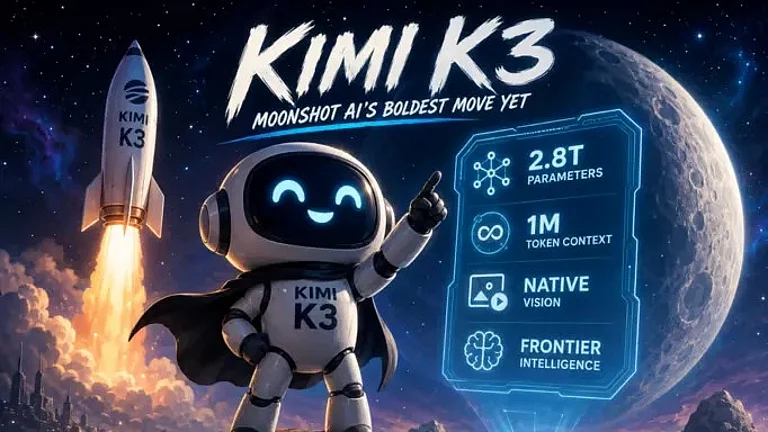
The model has 2.4 trillion parameters, the numerical settings a model learns from data and uses to recognise patterns, generate answers and carry out tasks. Moonshot's Kimi K3, by comparison, has 2.8 trillion parameters.
A higher parameter count does not automatically make a model better, but it remains a closely watched measure of the scale of computing and data behind advanced AI systems.
1 September 2026
Get the latest issue of Outlook Business

Separately, research firm Artificial Analysis said rival DeepSeek's newest model offers pricing that is over 100 times cheaper than Anthropic's Claude Fable 5.


The two developments highlight the rapid pace at which Chinese tech firms are advancing in artificial intelligence, as they compete to build more powerful systems without making them too expensive to run.
Both Alibaba's Qwen3.8-Max and DeepSeek's V4-Flash are open-weight models, meaning the underlying settings that let developers run or adapt the systems are available for download. This differs from the closed-source approach followed by OpenAI, Anthropic and Google.
Advertisement
Qwen3.8-Max Climbs The Leaderboards
Alibaba's Qwen3.8-Max was unveiled on the crowdsourced, model-comparison platform Arena.AI and quickly rose up leaderboards that assess AI capabilities.
On Arena.AI's leaderboard, Qwen3.8-Max became the highest-ranked Chinese text model, though it still trails Claude Fable 5 and three Opus variants, all developed by Anthropic. On the leaderboard for models that analyse images and visual content, Qwen3.8-Max ranked second globally, behind only a Claude Fable 5 variant.
Both Qwen3.8-Max and Kimi K3 can process text, images and video, and handle up to 1 million tokens, or chunks of data, at a time. This allows the models to process large volumes of material in a single instance, such as lengthy legal documents or extensive software code.
Advertisement
Alibaba said the model, due for release next week, completed a software engineering project in 16 days. It uses a "mixture-of-experts" design, activating only specific parts of the system for a given task instead of running the entire model each time. This means only 95 billion of its parameters are used at once, which helps cut costs and response times.
DeepSeek's V4-Flash Offers Steep Price Cut
DeepSeek's V4-Flash model, released last week, is currently the least expensive model to run among well-known global models on benchmark tests, according to Artificial Analysis. DeepSeek is reportedly preparing for a potential initial public offering. Its earlier R1 and V3 models had triggered a selloff in global tech stocks in early 2025 after raising questions about the scale of AI spending by American companies.
According to Artificial Analysis, V4-Flash charges $0.14 per million input tokens and $0.28 per million output tokens. The firm estimated the model's average cost per test at 3 cents, compared with 86 cents for Kimi K3, $1.86 for OpenAI's GPT-5.6 Sol, and $3.15 for Claude Fable 5.
This cost comparison offers a more accurate measure of value than headline pricing alone, as it accounts for the volume of data a model must process to complete a task.