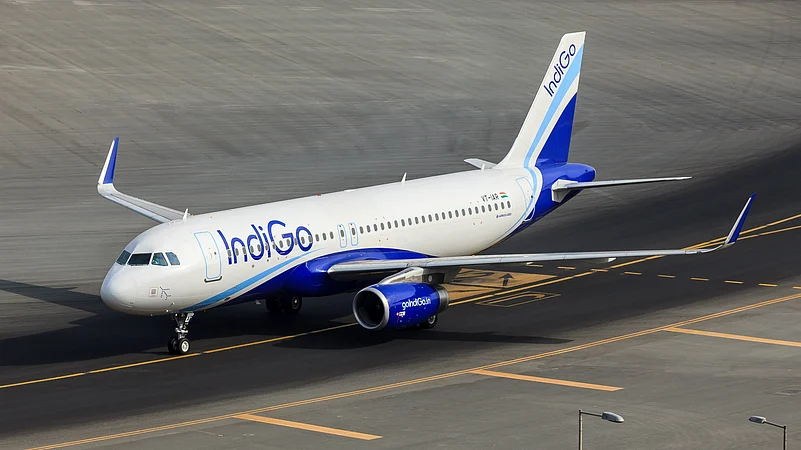

IndiGo's domestic market share touched a record 66.3% in June, reviving debate over competition in India's aviation sector.
Co-founder Rahul Bhatia says one-third of the airline's capacity serves routes where no rival flies, making the headline market share figure incomplete.
Here's why the debate has resurfaced, what IndiGo's defence is, and whether rivals can realistically narrow the gap.
IndiGo has once again found itself at the centre of a debate over competition after its share of India's domestic aviation market climbed to a record 66.3% in June, according to data released by the Directorate General of Civil Aviation (DGCA). The numbers mean that nearly two out of every three domestic passengers now fly with India's largest airline.
The discussion gathered pace after IndiGo co-founder and Managing Director Rahul Bhatia defended the airline's dominant position in interviews with The Economic Times and Mint. He argued that the headline market share figure does not reflect the full picture because a significant part of IndiGo's network operates on routes where no competing airline flies.

1 September 2026
Get the latest issue of Outlook Business

The debate goes beyond one airline's size. It raises broader questions about how concentrated India's aviation market has become, whether a dominant airline benefits consumers through better connectivity, and how competition could evolve as rivals expand their fleets. Here's a closer look.
Why Is IndiGo Facing Monopoly Questions?
The immediate trigger is the airline's record market share. DGCA data shows IndiGo accounted for 66.3% of domestic passenger traffic in June, its highest share so far. The Air India Group followed with 23.9%, while Akasa Air and SpiceJet held 6.4% and 1.9%, respectively.
Advertisement
The figures also show that IndiGo and the Air India Group together carried more than 90% of domestic passengers during the month. Such concentration naturally raises questions about how much of the market is controlled by a handful of airlines and whether smaller players can compete effectively.
The issue has received additional attention because Air India has reduced capacity on several domestic routes as part of its operational adjustments. That has helped push IndiGo's market share even higher. The airline also came under scrutiny after last December's operational disruption, when thousands of flights were cancelled over a week, highlighting how problems at a dominant carrier can affect a large number of passengers.
Advertisement
What Does Rahul Bhatia's 'One-Third Capacity' Argument Mean?
Rahul Bhatia says the market share debate misses an important point. According to him, around 34% of IndiGo's capacity is deployed on routes where no other airline currently operates. In an interview with Mint, he said this translates to nearly 250 city pairs that are served only by IndiGo.
His argument is that these routes should be viewed differently from those where airlines compete directly. While IndiGo's overall domestic market share stands above 66%, Bhatia says its share on routes where competitors are also present is significantly lower because a large part of its network connects destinations that others have chosen not to serve.
Bhatia also argues that building such a network has helped improve connectivity across the country. He says competitors are free to enter these routes but have largely chosen not to. According to him, India's ambition to become a global aviation hub will require one or two airlines with the scale to compete internationally, drawing comparisons with carriers such as Emirates, Singapore Airlines and Qantas.
How Concentrated Is India's Airline Market?
IndiGo's leadership has not emerged overnight. Over the past two decades, the airline has steadily expanded its fleet, added new routes and strengthened its position while several competitors struggled with financial challenges or exited the market altogether.
The domestic aviation landscape has changed significantly following the collapse of Jet Airways and the suspension of Go First's operations. More recently, Air India has trimmed capacity on some routes as it works through operational changes, while Akasa Air continues to expand from a much smaller base.
The result is a market where IndiGo remains the clear leader, Air India is the second-largest player, and the remaining airlines together account for only a small share of domestic traffic. Although India continues to have multiple airlines, the gap between the market leader and its competitors has widened considerably in recent years.
Does Connectivity Justify Market Dominance?
One of the key arguments put forward by IndiGo is that its market leadership is closely linked to the connectivity it has built over the years. According to Rahul Bhatia, nearly one-third of the airline's capacity is deployed on routes where no other carrier operates, helping connect smaller cities that may otherwise have limited air services.
Amit Mittal, Aviation Expert and Director at AeroIntellect Aviation, says IndiGo's market leadership is the result of several factors rather than just its market share. "IndiGo's market share of 66% can be viewed in two aspects. One is that it is an outcome of sheer size of the fleet, fleet mix of narrowbody and regional aircraft, airport slots, frequency, operational efficiency, first-mover advantage in some sectors and being the only airline to fly in some routes," he says.
According to Mittal, connectivity and a dense network naturally contribute to market leadership. However, he adds that as rival airlines induct more aircraft, expand their fleet mix and serve more routes, "it is likely that the dominant position of IndiGo Airlines could come under pressure."
Should Regulators Worry About Competition?
IndiGo's growing market share has naturally led to questions about whether regulators should be concerned. However, market share alone does not determine whether a company is operating unfairly or limiting competition.
Instead, competition debates generally consider whether consumers continue to have choices, whether new players can enter the market and whether existing airlines have a fair opportunity to expand. In India's aviation sector, airlines remain free to launch services on routes where they see commercial potential, including many currently served only by IndiGo.
Mittal believes regulators should focus on ensuring a level playing field rather than reacting only to market share figures. "The regulators' work is to facilitate fair competition, which they are already doing by keeping the doors open for new airline applicants," he says.
Can Rivals Realistically Challenge IndiGo?
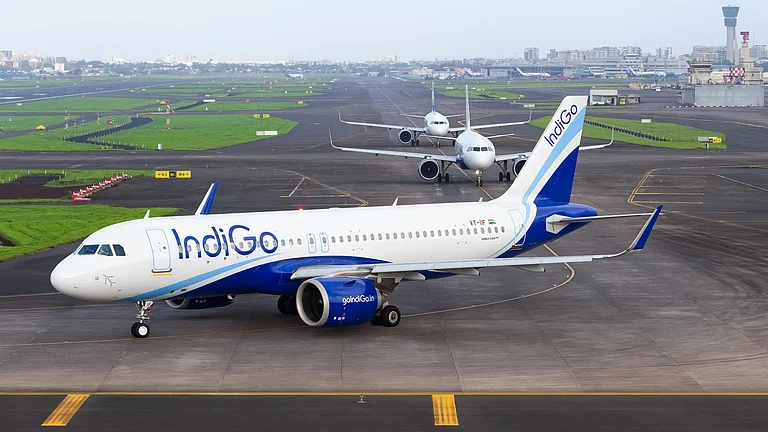
While IndiGo's lead appears significant today, industry experts believe the competitive landscape is unlikely to remain static. Air India is expanding its fleet and network under the Tata Group, while Akasa Air continues to add aircraft and increase its presence across domestic routes.
According to The Economic Times, aviation consultancy CAPA's South Asia CEO Kapil Kaul believes IndiGo's current market share is the outcome of a business strategy executed consistently over two decades. He also expects the airline's market share to moderate to around or below 50% if the industry's planned expansion progresses over the next few years.
Mittal also believes stronger competition will take time to emerge. "Any serious competition from rivals for a dominant player like IndiGo can only build up over time if the existing airlines and the new airlines coming up are able to have an appropriate number of aircraft in a reasonable time frame," he says.


He adds that competitors will also need operational efficiency and financial strength to sustain long-term expansion. As more aircraft enter the market and airlines expand into regional and international routes, the competitive landscape could gradually become more balanced.