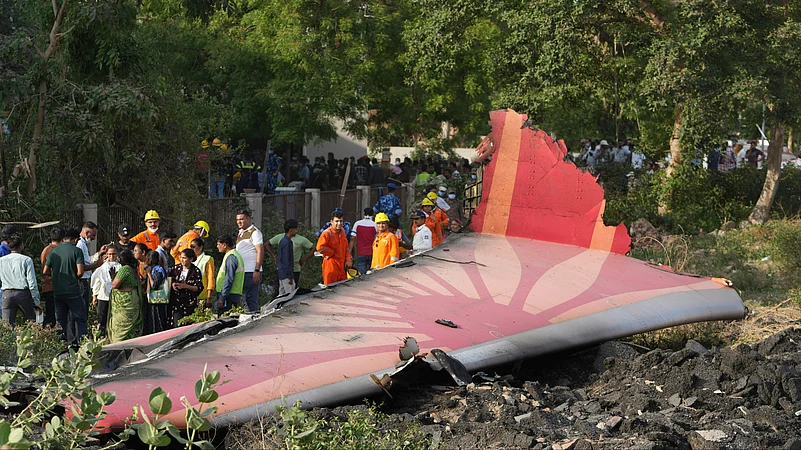

Air India's AI171 crash investigation report remains pending a year on, with the Supreme Court criticising the probe's handling and families objecting to compensation waiver terms.
The airline posted a record $2.8 billion loss in FY26, driven by the crash, airspace closures and rising fuel costs.
CEO Campbell Wilson has resigned, and Chairman N Chandrasekaran has taken direct charge amid pressure from Tata Trusts.
A year has passed since the Air India Ahmedabad crash, which occurred on June 12 last year. Though the final probe into the accident is still pending, teh carrier's staff observed a two-minute silence at their workstations on Friday, June 12, 2026, to mark the anniversary of the crash.
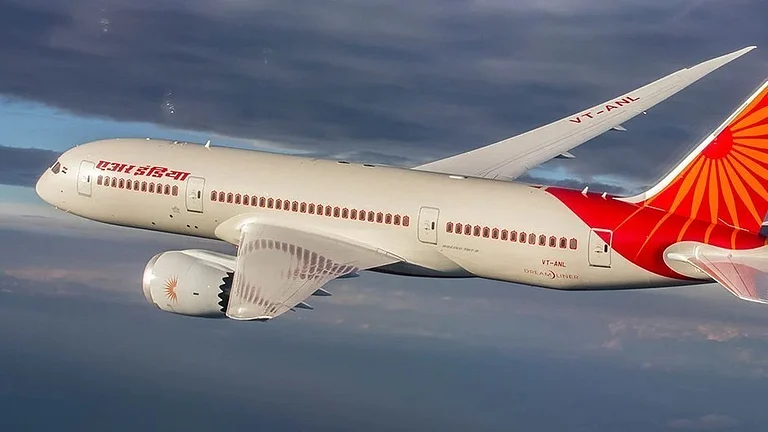
A Boeing 787 Dreamliner operating as AI171 from Ahmedabad to London had crashed seconds after take-off last year, killing 260 people. Only one of the 242 people onboard survived the crash, and 19 others on the ground also lost their lives.

1 September 2026
Get the latest issue of Outlook Business

While the crash brought immediate grief, its aftermath has continued to shape Air India's compensation process, its legal battles, its financial position and its leadership structure over the past year.


Families Object to Compensation Waiver
Families have objected to how Air India has handled compensation settlements. Relatives, including Radhika Mishra, daughter of former Gujarat Chief Minister Vijay Rupani, said the airline was asking families to permanently give up their right to sue, even before the official investigation was complete, according to The Indian Express.
Advertisement
Mishra had written to Tata Sons and Air India Chairman N Chandrasekaran, opposing this condition attached to the final compensation offer. She said the crash investigation was still ongoing, yet families were being asked to give up all present and future claims, not just against Air India, but also against Boeing, engine makers General Electric and Honeywell, the Ahmedabad airport, and government agencies, before the facts were even known.
In response, Air India said it made final compensation offers because some families wanted to settle rather than wait for the investigation report. It said this condition was standard practice followed by airlines worldwide for final settlements. "There is absolutely no deadline or pressure on any family or individual to accept our offer within a set timeframe," the airline said, according to The Indian Express, adding that families were free to wait for the investigation report, as some had chosen to do.
Advertisement
Air India also said the legal document's wording followed standard practice used by airlines in India and abroad, and that it had no intention of protecting other companies from legal action. Mishra was not the only one to raise these concerns, as several other victims' families and their lawyers had flagged similar issues earlier, according to reports.
Alongside the compensation dispute, the handling of the investigation itself has drawn criticism from the country's top court. Following the tragedy last year, the Supreme Court had strongly criticised India's aviation authorities for their handling of the aftermath of the crash, saying it was "irresponsible" for the aviation authority to suggest, through leaks to the media, that pilot error had caused the disaster. The court called on the government for its response before it rules on a case filed by activists demanding an independent investigation, and said the way the aviation body released its preliminary report was "selective and piecemeal."
The preliminary report, published by the Aircraft Accident Investigation Bureau (AAIB) in July last year, said fuel supply to the engines was cut off just seconds after take-off. It also said one of the pilots was heard asking the other "why did he cut off" in a cockpit voice recording, with another pilot responding that he did not do so. The recording did not clarify who said what. At the time of take-off, the co-pilot was flying the aircraft while the captain was monitoring.
The fuel control switches, which moved almost simultaneously from "RUN" to "CUTOFF" shortly after take-off, have remained central to the investigation. The primary technical probe is being led by the AAIB, with involvement from the US National Transportation Safety Board, Boeing and GE.
According to a recent report by Reuters, the final report is expected to be delayed past the anniversary, as detailed technical analysis of the aircraft's engines, sent to the US for examination, is yet to be completed. Under international rules, a final accident report is due within a year, but if that deadline is not met, an interim statement must be issued on each anniversary. Reuters had reported last month that Indian officials were preparing such an interim report, given the complexity of the investigation.
The Federation of Indian Pilots has urged the AAIB not to issue an interim report, arguing it could lead to greater confusion and speculation and would not be conclusive while further investigation continues.
The group has also urged investigators to seek additional technical data from Boeing and Air India. Separately, the captain's father has petitioned the Supreme Court for an independent investigation considering causes beyond deliberate pilot action. The preliminary report made no safety recommendations to Boeing or GE, indicating no technical issues had been identified at that stage.

Air India Posts Record Annual Loss
Beyond the investigation and compensation disputes, the crash has also weighed heavily on Air India's finances. The airline posted a full-year loss of about $2.8 billion, or roughly ₹24,000 crore, in FY26, according to Singapore Airlines Group, which owns a 25.1% stake in Air India. This was more than double FY25's loss of ₹10,859 crore and significantly above the airline's own internal estimate of ₹15,300 crore, marking its largest annual loss since the Tata Group's acquisition in 2022.
Three factors converged to drive this loss. The closure of Pakistani airspace to Indian carriers following the border situation after Operation Sindoor in early 2025 forced Air India's flights to Europe and North America onto significantly longer routes, increasing fuel burn, crew hours and maintenance cycles. At the same time, Aviation Turbine Fuel prices rose sharply as the Middle East conflict escalated, an impact that was amplified for Air India's wide-body international fleet by the longer routes already being flown. The AI171 crash added further costs through compensation, insurance settlements, legal proceedings and fleet inspections, while also setting back years of brand-rebuilding efforts.
CEO Campbell Wilson Steps Down
Now, against this backdrop of financial pressure, Air India's chief executive officer, Campbell Wilson, also announced his resignation. Wilson, whose term was set to end in 2027, will remain in the role until a successor is appointed.
A former Singapore Airlines executive, Wilson was brought in to lead the airline's turnaround after the Tata Group acquired Air India from the government in 2022.
The airline said Wilson had told Chandrasekaran in 2024 that he wanted to step down in 2026, and had been working to ensure the organisation was on a stable footing for the transition. "The time is right for me to hand over the reins for the next phase of Air India's rise," Wilson reportedly said. The Air India board has formed a committee to find his successor.
Wilson recently said that his successor will have his or her "hands full". "The next four years is going to be just as challenging as the past, albeit in a different way," Wilson told a lunch event at Wings Club in New York. "And so the person that takes over will have their hands full, but I want to make sure the right person is in place to carry that forward."
Chandrasekaran Takes Charge
With the CEO transition underway, Tata Group Chairman N Chandrasekaran took direct charge of Air India's day-to-day operations.
Five days after the crash, he addressed about 700 Air India employees in New Delhi, saying, "I've seen a reasonable number of crises in my career, but this is the most heartbreaking one. We need to use this incident as an act of force to build a safer airline," multiple reports quoted.
His responsibilities now include government relations, safety assessments, aircraft maintenance and staff welfare, and he is reported to be working closely with Wilson on strategic planning and regulatory matters.
The scale of Air India's losses has also drawn scrutiny from Tata Trusts, which controls the majority stake in Tata Sons. Tata Trusts Chairman Noel Tata had raised questions regarding the airline's capital consumption, pushing Chandrasekaran to present turnaround and loss-reduction plans, according to reports.
As head of Tata Trusts, Noel Tata has been reluctant to take Tata Sons public via an IPO, and is seeking a clear path to profitability to avoid triggering mandatory listing requirements set by the Reserve Bank of India.
Under this pressure, Chandrasekaran has reportedly introduced a three-year plan to reduce losses, with Air India deferring aircraft deliveries, cutting routes and adjusting its fleet expansion strategy to manage cash flows.