Adani Group has approached the government seeking relaxation of a clause that restricts airport operators from holding more than 10% stake in airlines.
IndiGo and Air India together control more than 90% of India's domestic aviation market.
The group operates eight airports and has announced ₹20,000 crore investment in airport cities, but faces challenges including aircraft shortages and regulatory scrutiny.
The Adani Group, India's largest private airport operator, has initiated discussions with the government to amend regulations that prevent it from launching an airline. The move comes as IndiGo and Air India together control more than 90% of the domestic aviation market.
India's aviation sector presents a paradox. It ranks among the fastest-growing airline markets worldwide, yet it has witnessed numerous carriers collapse over the past two decades. Kingfisher Airlines ceased operations in 2012. Jet Airways suspended flights in 2019 before making a partial comeback in 2022. Go First stopped operations in 2023. Air Deccan, Paramount Airways and Air Costa also shut down.

1 October 2026
Get the latest issue of Outlook Business

The Adani Group has approached the government seeking dilution of a clause that restricts operators of Delhi and Mumbai airports from holding more than 10% stake in a scheduled airline, according to Economic Times.
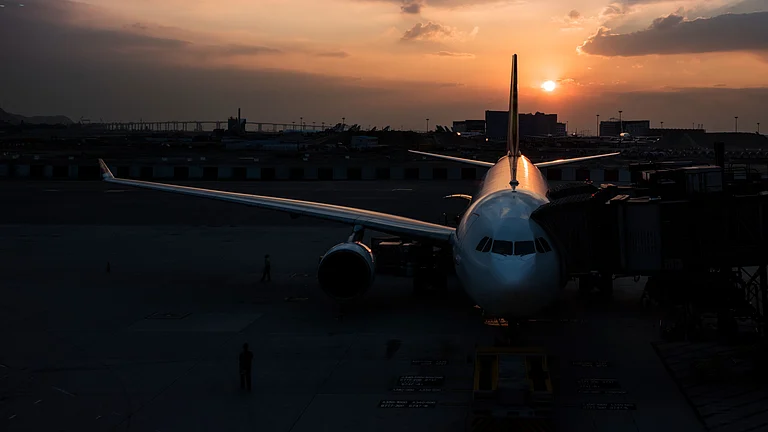

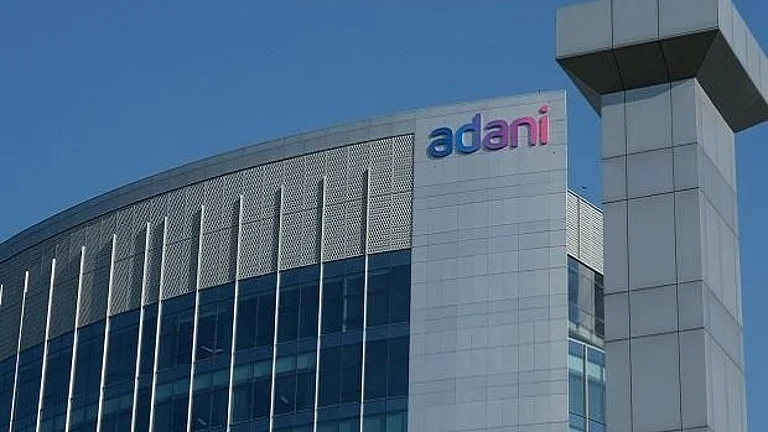

The restriction applies to Adani Group, which operates Mumbai airport, and GMR Group, which runs Delhi airport. Both companies are bound by concession agreements signed when the airports were privatised approximately two decades ago.
Advertisement
According to the report, Adani's request is also linked to its proposed partnership with Brazilian aerospace manufacturer Embraer for local aircraft production. The group may want to create a customer base for these manufactured planes through its own airline.
Sources within the civil aviation ministry told the publication that the matter has been discussed informally because the aviation landscape has transformed since the original agreements were drafted.
"There is no formal proposal before the government. These are preliminary discussions at best. If amended, the government may still cap the airport operators to have a shareholding in limited capacity," the sources said.
Advertisement
The Ministry of Civil Aviation is examining the proposal, according to Bloomberg. Any amendment would require clearance from the Ministry of Law and Justice and approval from the Union Cabinet, as it involves changes to contractual rights under public-private partnership agreements.
The Airports Authority of India, which granted the concessions, would negotiate a supplemental agreement with the airport operators DIAL and MIAL. Depending on the nature of the changes, the Cabinet Committee on Economic Affairs may also need to approve.
Neither the government nor Adani has officially confirmed these discussions.
Adani's Past Stance On Airlines
The Adani Group has previously stated it was not interested in the airline business. "I would say that there is nothing that we won't consider. However, legally we are not allowed," Jeet Adani, Director at Adani Airport Holdings Ltd, told reporters before the launch of Navi Mumbai airport in December 2025.
In earlier remarks, he had said, "We will not consider it as it stands today; the airline industry is not something that we see fitting the capital discipline. We are used to high-margin business and investing in assets and using our assets well. The airline business is opposite. We have no plans to enter the airline business."
Adani's Aviation Infrastructure Portfolio
Adani Airport Holdings Ltd operates eight airports across India, including Mumbai and Navi Mumbai. The GMR Group operates five airports, including Delhi and Hyderabad.
The group has announced an investment of ₹20,000 crore for the first phase of developing integrated airport cities at six locations. AAHL's aero revenue grew 26% year-on-year (YoY) in FY26, while non-aero revenue increased 31% during the same period, according to company reports.
Both IndiGo and Air India reported losses in FY26, attributed to high aviation turbine fuel costs, a strong dollar against the rupee and geopolitical disruptions.
Market Concentration In Indian Aviation
IndiGo controls more than 60% of the domestic market. The Air India Group, which has absorbed Vistara and AirAsia India, holds the second position. Together, they account for nearly 90% of domestic capacity.
The concentration has raised policy concerns. When IndiGo faced operational disruptions last year, the impact was felt across the entire aviation ecosystem, highlighting the risks of over-dependence on a few carriers.
India's long-term growth projections make the situation significant. The country plans to expand its airport network and industry bodies estimate hundreds of millions of additional passengers will enter the market in the coming decades.
Advantages Adani Could Bring
Most failed Indian airlines suffered from one of three problems. They lacked sufficient capital. They could not achieve operational scale. Or they entered the market without a broader ecosystem around them.
Kingfisher Airlines, launched in 2005, expanded rapidly through expensive acquisitions, including Air Deccan in 2007. Poor financial management, mounting debt and loss of investor confidence led to the suspension of its license by the Directorate General of Civil Aviation in 2012.
Jet Airways, once India's largest private airline, suspended operations in April 2019 with accumulated debt of approximately ₹18,000 crore. Despite attempts at revival, the airline is set for liquidation.
Go First, formerly GoAir, filed for insolvency in May 2023. The airline cited Pratt & Whitney engine issues that grounded half its fleet, though industry sources pointed to a long history of unpaid dues and deferred maintenance during COVID.
Air Deccan, India's first low-cost carrier launched in 2003, democratised air travel with fares comparable to train tickets. However, razor-thin margins and high operating costs led to its acquisition by Kingfisher in 2007, and it eventually ceased operations in 2020 due to the economic impact of COVID.
Paramount Airways, launched in 2005 as a business-class-only regional airline with a strong presence in South India, ceased operations in 2010. The downfall was caused by legal disputes, inability to replace aircraft and financial issues.
Air Costa, a regional carrier, ceased operations in 2017. Air Pegasus had its flying permit suspended by the DGCA in November 2016 because of accumulated losses. TruJet, a regional carrier launched under the UDAN scheme in 2015, suspended operations in 2022 due to heavy losses and financial distress.
These failures highlight the difficulties of sustaining an airline in India's competitive and capital-intensive market.

Notably, Adani addresses all three gaps. The group operates eight airports and has diversified into ground handling, pilot training and aircraft maintenance and is also pursuing a manufacturing partnership with Embraer.
This level of vertical integration is rare in Indian aviation. An airline would operate alongside airports, maintenance facilities, training academies and potentially manufacturing operations. This adjacency-driven expansion model has been a hallmark of the group's growth across sectors such as ports, logistics and energy.
Such a structure could make airline economics more attractive as part of a larger ecosystem. An airline generates traffic for airports. Airports produce commercial revenues from retail and passenger services. Maintenance facilities benefit from fleet growth. Pilot training schools gain from recruitment requirements. Aircraft manufacturing projects receive a potential launch customer.
Financial capacity will also matter. IndiGo has hundreds of aircraft on order. Air India has launched one of the largest fleet expansion programmes globally. A new airline attempting to challenge them would require years of investment before achieving meaningful market share. Few Indian business groups possess the financial resources to sustain that kind of long-term battle.
Challenges Ahead
Even with substantial resources, Adani would be entering at a difficult time. The global aircraft shortage remains severe. Airbus and Boeing continue to face delivery delays caused by supply chain disruptions. Airlines worldwide are waiting longer for new aircraft.
Without sufficient aircraft, building a meaningful network becomes difficult. This makes attracting corporate travellers challenging. Without premium passengers, profitability remains elusive.
Many airlines have entered the market but very few have altered the industry's structure. IndiGo and Air India possess extensive fleets, strong distribution networks, loyalty programmes, airport access and established customer bases. IndiGo in particular enjoys a scale advantage that few global airlines can match within their domestic markets, according to reports.
Conflict-Of-Interest Concerns
Competing airlines have raised concerns about an airport operator owning an airline. Their primary worry relates to airport slots, especially at congested hubs such as Mumbai, according to industry executives cited in media reports. Even if no preferential treatment occurs, competitors may argue that the perception of unequal treatment could undermine confidence in the system.
Government officials, as the ET reported, believe safeguards can address these concerns through arm's-length structures, restrictions on information sharing and stronger oversight mechanisms. Existing slot allocation rules provide protection to incumbent airlines.
Adani has proposed an aircraft manufacturing partnership with Embraer. Industry executives cited in recent reports suggest that attracting customers for locally manufactured aircraft could be easier if the group itself operated an airline capable of placing sizeable orders.
An airline could become a catalyst for a broader aerospace manufacturing ecosystem. Such a model would resemble approaches seen in some international markets where airlines, maintenance operations and manufacturing capabilities reinforce one another.
If Adani eventually enters aviation, it would do so with advantages few previous airline promoters in India have had, including capital, infrastructure and a network of related businesses.
But none of these advantages eliminate the fundamental realities of the airline business. Aircraft shortages, high operating costs, entrenched incumbents and regulatory scrutiny remain formidable obstacles. The history of Indian aviation is filled with companies that appeared well-positioned before discovering how difficult the industry can be.