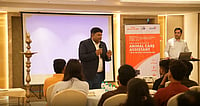


New Delhi, Delhi, India: PCI India convened the third edition of Intersection, its flagship annual thought-leadership platform, at Stein Auditorium, India Habitat Centre, New Delhi. Themed “Intersectoral Green Growth-Talk for a Viksit Bharat”, the convening brought together policymakers, development practitioners, private sector leaders, financial institutions, philanthropies, academia and community representatives to discuss how economic growth and climate action can reinforce one another.
Setting the context, Mr Indrajit Chaudhuri, CEO and Country Director, PCI opened the conference by posing the question: How can we make climate action an engine of economic growth? This is the question that lies at the heart of Intersection. He emphasised that women must be seen as the drivers of this change. India has the opportunity to develop into a Viksit Bharat that is both economically prosperous as well as environmentally sustainable.
During one of the panel discussions Mr Shikhar Jain, Executive Director, CII-ITC aptly reminded that Viksit Bharat goes hand in hand with Harit Bharat. The discussion stressed convergence among government, industry, financial institutions and philanthropy to build implementable models that the government buys into from the start.

1 November 2026
Get the latest issue of Outlook Business

Ms Anna Roy, Programme Director, NITI Aayog, spoke about how the Women Entrepreneurship Platform (WEP) supports women building green enterprises. She described WEP as a vehicle that can build enterprises in the green economy and make economy more inclusive. With the right business models, schemes and finance, women's collectives such as Cluster Level Federations can run enterprises like community-level plants on a sustainable basis.
Advertisement
During the fireside chat, Dr. Ashish Chaturvedi, Head of Action for Climate and Environment, UNDP highlighted how repair and reuse of materials were part of our Indian traditional practice. He emphasised that India's informal sector is the backbone of its recycling system. The way forward is to share the value created by Extended Producers Responsibility (EPR) with informal workers, finance the "missing middle" of aggregators, and link waste pickers to social protection. Scale, he said, will come from hundreds of community-led models rather than one big solution.
The key highlight of the convening was ‘Voices from the Ground,’ where our community partners from Haryana, Uttar Pradesh, and Karnataka—including women farmers and women entrepreneurs—shared their experiences. This highlighted the role of women-led community enterprises and rural institutions in advancing decentralised renewable energy, strengthening climate-resilient livelihoods, and creating inclusive economic opportunities within emerging green value chains.
Advertisement
As India advances towards Viksit Bharat 2047, the transition to a low-carbon economy offers an opportunity to strengthen enterprise competitiveness, create resilient livelihoods and support sustainable communities. MSMEs and rural enterprises are central to this transition, with accessible finance, clean technologies and stronger institutional and market linkages playing an important role.
The event brought together perspectives and insights on advancing green growth through stronger cross-sector partnerships, accessible green finance and sustainable enterprise models. Discussions also highlighted the importance of drawing on implementation experiences in rural energy, agriculture and enterprise development to support an inclusive transition.


Intersection 2026 was supported by Prerna UPSRLM, JEEVIKA Bihar, United Nations Global Compact Network India, Gates Foundation, Global Energy Alliance for People and Planet, HSBC, Energiva, KP Singh Foundation, Schneider Electric, Mobius Foundation and with The Bridgespan Group as its strategic partner.
About PCI India
PCI India has been working in India since 1998, partnering with governments, the private sector and development organisations to address social and developmental challenges. Through evidence-based programmes, technical assistance and community-led solutions, it works across health and nutrition, gender equality, women’s economic empowerment, livelihoods, social protection and climate action. PCI India works across 23 states and 259 districts, with programmes impacting 20 million people.
Learn more at www.pciglobal.in.