India’s $179 billion textile industry faces a 2027 "compliance cliff" with EU digital product passports
The PM MITRA parks and TexRamps schemes aim to integrate the fragmented MSME value chain
Recycled PET costs have dropped below virgin polyester, making circular economy models commercially viable
India’s textile industry, a $179-billion powerhouse, is entering a decisive phase as global compliance norms, domestic policy support and business pressure push the sector toward circularity.
At an Outlook Planet C3 idea exchange session titled Sutradhar (The Thread-Holder) – Orchestrating a Circular Economy, speakers said the industry now has the ingredients to lead the transition, but only if it can solve for data, decentralised execution, commercial viability and scale.

1 October 2026
Get the latest issue of Outlook Business

Moderating the discussion, Surojit Bose, Sustainability Leader at Intueris, said the industry faces a “critical juncture,” warning of the 2027 compliance cliff linked to the EU digital product passport. “India's textile industry is a huge behemoth of a $179 billion powerhouse. Yet we face many many challenges, including, including the 2027 compliance cliff which is with the EU digital product passport,” he said.



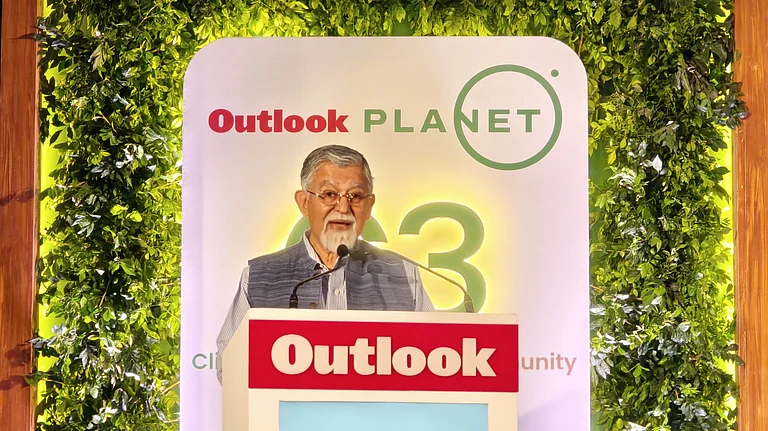
Chandrima Chatterjee, Secretary General of the Confederation of Indian Textile Industry, said the biggest hurdle is fragmentation across the textile value chain. “Where is the data, and where is the benchmark to begin?” she asked, calling for a stronger evidence base, measurable targets and a decentralised cluster-level approach.
Advertisement
She said, “...this is an optimistic time for the textile industry. Several schemes are already in place, including TexRamps for MSMEs, the upcoming TexEco initiative, the TEAM scheme for cluster-level interventions, and SPICE, also focused on MSMEs. Complementing these is the development of PM MITRA parks, which aim to provide the infrastructure needed to integrate the entire value chain.”
Naresh Tyagi, Chief Sustainability Officer at Aditya Birla Fashion & Retail, said sustainability must move beyond compliance and become a long-term business journey. His company began its “10 Mission” programme over a decade ago, focusing on water, energy, carbon and waste. Tyagi stressed that collaboration alone is not enough. “It must become more inclusive and expansive,” he said, adding that commercial viability is the fifth C.
Advertisement
“There is already a lot of good work happening across the sector. By connecting these efforts through collaboration and ensuring commercial viability, India can position itself as a global hub for sustainability. I remain very optimistic. Often, people say that nothing is happening, but that is not true. For instance, as an organisation, we have already achieved 69% renewable energy usage,” he said.

Bharat B Mehta, Vice President at Reliance Industries, said global shortages of gas, raw materials and space have made sustainability unavoidable. He argued that changing economics are now favouring recycling, pointing out that recycled PET has become cheaper than virgin PET in some cases.
“With the changing cost dynamics driven by global events, there is now a strong case for advancing chemical recycling of polyester and recovering it instead of relying on fossil-based feedstock. This could help create a more balanced and sustainable system,” he said.
Parvinder Singh, Managing Director of Aadi Sustainability Solutions, said India is simultaneously dealing with resource stress and waste management challenges. Citing Panipat’s large recycling ecosystem, he said the country already processes most post-industrial waste and has strong examples of circular production.
But he warned that the industry needs better storytelling and stronger links between brands, collectors and recyclers. “What we lack, however, is effective storytelling,” he said.
“We must understand our position, recognise our strengths, and identify the challenges ahead. If resources and waste are the defining issues, there is no country better positioned than India to address them,” he added.
Together, the speakers framed India’s textile future as one where policy, infrastructure and circular business models are converging. The challenge now, they said, is turning this momentum into a scalable, commercially viable system.