




IMD launches AI systems for hyperlocal monsoon and rainfall forecasting across Indian regions.
AI weather models deliver faster forecasts using significantly lower computing power and energy.
India joins global economies adopting AI-driven forecasting for agriculture and disaster preparedness needs.
The India Meteorological Department (IMD) on May 11 launched the country’s first artificial intelligence (AI) based monsoon advance forecast model that can predict the onset of the monsoon at block level up to four weeks in advance.
IMD also launched a pilot project developed by NCMRWF to use advanced AI systems for high resolution rainfall forecasting in Uttar Pradesh which can generate forecasts at a grid resolution of 1 km.

1 September 2026
Get the latest issue of Outlook Business

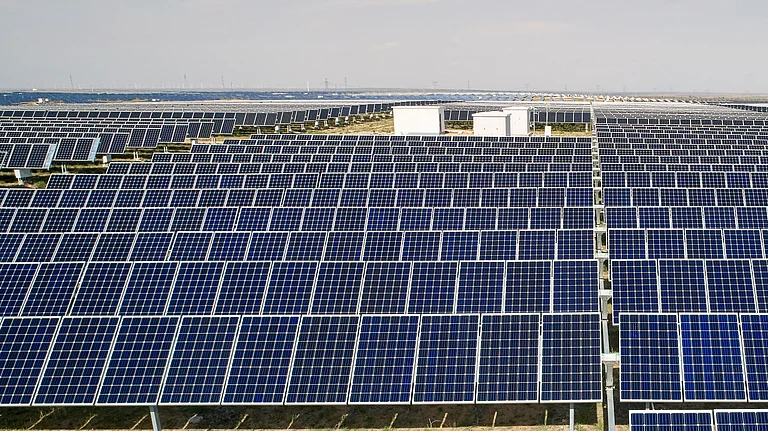
AI In Monsoon Forecasting
The system uses AI-driven downscaling techniques and integrates data from automatic rain gauges, automatic weather stations, Doppler weather radars and satellite-based rainfall datasets. It is expected to help farmers take more informed decisions on sowing, irrigation, crop protection and harvesting with greater local precision.
According to IMD, both systems aim to deliver hyperlocal, impact-based and AI-driven weather services across the country. The models were developed in consultation with the Ministry of Agriculture and Farmers Welfare, and their outputs will be shared with farmers through application programming interfaces developed by the ministry and through the Agri Stack platform.
Advertisement
“The block-level monsoon onset forecast model combines existing numerical weather prediction models with AI to generate probabilistic forecasts of monsoon progression every Wednesday up to four weeks in advance, with a model error margin of around four days,” Minister of State (Independent Charge) for Earth Sciences Jitendra Singh said while launching the two models.

Need for AI Forecasting
The September 2025 report published by the University of Chicago also acknowledged that the physics-based weather prediction models used by major meteorological centres around the world are powerful but costly. They simulate atmospheric physics to forecast weather conditions but they demand expensive computing infrastructure.
Advertisement
In contrast, the newer models, such as Pangu-Weather and GraphCast, have matched or even outperformed leading physics-based systems for some predictions. Compared to traditional systems, the AI-based models consume dramatically less computing power than the traditional systems.
AI weather models can produce forecasts in minutes using a single GPU, while physics-based systems need thousands of CPU hours for each forecast cycle. AI training requires a large amount of upfront computational power, but trained models can produce large-scale forecasts at a fraction of the computational cost, sometimes delivering global high-resolution forecasts in seconds on a standard computer.
India’s New Forecast Systems
According to the news release by the Ministry of Earth Sciences, Union Minister Jitendra Singh said during the launch of the system in New Delhi on May 12 that India’s weather forecasting capabilities have witnessed a major transformation during the last decade, with technology, data integration and advanced modelling significantly improving forecast accuracy and public trust in IMD services.
He asserted that IMD has become an integral component of governance, disaster preparedness, agriculture planning and everyday public decision-making.
The minister added that the newly launched systems mark a major shift from conventional weather forecasting towards impact-based and decision-support forecasting, capable of providing precise, location-specific and actionable information to farmers, administrators, disaster managers and citizens.
Technologies Behind Forecasting
Modern weather forecasting in 2026 relies on a synergy of AI architectures and global sensor networks. According to the ECMWF and Google DeepMind, cutting-edge systems like GraphCast and AIFS use deep learning to analyse decades of historical data, generating forecasts in seconds with 1,000x less energy than traditional models. These are supported by SAR satellites and IoT-enabled weather networds. According to the India Meteorological Department (IMD), this hybrid approach enables 1km-grid accuracy, allowing agencies to predict hyperlocal monsoon patterns and extreme events with unprecedented speed and precision.
According to the Articsled website, several economies and international agencies have recently moved AI systems into operational (daily use) status. These countries include, India, the European Union, United States and China.
Traditional Vs AI Weather Forecasting
The difference between traditional and AI weather forecasting remains primarily in how they process information. While one method uses laws of physics, the other uses ‘pattern recognition’.
In terms of speed, the AI weather forecasting can deliver a 10-day forecast in seconds or minutes. Similarly, the AI model can run on standard GPU clusters with up to 1,000x less energy while the traditional forecasting requires massive energy and high-end supercomputing hardware.
When it comes to accuracy, the traditional forecasting is better at predicting unprecedented “once-in-a-centrury” events, whereas, the AI model beats traditional models in standard 1-14 day forecasts.


In 2026, the industry is rapidly moving toward hybrid models that combine both to get the best of both worlds.









