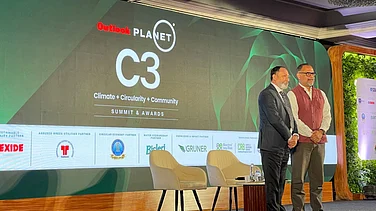

Industry leaders flagged leakages in India’s lead-acid battery recycling ecosystem amid rising demand for critical minerals.
Speaking at Outlook Business C3 2026, Trilegal’s Umang Pathak said India is “sitting on urban mineral mines.”
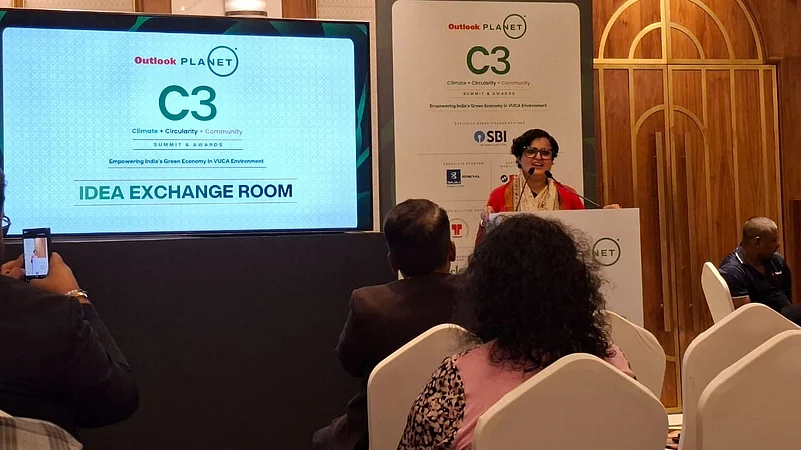
She made the remarks during an Idea Exchange panel on circularity in lead-acid battery recycling and the way forward.
Industry leaders and experts highlighted leakages in India’s lead-acid battery recycling ecosystem at a time when the country is facing high demand for critical minerals derived from these batteries.
“We are sitting on urban mineral mines,” said Umang Pathak, Senior Specialist – ESG Disputes and Regulatory, Environment and Climate Change, Environmental, Social, and Governance (ESG) at Trilegal, speaking at Outlook Business C3 2026 on Friday.

1 September 2026
Get the latest issue of Outlook Business

She was speaking at the Idea Exchange panel on “Circularity in Lead-Acid Battery Recycling: Policy & Practice – The Way Forward.”



Highlighting the increasing need for minerals and renewable energy storage, she said, “What we are not discussing right now is that we are moving towards electrification, which will require more electricity. India is leading in the renewable energy space globally. And for all that technological development—solar, hydro projects, and battery storage—the kind of minerals we need are already sitting in these batteries. Our cities are urban mines—from your cars, your batteries, your phones, PCs, refrigerators—there are all the metals we need.”
Advertisement
However, she added that some parts of the battery recycling industry are content with obtaining fake EPR (Extended Producer Responsibility) certificates, which are meant to verify that producers, importers, and brand owners have fulfilled their mandatory obligations to manage, recycle, and dispose of environmental waste generated by their products.
Pathak noted that regulators and the government lack the bandwidth to crack down on such fake recyclers, which is why various incentive schemes have been introduced to encourage formalisation. She also highlighted how lead-acid battery recyclers can benefit from the broader policy push around the circular economy and resource security under the National Critical Minerals Mission.
Advertisement

The panel, moderated by Dr Suneel Pandey, Director & Senior Fellow at TERI, opened the discussion with a call for recycling lead-acid batteries through formal routes only, as the informal sector does not take responsibility for the damage caused. He cited instances of lead poisoning in the Philippines due to informal recycling practices.
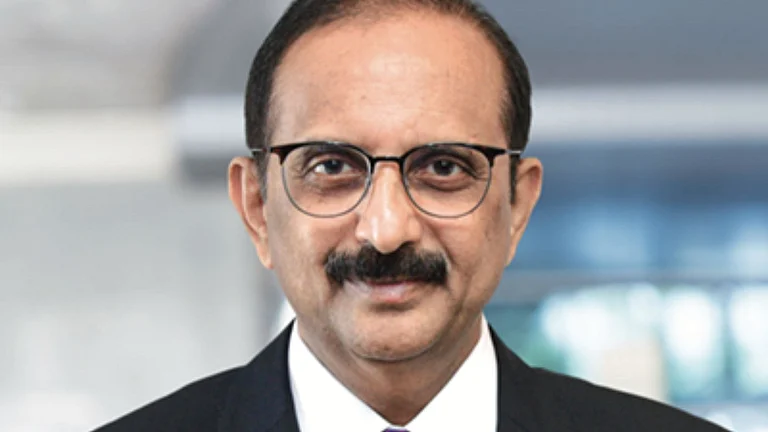
R Rajalakshman, MD & CEO of Chloride Metals Limited, a wholly owned subsidiary of Exide, also raised concerns, stating that similar issues are now being seen in African nations.
Rajalakshman further noted that their plant is running at only 40% capacity because they are not receiving enough batteries, as many are leaking out of the formal system.