

Private sector CSR funding is projected to reach ₹1.43 lakh crore in FY25, growing at 9–11% annually through FY30, driven largely by family philanthropy and UHNI contributions.
Startups working on climate, circular economy, and livelihood solutions face difficulty securing multi-year capital due to CSR structures favouring short-term measurable outcomes.
Experts highlight the need for catalytic funding models that support long-gestation impact projects, aligning social outcomes with long-term economic value.
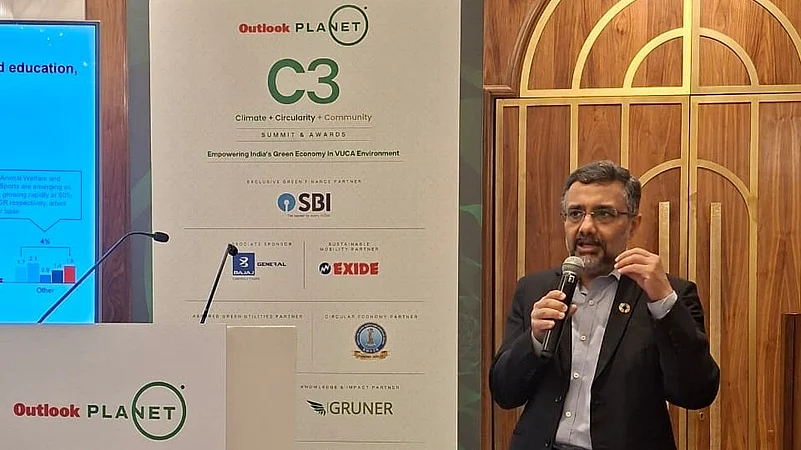
Corporate Social Responsibility (CSR) funding is increasingly emerging as a crucial bridge between early-stage innovation and scalable impact, especially in sectors aligned with climate transition, circular economy, and social development, Jayanta Chaudhuri, director- marketing, alliances and partnerships, at Alliance for an Energy Efficient Economy (AEEE) said.
Speaking at the Outlook Planet C3 Summit, Chaudhuri highlighted the CSR funding is expected to hit over ₹35,000 crore while the philanthropic funding is expected to reach approximately ₹1.43 lakh crore in FY25, growing at 9–11% annually between FY25–30, largely driven by family philanthropy and rising participation from high-net-worth individuals (HNIs) and ultra-HNIs.
1 June 2026
Get the latest issue of Outlook Business

However, despite this growing pool of capital, startups working on sustainability and social innovation continue to face challenges in securing long-term funding commitments, he added. One of the central issues is the structure of CSR spending itself, which often prioritises short-term, measurable outcomes over deep, multi-year transformation. Many social enterprises working in areas such as recycling, livelihood generation, climate-resilient infrastructure, and waste management require sustained capital to demonstrate viability and scale impact.
Industry conversations highlight that CSR funding is frequently treated as a compliance exercise rather than catalytic capital capable of unlocking innovation. Startups working on circular economy models — such as converting multi-layer packaging waste into consumer products or building sustainable supply chains — often require patient capital to build ecosystems, train communities, and create measurable social outcomes over time. However, funding cycles typically emphasise annual reporting metrics, limiting investor appetite for long-gestation projects.
Data suggests that UHNI giving is expected to grow at 23–25%, supported by rising wealth and institutionalisation of philanthropy, while retail contributions may expand 9–11%, aided by digital giving platforms and broader financial inclusion. Yet the allocation of these funds toward early-stage climate-tech and social startups remains uneven.
Stakeholders point to gaps in transparency, impact measurement frameworks, and scalability pathways as reasons why corporates hesitate to commit to multi-year investments. While CSR can act as catalytic funding — enabling pilot programmes in areas such as sustainable housing materials, energy-efficient infrastructure, or community skilling — organisations often seek near-term visibility of results. This creates a mismatch between capital expectations and the realities of building sustainable solutions.

Increasingly, policymakers and industry leaders are recognising that CSR funding must evolve from a tick-box mandate to a strategic lever for innovation. As climate-linked risks reshape supply chains and regulatory frameworks tighten, long-term investments in sustainability-focused startups could generate both measurable social outcomes and economic resilience.
With private philanthropy expanding and digital transparency tools improving impact measurement, CSR capital has the potential to play a pivotal role in supporting startups that address structural challenges — from waste circularity to climate adaptation — provided investors adopt a longer investment horizon.