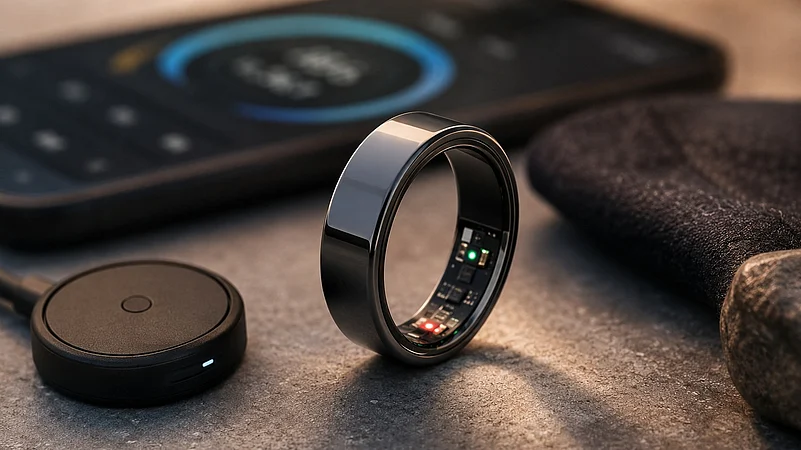

The Oura Ring 4 offers excellent sleep and health tracking through a strong app, with great comfort and long battery life.
Heart rate and sleep tracking are highly accurate, but step counting is less reliable.
Its subscription model and the near-simultaneous global launch of the Ring 5 raise concerns.
I’ve had two main issues with the Oura Ring 4, but I can’t deny that it is by far one of the best health trackers on the market in India as of today. It all boils down to the excellent Oura app. I travel frequently, and the multi-day battery life is one of the best parts about the Oura Ring 4.
I’ve been wearing it for about a month now, and over the last few weeks, I have been travelling from India to Taiwan and then to Canada. A couple of flights and train rides later, and my evening check-ins with the app become unmissable. I’m not a data nerd, but reading the numbers on a surface level and talking to the “Advisor” has been quite revelatory.

1 September 2026
Get the latest issue of Outlook Business

I’m not a fitness freak, and neither am I an athlete. I’m a regular human being with an affinity for walking, especially on trips, but hardly any gym time. I do, however, take my sleep tracking seriously. I know that I’m able to fall asleep pretty quickly, but how well do I actually sleep? That has been a mystery for many years, beyond the fact that I know which days I wake up refreshed and which days I don’t. That is, until I started wearing fitness bands, and now my first health ring is the Oura Ring 4.
Advertisement
Having a ring, as a fitness tracker, has been a boon for me. It means I’m more focused and less ‘addicted’ to checking my data every few minutes. The Oura Ring 4, once you’ve gotten the size kit, fits absolutely snug on your finger. In fact, it fits comfortably on two fingers - index and middle - for me. The only trouble is that you can feel a pinch when someone gives you a firm handshake.
The one design change vis-à-vis the Ring 3 is that Oura has removed the internal sensor bumps that held the ring in place. They’ve done this to prioritise comfort, and yes, it is the comfiest ring out there. But sizing is vital to the experience, as a slightly loose fit will cause the ring to slip out of place.
Advertisement
Reason #1 Why I’m Upset: The Ring 5
Within a month or so of Oura debuting in India with the Ring 4, the Ring 5 launched across many countries. The Ring 5 is 40 per cent smaller than the original Ring. The Ring 5 reduced the ring's width to 6.09mm and its thickness to 2.28mm. Even with reduced size, the company has improved tracking accuracy.
Depending on the ring size, the Ring 4 came in at 3.3-5.2g versus the Ring 5’s 2-2.69g weight. The sensor bumps may have made a comeback with the Ring 5, but overall, it is much more comfortable to wear.
The question is. Why did Oura launch the Ring 4 in India so close to the global release of the Ring 5. Was it to clear out inventory, or was it to gauge interest for a future rollout of the Ring 5 (who knows when that’ll be). Indians are right to be miffed at the company, even if the Ring 4 is amazing. I hope that if the Ring 5 launches in the next few weeks, the first few Ring 4 customers are automatically given a replacement for the newer Ring. This is something not many reviewers have addressed, and its a shame.
Time to get back to why the Ring 4 is a compelling choice for everyone out there.
What Makes the Ring 4 So Compelling
What makes the Ring 4 so compelling is the Oura companion app. You learn a lot about your body, and can improve those habits, and see if what you’re doing is actually helping. I want to talk about the subscription cost (and I will later), but I do think it's ultimately worth it.
The Oura Ring 4 isn’t designed to be a fitness tracker. It doesn’t help if you obsess over the numbers and try to perfect it to the tee. That’s actually going to do you no good. What the Oura Ring 4 and the accompanying app do is analyse your daily routine, including steps, sleep, your overall lifestyle, and so much more.
I tried various sizes from the sizing kit and finally settled on size 10 after a few days. This is an absolute must, and you can’t skip it under any circumstances. Getting the right size will not only make it a comfortable experience but also improve accuracy. I got size 10, and the ring comfortably lasts me a week before I have to plonk it on the charger. Not having to charge it for an entire week is genuinely a revelation.
But let’s get back to the app. As I said above, it does have a subscription, but it's ultimately worth it. It may be feature-rich and overwhelming at first, but the contextual data is easy to understand. Open the app, and you’re greeted with your stats up top, a big text update depending on the time of day, and then activity goal, stress, heart rate, readiness, and timeline below. There are three tabs - Today, Vitals, and My Health - at the bottom, alongside a “+” sign to access the AI advisor, add an activity, and do much more.
The Today tab is the most important, and it opens by default. It’s exactly as I explained above. It’s very easy to understand, and you don’t have to go looking for the most important metrics.
The Vitals tab is basically a hub for all your scores (Readiness, Sleep, Activity, Heart Health, Metabolic Health, and Core Metrics). You can click on any to dive into them for more data. The Vitals tab also lets you look at past days to see how you did.
Finally, there is the My Health tab. That will populate once you’ve used your ring for a while, as it shows long-term trends and shareable reports.
The thing I liked most is how contextually aware the app is about my data. It’s easy to confirm an activity - naps, walking, and more - from the ‘Today’ tab. When I wake up, I’m greeted with a note that tells me how well I slept. I scroll down a bit, and I’m told why my ‘Daytime Stress’ was high. And if I go to the bottom, I can see a timeline of my day, which, for the most part, brings a smile to my face. Yes, I’ve been trying to keep up walking, if nothing else, and seeing a bunch of ‘walking’ activities is a good thing.
Some small touches go a long way. When you open your heart rate graph and press on any section, it sends feedback via the phone’s haptic sensors.
While step tracking was a bit off, heart rate tracking was about 99 per cent accurate. Oura has been constantly saying that its ring is comparable to research-grade sensors. I’m no expert, nor do I have a chest strap or anything similar to compare it to, but I can say with a fair amount of confidence that heart rate tracking was very accurate. Even sleep tracking was spot on, compared to other trackers I had on simultaneously. It’s only the step counting that was off during my testing period.
Then there’s an AI Advisor, which is a health-oriented chatbot. It can help you interpret your health data or provide advice if you have any questions. I used it sparingly, but I like its presence. Last week, I had my chronic pain flare-up, but the Oura app had no way to register it and showed a good Readiness score, which didn’t reflect how I actually felt. I asked the AI Advisor about it, and it nudged me in the right direction.
I’m in Canada, after having been to Taiwan, and I’m on my way to London. The AI Advisor told me to maintain a certain consistency with walking (my preferred method of cardio exercise) daily and said I can have a ‘rest week’ when I’m back in India. It provides helpful analysis, even if much of it seems surface-level and something you’ve heard before. It uses data from your body to support the advice, and therein lies its advantage.

Reason #2: Subscription Price
Enough about the app. Let’s talk about price. I can’t finish this review without factoring in the cost of owning the Oura Ring 5. The Oura Ring 4 launched at Rs 28,900 for the Silver and Black versions, with the Stealth and Brushed Silver versions costing extra, and the Rose Gold version at an even higher price. Thereafter, if you want to access most of what the Oura Ring 4 offers, you need to get the subscription, which costs Rs 599 per month or Rs 6,999 annually.
For some, this may be a deal-breaker, especially for those who don’t want any add-on costs to an already expensive product. With 24/7 heart rate data locked behind a subscription, the membership cost is, unfortunately, unavoidable.
Verdict: Best Health Ring Out There?
The simple answer is yes. Ultrahuman, Gabit, and all the other competitors don’t even come close to what Oura offers with its companion app. I’m miffed that Indians got the shtick with the Ring 4 launching so close to the Ring 5’s global availability. That aside, the Ring 4 remains the best tracker for monitoring your daily vitals - activity, sleep, and stress - without making you rack your brain and overanalyse the data every time you open the app.
For a holistic overview of your health and wellbeing, and with a wealth of insights in the accompanying app, the Oura Ring 4 is definitely the best health ring in India today.
On the other hand, the Ring 5 has launched globally, and India’s launch is imminent. Furthermore, it is tough to sell consumers on the yearly subscription price, which is above and beyond the cost of the actual ring. The competition - Ultrahuman Ring Air, Samsung Galaxy Ring and others - do not require a subscription.
The Ring 4 is also just a ring, and hence it is difficult to wear to the gym. At the same time, a dedicated fitness tracker can be worn whilst in the gym. Maybe one can wear both.


I stand by what I said up top. The Oura Ring 4 is one of the best health trackers in India as of today. Going further in-depth, it is the absolute best ring tracker out there. I wish that Oura had waited for the Ring 5 before making its debut in India.
Yes, before you ask, I’m going to wear this ring well beyond my review period.