US President Trump has proposed a phased tariff regime for imported generic medicines offering a two-year duty-free window
The proposal could significantly reshape India's pharmaceutical exports and manufacturing strategy, with experts expecting companies to diversify markets, and strengthen US manufacturing footprints
GTRI believes India's long-term priorities should include reducing dependence on China for APIs and expanding exports beyond the US
United States President Donald Trump has unveiled a phased tariff roadmap for imported generic medicines, giving pharmaceutical companies a two-year transition period before imposing steep duties designed to encourage domestic manufacturing in the US.
Announcing the decision on his Truth Social platform, Trump said that imported generic medicines will continue to attract zero tariffs from August 1, 2026, for two years.

1 October 2026
Get the latest issue of Outlook Business

Thereafter, tariffs will rise to 100% for one year and then to 200%, while the policy governing patented and innovative medicines will remain unchanged, he added.
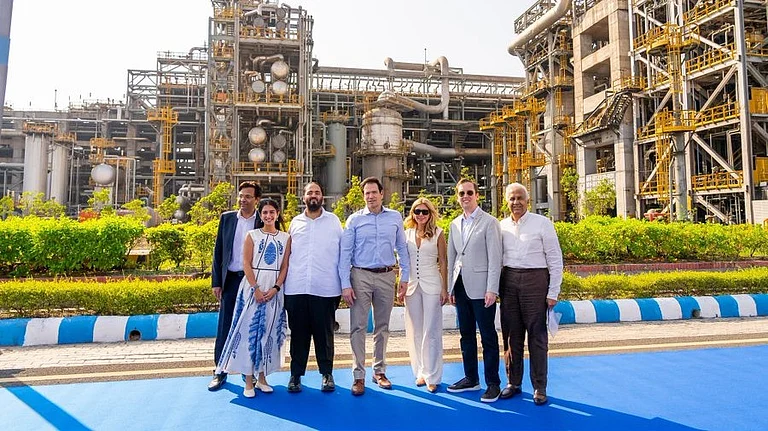


The proposal forms part of the Trump administration's broader strategy to bring pharmaceutical manufacturing back to the US. Trump said companies that do not establish manufacturing facilities within the transition period would eventually face punitive tariffs.
While the proposal offers temporary relief for Indian drugmakers, industry experts believe it also signals the beginning of a longer-term restructuring of global pharmaceutical supply chains.

Advertisement
Why India Has The Most At Stake
India is among the world's largest suppliers of affordable generic medicines and counts the US as its biggest export market.
According to a report by the Global Trade Research Initiative (GTRI), India's pharmaceutical exports stood at $25.8 billion in 2025, of which $9.7 billion, or 37.7%, went to the US.
Indian companies account for nearly 47% of generic prescriptions dispensed in the US, making the country a critical supplier of low-cost medicines.
Generics also dominate the American healthcare system. The US Food and Drug Administration (FDA) estimates that more than 90% of medicines dispensed in the country are generic drugs, as per Reuters. This underlines the importance of uninterrupted imports for healthcare affordability.
Advertisement
Several multinational pharmaceutical companies reportedly had previously secured tariff exemptions under separate agreements with the US government.

Immediate Impact May Be Limited
The two-year transition period gives Indian pharmaceutical companies time to reassess their global manufacturing strategies rather than respond immediately.
Experts say companies with significant exposure to the US generics market are likely to review product portfolios, optimise supply chains, improve operational efficiency and diversify exports to reduce dependence on a single geography.
"The impact of the tariff proposal for those Indian pharmaceutical companies that derive a substantial share of their revenues from the US market will undoubtedly be most significant and put pressure on pricing and margins," said Vijay Kumar Aggarwal, Managing Director of Medicef Pharma.
"However, those companies with diversified exports would naturally be better insulated," he added.
But Long-Term Decisions Can't Wait
Aggarwal further said that any policy increasing the cost of generic medicines could ultimately affect healthcare affordability in both the US and India as companies attempt to balance rising costs across markets.
Industry leaders also believe companies will continue engaging policymakers while evaluating commercial options.
According to Venkat Nelabhotla, Co-Founder of Nasdaq listed Vyome Holdings, firms are expected to reassess manufacturing footprints, improve sourcing strategies and participate in ongoing India-US trade discussions before committing significant capital to new facilities.
"The immediate focus will be on protecting supply chains and profitability," Nelabhotla said, adding that the Indian and the US governments would continue to engage as part of the bilateral trade negotiations "to arrive at a commercially and strategically balanced outcome".
Will Indian Companies Manufacture In The US?
The proposed tariffs could accelerate investments in US manufacturing, although experts expect companies to wait for greater policy clarity before announcing major projects.
Drugmaker Granules India believes it is already well positioned through its three US facilities and has the ability to expand manufacturing capacity if required. However, the company said that it would be too early to predict any impact as such.

"Our manufacturing network is capable of technology transfers for key products, several of which have already been successfully implemented as part of our business continuity strategy," said Priyanka Chigurupati, ED of Granules India.
While generic medicines account for almost 90% of prescriptions in the US, they represent only around 13% of prescription drug spending. Any substantial increase in their cost could affect patient affordability across the healthcare system, Chigurupati added.
The GTRI report noted that several leading Indian pharmaceutical companies, including Sun Pharma, Dr Reddy's Laboratories, Lupin, Cipla, Zydus Lifesciences and Aurobindo Pharma, already operate FDA-approved manufacturing facilities in the US.
However, relocating large-scale generic drug production remains commercially challenging because the industry relies on thin margins and globally integrated supply chains.
Generic Medicines Remain Biggest Concern
Experts broadly agree that generic formulations will bear the greatest impact if the proposed tariffs take effect, while active pharmaceutical ingredients (APIs) and specialty medicines are expected to face more indirect effects.

According to Medicef Pharma's Aggarwal, generic formulations are particularly vulnerable because they compete primarily on price and form the core of India's pharmaceutical exports to the US.
But could these tariffs be imposed on the pharmaceutical machinery and equipment manufacturing as well? Nitin Prabhakar, MD of Anton Paar India, said that it would be too early to discuss particular classes of equipment.
"The range of any tariff will be determined by the final policy framework," Prabhakar said, adding that generics and APIs are likely to experience the greatest pressure, making investments in analytical technologies and quality control even more important as manufacturers seek greater efficiency.
Supply Chains, China Dependence And New Export Markets
Beyond tariffs, GTRI argues that India's larger strategic challenge lies in its dependence on China for active pharmaceutical ingredients.
"Around 70% of chemical-based APIs and nearly 90% of biologic inputs used by Indian manufacturers originate from China, exposing the industry to potential supply disruptions," GTRI Founder Ajay Srivastava said.

He recommended rebuilding domestic API manufacturing while simultaneously expanding exports to Europe, Latin America, Africa and Asia to reduce reliance on the US market.
Despite higher tariffs, many Indian generic medicines could remain competitive because they are several times cheaper than branded alternatives, meaning a significant share of additional costs may ultimately be borne by US healthcare providers and patients.
"Many Indian generic medicines sell for seven to ten times less than branded alternatives. Even after a 100% tariff, many products could remain cheaper than branded medicines, meaning much of the additional cost would likely be passed on to US healthcare providers, insurers and patients rather than immediately eliminating Indian exports," Srivastava remarked.
Legal Hurdles And India-US Trade Negotiations
Although Trump's announcement has generated significant attention, legal experts caution that the proposal is not yet an enforceable tariff order.
The announcement remains a statement of intent rather than a legally implemented policy, according to Biplab Lenin, Partner at Cyril Amarchand Mangaldas (CAM).
Previous pharmaceutical tariffs followed formal investigations and regulatory procedures, while courts in the US have recently struck down certain tariff measures that lacked adequate legal grounding.
"The tariff on patented drugs earlier this year followed a proper process: a government investigation, findings, and then a formal order with clear effective dates. This new generics tariff hasn't gone through that process yet," Lenin said.
Ask whether tariffs of these nature can be challenged legally under the World Trade Organization's (WTO) rules, he said that in principle, these steep tariffs can be challenged internationally. However, that could be a long way as cases drag on and the US ignoring unfavourable rulings earlier.
"So, while India would have a legitimate legal case to bring, the more realistic path to a resolution is direct negotiation between the two governments, not a courtroom-style win. Companies should treat the commercial fallout as the real risk to manage, with legal recourse as a slower moving backup," Lenin said.
He recommended that exporters should review commercial contracts, tariff allocation clauses and compliance obligations during the transition period while closely monitoring India-US trade negotiations.
The Road Ahead
The proposed tariff regime represents one of the clearest signals yet that the US intends to localise more pharmaceutical manufacturing.

For India, the immediate disruption may be limited by the two-year transition period, but the longer-term implications could reshape export strategies, manufacturing investments and global supply chains.
The already signed and ongoing discussions on bilateral trade, could also make a way for Indian companies to expand their export markets. Now whether the companies choose to expand their US footprint, diversify into new markets or strengthen domestic capabilities, the next two years are likely to be crucial for the future of India's pharmaceutical exports.