

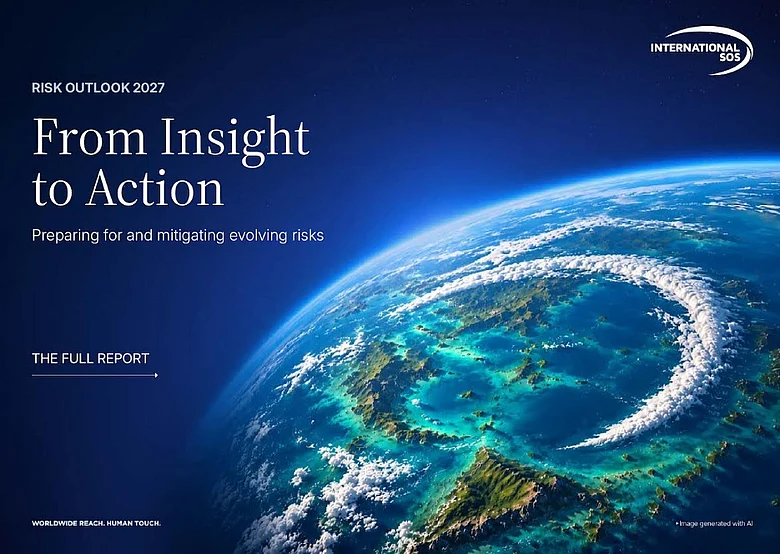
Mumbai, Maharashtra, India: As Indian businesses expand their global footprint and navigate an increasingly interconnected risk environment, protecting employees and ensuring business continuity are emerging as critical leadership priorities. International SOS, today, released its 11th annual Risk Outlook 2027, highlighting how geopolitical tensions, cyber threats, extreme weather events, AI-enabled misinformation and workforce health challenges are converging to create complex risks for organizations worldwide.
The report highlights that these developments can no longer be addressed as isolated operational challenges. Their interconnected nature can trigger cascading consequences for employee safety, business operations, supply chains and organizational stability. For Indian organizations, particularly those with international operations, extensive supply chains and geographically dispersed workforces, this calls for a more integrated and proactive approach to risk management.
Arnaud Vaissié, Co-Founder, Chairman and CEO of International SOS, said, “While the specific risks facing organizations, sectors and geographies will vary, the defining characteristic of the risk landscape in 2027 is convergence. As risks become more interconnected, leaders are being challenged to anticipate the shape, extent and evolution of the interaction. In this environment, resilience is a key differentiator. Preparedness, informed decision-making and the ability to adapt quickly are increasingly critical to protecting people, maintaining business continuity and achieving long-term success. The organizations best positioned to navigate uncertainty in 2027 will be those that take an integrated approach to risk, recognizing that protecting their workforce and strengthening organizational resilience are fundamentally connected.”

1 November 2026
Get the latest issue of Outlook Business

Advertisement
Chris Shaw, Senior Manager, Global Travel Security and Security Risk Intelligence at Philip Morris International, said, “Extreme weather, geopolitical complexity, and AI are three powerful forces reshaping the global risk landscape. AI is a force multiplier: it is strengthening the capabilities of security and intelligence teams while simultaneously enabling threat actors to operate with greater speed, scale, and sophistication. Extreme weather is increasingly difficult to anticipate and can demand rapid, complex responses. At the same time, growing geopolitical fragmentation is creating a more volatile operating environment, leaving few parts of the world untouched by risk. Organizations therefore need to become truly risk-sensing, combining the best of human judgement with advanced digital capabilities to anticipate emerging threat and response with speed, clarity, and resilience.”
Advertisement
Dr. Pamela Hymel, MD, MPH, FACOEM, Chief Medical Officer, Disney Parks, Experiences and Products, said, “Infectious diseases and climate continue to be key issues, with significant impacts on operations globally. We are continuing to model how this affects our people, with a focus on aligning safety and health.”
Ken Senser, former Chief Security Officer at Walmart and Partner and Chief Strategy Officer at Corporate Security Advisors, commented, “Combined with increasing capability of adversaries, whether it's the foreign adversary or the individual with AI who's a fraudster, we're going to start seeing things we've never seen before.”
Key Risks Shaping the Business and Workforce Landscape in 2027
Geopolitical Uncertainty Moves to the Boardroom
Geopolitical instability is emerging as a major consideration for organizational leadership, with conflicts involving Russia and Ukraine and continuing tensions across the Middle East influencing global security, trade, supply chains and workforce mobility. For Indian companies with international business interests, these developments underline the importance of monitoring geopolitical shifts and assessing their potential impact on employee safety, business travel and operational continuity.
Extreme Weather Makes Workforce Preparedness More Critical
Rising temperatures, floods, air pollution, wildfire smoke and climate-sensitive disease outbreaks are creating growing challenges for businesses and their employees. In India, where heatwaves, urban flooding and deteriorating air quality can directly affect workforce health and productivity, climate-related preparedness is becoming increasingly important. Organizations need to account for these risks while planning employee travel, workplace safety measures and business continuity strategies.


AI and Cyber Threats Put Organizational Trust to the Test
The growing intersection of artificial intelligence, geopolitics and cybersecurity is creating a more complex threat environment. State-linked cyber actors continue to target organizations and critical infrastructure, while AI-generated misinformation and deepfakes can undermine trust, disrupt crisis communication and complicate emergency response. Businesses need to strengthen cybersecurity frameworks, establish robust verification mechanisms and ensure that employees are equipped to recognize and respond to emerging digital threats.
Growing Activism Creates New Operational Challenges
Rapidly mobilized protest movements and evolving social tensions are contributing to unpredictable operating environments. These developments can affect employee movement, business travel, supply chains and access to critical infrastructure. Organizations will need stronger intelligence capabilities, early-warning mechanisms and contingency plans to safeguard employees and minimize operational disruption.
Workforce Health and Wellbeing Become Central to Resilience
Mental health concerns, workplace fatigue, chronic diseases, increasing work intensity and changing workforce demographics are placing additional demands on employers. These challenges are closely linked to broader environmental, social and geopolitical developments and can have a direct bearing on employee performance and organizational resilience. Employers will increasingly need to move beyond traditional workplace safety measures and adopt a more comprehensive approach to workforce health, wellbeing and preparedness.
Alongside the report, International SOS has also released its updated Risk Map 2027 mhub.internationalsos.com/bms/albums/?albumShare=ZHcfrvwJ.
An interactive tool (www.internationalsos.com/risk-map-embed) providing a visual assessment of medical and security risks around the world.
About the International SOS Group of Companies; 40 years of saving lives
The International SOS Group of Companies is in the business of protecting and saving lives. Wherever you are, we deliver customized security risk management, health and wellbeing solutions to fuel your growth and productivity. We uniquely combine industry-leading technology with expertise in security, medical and logistics to deliver risk prevention programs that offer real-time, actionable insights and on-the-ground support. In the event of a security incident, epidemic, extreme weather or any other business-disrupting event, we provide fast, industry-leading response and assistance capabilities, giving you and your workforce peace of mind.
Founded in 1985, the International SOS Group has been saving lives for over 40 years. Headquartered in London and Singapore, we are trusted by over 9,000 organizations. This includes the majority of the Fortune Global 500, as well as mid-size enterprises, governments, educational institutions, and NGOs. Nearly 13,000 global experts stand with you to provide support and assistance from over 1,200 locations in 90 countries, in over 110 languages, 24/7, 365 days a year.
We help protect your people and your organization, as well as support your compliance reporting needs. By partnering with us, your organization can fulfil its Duty of Care responsibilities and fortify its business continuity.