Iran imposes fresh Strait of Hormuz transit rules amid escalating US conflict
Vessels must file PGSA declarations or risk attacks from IRGC naval forces
Analysts warn full normalisation unlikely if Iran retains long-term Hormuz control
As the US-Iran conflict enters day 69, Tehran moved to impose fresh rules for transiting the Strait of Hormuz or risk attack, according to a CNN report. This is an effort to formalise its control over the chokepoint while defying US warnings.
According to CNN, the document namely Vessel Information Declaration, is an application form issued by Iran’s newly created Persian Gulf Strait Authority (PGSA). It is supposed be filled by every transiting vessel to ensure safe passage.

1 September 2026
Get the latest issue of Outlook Business

The document, cited by CNN, warns that “complete and accurate information is essential” and states that “any incorrect or incomplete information provided will be the sole responsibility of the applicant, and any resulting consequences will be borne accordingly”.
Before the February 28 US-Israel joint operation against Iran, there was no such rules. However, Iran has shut the Hormuz after the attacks and threatened to strike any ship passing through it without permission from the Islamic Revolutionary Guard Corps (IRGC) navy. A few tankers came under attack earlier.

Strikes and Counterstrikes
Meanwhile, US forces targeted Iranian military facilities responsible for launching a series of “unprovoked” missile, drone and small boat attacks against American warships transiting the Hormuz, US Central Command informed on Thursday.
Advertisement
Following the attack, President Donald Trump warned Iran through a social media post against escalating tensions further and to sign a deal soon.
Normalisation Possible?
As much as Tehran is seeking to control the Hormuz, Washington continues its "full blockade" of shipping to and from Iranian ports. Caught in between their fights, analysts told CNN that as many as 20,000 seafarers on nearly 1,000 vessels trapped in the Persian Gulf.
During the entire week of May 3, only 40 ships could cross the strait, compared with an average of 120 during the pre-war period.

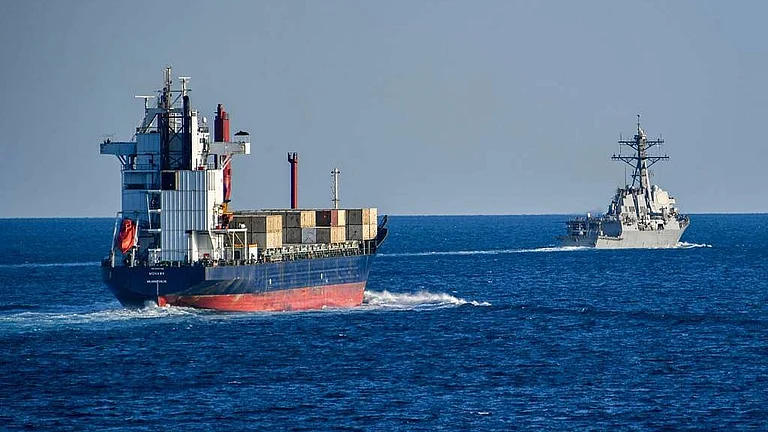
Many international reports also accused Iran of demanding steep transit payments from vessels crossing the strait, with some shipowners reportedly being asked to pay up to $2mn for safe passage.
Advertisement
Analysts also fear that Iran may seek to retain strategic control of the strait for as long as possible. "Under a long-term Iranian control scenario, transits could rise to 40-50% of export capacity, but normalization is not achievable," said Matt Wright at Kpler talking to CNN.