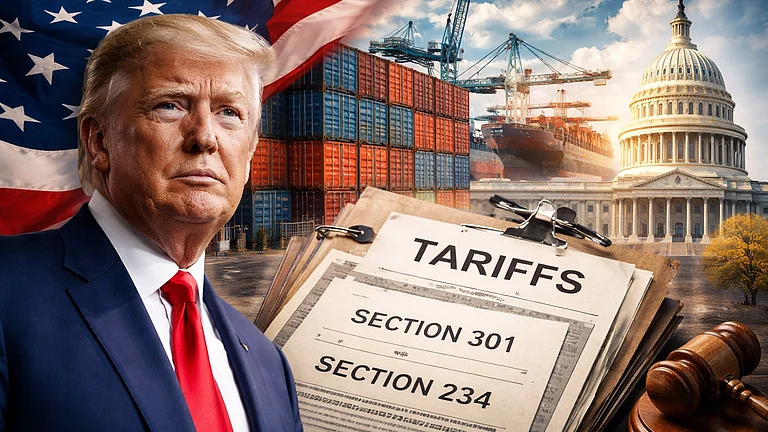
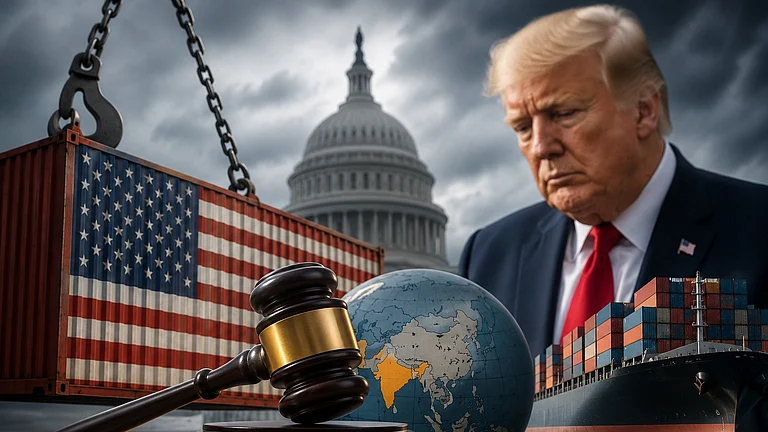
A US federal court ruled that Donald Trump’s 10% blanket global tariffs under Section 122 were unlawful, dealing another setback to his tariff strategy.
The ruling has complicated ongoing India-US trade negotiations, which were already under pressure following reciprocal and punitive tariffs imposed on Indian exports.
Analysts warn that the US administration may explore alternative legal routes for tariffs, prolonging uncertainty for global trade and supply chains.
In a fresh blow to US President Donald Trump’s tariff policies, a federal court has ruled that the 10% global tariffs were unlawful. The 10% blanket tariff was announced following the US Supreme Court’s decision to invalidate the ‘Liberation Day’ tariffs, or the reciprocal tariffs.
A divided three-judge panel at the US Court of International Trade in Manhattan on Thursday granted a request by small businesses and nearly a dozen Democrat-led states to invalidate the tariffs, a Bloomberg report said.

1 September 2026
Get the latest issue of Outlook Business

The 10% tariff under Section 122 was set to expire in July. Section 122 allows the President to impose up to a 15% tariff for a period of 150 days.
The court decision has currently only blocked the Trump administration from enforcing the tariffs against the two companies that sued.
The panel of jurists found that other states which raised complaints were not direct importers, but were harmed by having to pay higher prices for goods due to tariff costs being passed on.
Advertisement
According to the Bloomberg report, the verdict does not clarify what it will immediately mean for other importers that have been paying the levies. Under Section 122 of the Trade Act, through which the 10% tariff was levied, US customs authorities collected nearly $8 billion in March alone, as per reports.
“The US administration has effectively been playing a cat-and-mouse game — using one legal provision to impose broad tariffs, and when courts block it, shifting to another questionable legal tool," Ajay Srivastava, former trade official and founder of policy think tank GTRI, said in a report. "Such an uncertain tariff regime in the world’s largest market creates uncertainty for businesses, disrupts global supply chains, and raises costs for manufacturers and consumers.”
Advertisement
Asked about the court ruling, Trump on Thursday said, “We had two radical left judges who voted against it. So nothing surprises me with the courts. Nothing surprises me. So we always do it a different way. We get one ruling and we do it a different way.”
Trump’s remarks likely signal that the administration is actively exploring other legal routes to impose tariffs. Last month, Washington launched probes against 16 trading partners, including India and China, under Section 301 of the US Trade Act of 1974.
Section 232 national-security tariffs are also being explored. These sections could significantly impact countries that export steel, semiconductors, automobiles, pharmaceuticals, and critical minerals.
The trade and tariff uncertainty is also impacting trade negotiations, including those with India, which are currently in limbo. Malaysia has walked away from a trade deal with Washington, while others are recalibrating the framework of bilateral agreements with the US, Srivastava said in the GTRI report.
Rationale Behind the Ruling
The court ruled that the administration’s argument around “balance-of-payments deficits,” a key criterion required to impose Section 122 tariffs, was a “malleable phrase.” Hence, the bench concluded that Trump’s decision to impose the tariffs failed to identify whether such deficits existed within the meaning of the 1974 law.
Judges Mark A. Barnett and Claire R. Kelly formed the majority, while Timothy C. Stanceu dissented.
The reciprocal tariffs, which were imposed in April 2025, were also overturned by the court in February.
The court stated that the President does not have the authority to levy taxes under the International Emergency Economic Powers Act without congressional support. The decision led to the biggest tax return of $170 billion in American history.
What Does it Mean for India?
India was among the worst-hit economies when Trump introduced the reciprocal tariffs. New Delhi faced a sweeping 25% tariff, along with a 25% punitive tariff on imports of Russian crude oil. The combined 50% tariff on India was among the highest levied on any Asian country.
Following negotiations, New Delhi and Washington agreed to an interim bilateral trade agreement, bringing the tariffs down to 18% along with a reversal of the 25% punitive tariff.
However, the US Supreme Court verdict complicated negotiations for the broader agreement, and talks are now effectively frozen pending greater clarity. Trump has reiterated that irrespective of the verdict, the deal negotiated with India remains intact.
Among various sectors, pharmaceuticals, textiles, and automobiles were considered the most vulnerable to the US tariffs.

Srivastava argued that India should wait for greater legal and policy clarity in the US before finalising a bilateral trade agreement.
The GTRI report said that Washington was unwilling to reduce its own MFN tariffs while simultaneously expecting India to lower duties across sectors, potentially making any agreement structurally one-sided for New Delhi.