




Quick commerce firm Zepto's IPO filing offers the clearest picture yet of where the company stands in India's fiercely contested 10-minute delivery market. The numbers reveal a company that has rapidly emerged as the country's second-largest quick commerce player, widening its lead over Swiggy Instamart and narrowing the scale gap with market leader Blinkit. At the same time, the filing highlights the central challenge facing Zepto ahead of its public market debut: translating scale into profitability.
The proposed IPO comprises a fresh issue of up to ₹8,010 crore and an offer-for-sale (OFS) of more than 11.34 crore shares by existing investors. Notably, co-founders Aadit Palicha and Kaivalya Vohra, along with promoter family trusts, are not selling shares in the issue, signalling continued commitment to the business. The largest selling shareholders include Nexus Venture entities, Kaiser-linked investors and Razor Ventures.
The filing also sheds light on the evolving competitive dynamics between Zepto, Blinkit and Instamart, with each player pursuing a different balance between growth, expansion and profitability.

1 October 2026
Get the latest issue of Outlook Business

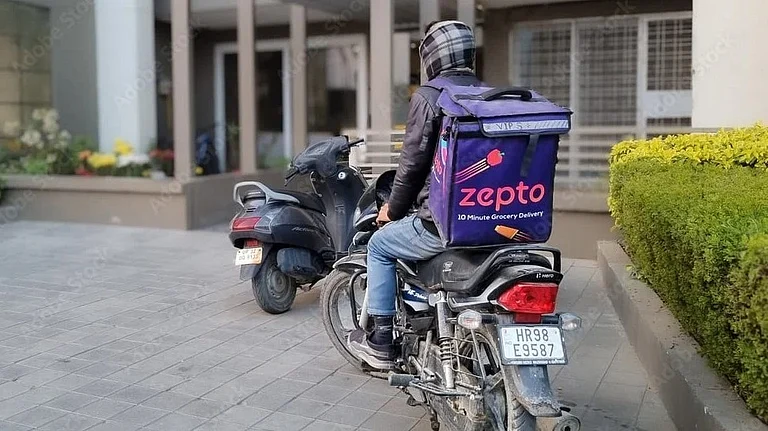


Zepto Has Pulled Ahead Of Instamart
One of the biggest takeaways from the filing is the extent to which Zepto has widened its lead over Swiggy Instamart.
Zepto reported Net Receivables Value (NRV) of ₹8,134 crore in the March quarter, up 73% year-on-year and 28% sequentially. Since NRV includes advertising revenue of ₹543 crore, the comapny's March-quarter Net Order Value (NOV) works out to roughly Rs 7,591 crore.
Advertisement
That comfortably exceeds Instamart's estimated net order value of about Rs 5,674 crore, though it remains significantly below Blinkit's ₹14,386 crore.
The order volume comparison is even more striking. Zepto processed 210 million orders during the March quarter, nearly double Instamart's 112.6 million orders. Blinkit remained ahead with 273.9 million orders, but Zepto has substantially narrowed the gap.
The comparison becomes even more impressive when viewed through the lens of store count. Zepto operated 1,139 dark stores at the end of March, almost identical to Instamart's 1,143 stores. Yet it generated nearly twice as many orders.
Average daily orders rose to 23.3 lakh from 18.1 lakh in the December quarter and 13.7 lakh a year earlier, highlighting strong customer adoption and network utilisation.
Advertisement

Blinkit Still Leads
While Zepto has established itself as a clear No. 2 player, Blinkit continues to dominate the industry on both scale and profitability.
Blinkit's NOV reached ₹14,386 crore in the March quarter, nearly double Zepto's comparable transaction value. Revenue stood at ₹13,232 crore, also significantly ahead of Zepto's ₹7,498 crore.
The difference is even more pronounced when it comes to physical infrastructure. Blinkit ended the quarter with 2,243 dark stores, nearly twice the network size of Zepto and Instamart.
Importantly, Blinkit has also become the only major player to achieve positive adjusted EBITDA. The company reported adjusted EBITDA of ₹37 crore in Q4FY26, improving from ₹4 crore in the previous quarter.
Management remains confident about sustaining growth while maintaining pricing discipline. Blinkit expects NOV to grow at more than 60% annually over the next three years through assortment expansion, geographic expansion and demand densification.
The company's profitability milestone marks a significant turning point for the quick commerce industry, which has historically prioritised growth over earnings.
Zepto's Growth Comes At A Cost
If Blinkit represents the industry's profitability benchmark, Zepto's numbers illustrate the cost of pursuing rapid expansion.
Despite its strong growth trajectory, Zepto reported an adjusted EBITDA loss of ₹1,248 crore in the March quarter. Although the loss improved from ₹1,764 crore a year earlier and ₹1,309 crore in the December quarter, it remains substantially higher than both Blinkit and Instamart. For the full year, the picture is even starker.
Revenue from operations more than doubled to ₹22,624 crore in FY26 from ₹11,110 crore in FY25. Annual NRV almost doubled to ₹24,816 crore, while order volumes surged to 640 million from 332 million.
Annual transacting users increased to nearly 48 million from 38.4 million. Yet net losses widened to ₹5,905 crore from ₹4,700 crore in FY25.
The widening losses reflect heavy investments in dark stores, logistics infrastructure, customer acquisition and market expansion. Zepto appears willing to sacrifice near-term profitability to strengthen its position in a market where scale is increasingly becoming a competitive advantage.
Advertising is also emerging as an important revenue stream. Advertising revenue reached ₹1,636 crore during FY26, accounting for nearly 8% of annual NRV compared with ₹651 crore in FY25.

The Productivity Advantage
One area where Zepto appears to hold a competitive edge is operational efficiency.
The company disclosed that its dark stores processed 2,140 orders per store per day during the March quarter. While Blinkit and Instamart do not report this metric directly, estimates based on quarterly order volumes and store counts suggest Blinkit's network handled roughly 1,357 orders per store per day and Instamart around 1,095.
This suggests Zepto's existing network is operating at significantly higher throughput levels.
Higher store productivity can improve economics over time by spreading fixed costs across a larger number of orders. It may also explain why Zepto has been able to generate nearly twice Instamart's order volume despite operating a similar number of dark stores.
However, whether this productivity advantage can eventually translate into profitability remains one of the key questions investors will be evaluating during the IPO process.
Different Strategies, Same End Goal
The latest numbers suggest that India's quick commerce leaders are pursuing different strategies as the market matures.
Blinkit is leveraging its scale advantage and expanding aggressively while simultaneously moving towards profitability. Instamart is taking a more calibrated approach, focusing on gradual margin improvement and disciplined network expansion.
Zepto sits somewhere in between. It has built scale faster than Instamart and narrowed the gap with Blinkit, but its losses remain the highest among the three players.
The company's IPO filing effectively presents investors with a proposition that future profitability will follow current scale.
Whether public market investors are willing to back that thesis may ultimately determine the success of Zepto's ₹8,010-crore IPO and shape the next phase of India's quick commerce battle.









