For the past two years, the quick commerce race has largely been about who could add more dark stores, burn more cash and grow faster. In that race, Swiggy Instamart has steadily lost ground to both Blinkit and Zepto across metrics like net order value, order growth, order throughput, dark-store expansion and adjusted EBITDA.
Swiggy Instamart now trails Blinkit and Zepto on net order value (NOV). Instamart reported a net order value (NOV) of ₹5,700 crore in Q4 FY26, compared with Blinkit's ₹14,400 crore and Zepto's implied NOV of about ₹7,500 crore, according to a Jefferies report. Order growth has also been slower, with Instamart growing 27% year-on-year against Blinkit's 93% and Zepto's 70%.
Swiggy has similarly fallen behind in expanding its dark-store network. Instamart operated 1,143 dark stores at the end of Q4 FY26, about half of Blinkit's 2,243, while Zepto had 1,139.

1 October 2026
Get the latest issue of Outlook Business

Instamart also seems to be behind both rivals in order volumes if we look at the latest quarter numbers. It also processed 11.3 crore orders during the quarter (Q4 FY26), compared with Blinkit's 27.4 crore and Zepto's 21 crore.
The gap is also visible in daily order throughout. On a daily basis, Instamart handled about 1.3 million orders, well below Blinkit's 3 million and Zepto's 2.3 million. Even each Instamart dark store processed fewer orders on average- 1,074 orders a day versus 1,425 for Blinkit and 2,071 for Zepto, which also suggests lower utilisation of its fulfilment network.
Advertisement
While Swiggy has increased investments in Instamart, it hasn’t really succeeded in bridging the gap with its rivals across operating efficiency and market share.
The gap is equally evident in profitability. While Blinkit has already turned adjusted EBITDA positive, reporting a margin of 0.3% of NOV in Q4 FY26, Instamart remained loss-making with an adjusted EBITDA margin of negative 15.1% of NOV, marginally better than Zepto's negative 16.6%, according to Jefferies.
And now there is a greater looming threat over Instamart with the addition of newer rivals such as Flipkart and Amazon which are determined to do aggressive expansion and take away market share from the incumbents and hence it might have to continue cash burn to fight this battle.
Advertisement
Against this backdrop, Swiggy appears to be pursuing an alternative route to improve Instamart's economics by transitioning from a marketplace model to an inventory-led model through Indian-Owned and Controlled Company (IOCC) status.
Swiggy recently announced that its aggregate foreign investment stood at 49.76% of its paid-up equity share capital. This is after the company earlier this year tried to amend its Articles of Association (AoA) to cap its foreign shareholding below 50% and become an Indian owned company fit for inventory model operations.
This aligns with broader trend of Swiggy reducing its foreign shareholding over the past few years.
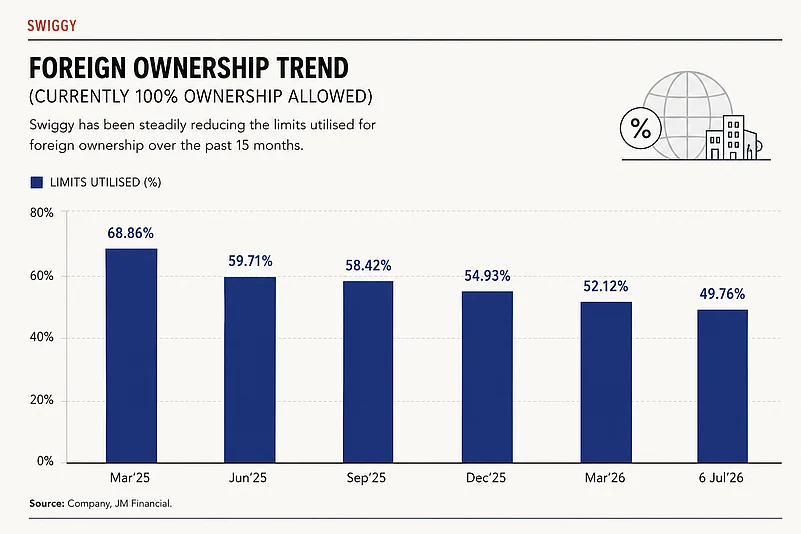
So, whenever this transition will take place and Swiggy will achieve IOCC status, it will not merely be a regulatory exercise but an attempt to reshape Instamart's economics by adopting an inventory-led model similar to rival Eternal's Blinkit.
Blinkit was reporting a negative adjusted EBITDA of ₹103 crore in Q3 FY25 when it transitioned to the inventory model in September 2025, but gradually turned profitable and reported a positive adjusted EBITDA of ₹37 crore in Q4 FY26, its latest reported quarter. However, the shift in business model was only one of several factors behind this improvement.
On Instamart's proposed transition from a marketplace to an inventory-led business, the management said during its Q1 FY26 earnings call that the move could improve adjusted EBITDA margins by 50–70 basis points.
However, changing the business model alone is unlikely to be sufficient. As Blinkit's experience showed, Swiggy would still need stronger order growth, higher average order values, better take rates, improved procurement efficiencies, lower fulfilment costs and greater operating leverage from a larger network of dark stores to narrow the profitability gap.
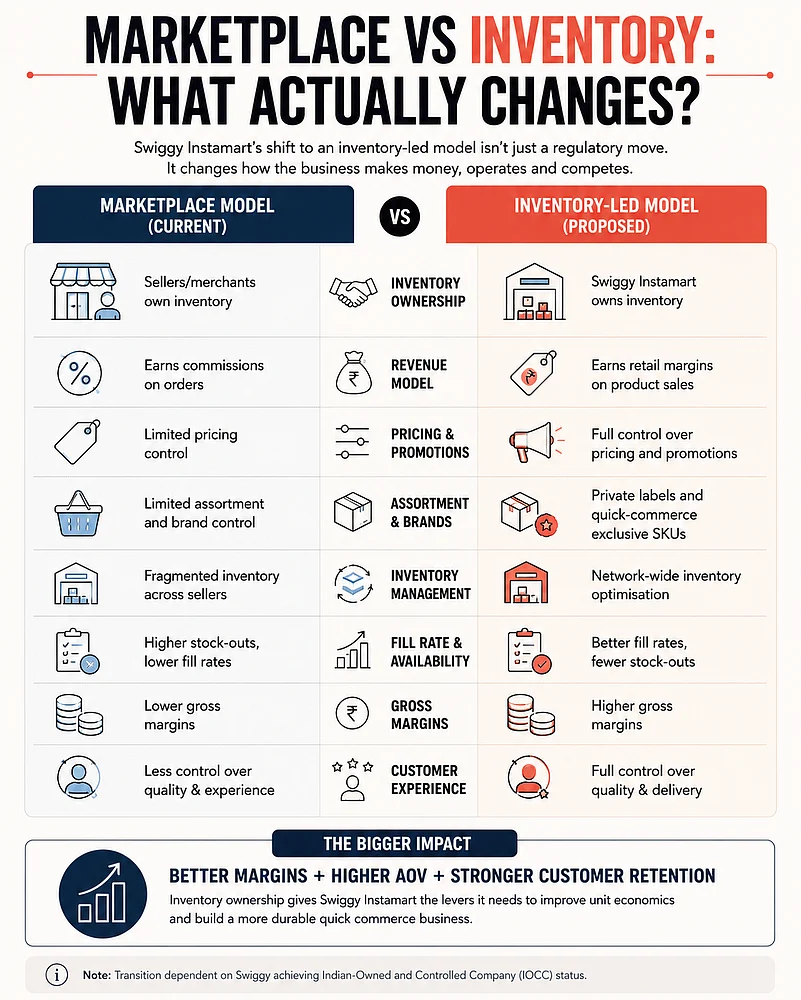
Inventory Ownership Changes More Than Just Margins
According to JM Financial, an inventory-led structure would allow Instamart to "procure merchandise directly from brands/manufacturers", "negotiate superior commercial terms", introduce "private labels and quick-commerce-specific SKUs with better pricing and margin economics", and improve "fill rates, lower wastage and tighter inventory management".
The operational impact goes well beyond simply procuring products directly. Lalit Mangal, founder and CEO of FMCG distribution platform Bizom, says the biggest advantage of an inventory-led model is the degree of control it gives platforms over the customer experience.
"If it's a marketplace model, you're never sure about service quality, whether the partner will have it in stock, whether what is shown in inventory is of the right quality, or whether it will be fulfilled on time. But in an inventory-led model, you can control the quality of the product, the stock, delivery, availability—all of that," he says. "That way, customer happiness definitely goes up and eventually the reasoning is that if happiness goes up, average order value goes up."
These may appear to be operational improvements individually, but together they fundamentally change how Instamart earns money.
As a marketplace, Swiggy primarily earns through commissions from sellers. Under an inventory-led model, it captures a larger share of the retail value chain. Direct sourcing removes intermediaries, allowing better procurement prices, higher gross margins and greater control over assortment.
However, this also fundamentally changes how inventory is managed. According to Mangal, inventory-led commerce works best when demand is highly predictable rather than when platforms attempt to stock everything. "The inventory model works well when you understand a particular demography, their needs, and are therefore able to stock the right quantities—limited SKUs, but in the right quantities," he explains.
"This allows you to go deeper rather than wider, capture a larger wallet share and increase average order values."
An inventory-led Instamart can optimise inventory across its entire network, expand into underpenetrated categories while improving product availability. Better fill rates mean fewer cancelled items, larger baskets and higher customer satisfaction, all of which improve unit economics over time.
The inventory model also improves asset utilisation by enabling companies to optimise inventory across multiple warehouses instead of operating them as isolated units.
While the margin improvement may help Swiggy achieve its EBITDA goals, the longer-term significance lies in creating operating leverage rather than merely adding a few basis points to profitability.
That said, greater control comes with significantly higher capital requirements. "If you do an inventory-led business, you are going to invest more money in inventory. Stocking, warehousing, damages—all of that comes with it," Mangal says.
Mangal also underlined that an inventory-led business works only when companies have a deep understanding of local demand and can stock the right products in the right quantities. Otherwise, the risk of unsold inventory, wastage and higher working capital can quickly erode the margin gains.
Private labels, Toing and competitive dynamics
Inventory ownership also unlocks what could become Swiggy's biggest profitability lever, private labels.
Unlike traditional private labels that compete largely on price, Swiggy's recently launched Noice brand is attempting a premium positioning with apparently cleaner ingredients and higher-quality products.
The idea is not merely to replace branded products with cheaper alternatives but to create products that customers actively seek out, allowing Swiggy to capture higher gross margins while improving customer retention.
Industry experts believe this is a natural progression for quick commerce platforms once they accumulate enough consumer data. Once a platform understands demand based on the data it collects, it can identify which categories are suitable for private labels.
According to Mangal, the opportunity lies in categories where consumers are less attached to established brands. "There are certain categories which are brand agnostic where they would surely go into private labels. If you see Noice, it is present in a lot of staples, and staples are categories where consumers can be relatively brand agnostic," he explains.
There is also a direct impact on average order value (AOV) at ₹504 currently which is ahead of Zepto’s ₹357 and is very close to Blinkit’s 525. As Swiggy expands its portfolio of exclusive products across snacks, beverages, ready-to-cook meals and household essentials, customers are more likely to add these products alongside their everyday grocery purchases.
The private label strategy behind Noice also changes how products are developed. Instead of building everything in-house, Swiggy partners with local manufacturers and founders who focus on product development and quality, while Instamart handles branding, packaging and distribution.
The premium positioning of Noice is also consistent with broader consumption trends.
"Premiumisation is the trend. Indians now associate higher prices with better quality, and everybody wants quality—even rural India wants premium products. If you say natural, organic or no sugar, these are the keywords people are willing to pay more for. I'm sure Swiggy observed the same trend on its platform because it has so much consumer data," Mangal added.
Then there is Toing.
There is also growing competition from Rapido, which has entered the food delivery segment with Ownly.
With Rapido betting on zero commissions and no platform or delivery fees through Ownly, Swiggy has also launched a separate budget-friendly food delivery app, Toing. Toing charges slightly lower commissions from restaurant partners and no platform or packaging fees from customers.
While the best-case scenario is that Toing successfully prevents Ownly from disrupting the market, the downside could be equally damaging-Swiggy could cannibalise growth from its own food delivery marketplace at the cost of profit margins.
Mangal, however, believes the competitive landscape is unlikely to settle around a single business model. Drawing parallels with ride-hailing, he says different fulfilment models will coexist. "India is an 'and' country, not an 'or' country. There will not be one winner. You will have multiple ways, and everybody will have their own space."
According to him, inventory-led quick commerce, marketplace models and traditional retail each solve different consumer needs. "Something that consumers need immediately will be better served by an inventory-led or dark-store model. Obscure SKUs that are difficult to stock will continue to be served through third-party kiranas. And there will still be products for which consumers will prefer to walk into a physical store. All of them will eventually coexist."
Why Inventory Isn't a Silver Bullet
An inventory-led model may improve margins, but it does not solve quick commerce's biggest challenge- scaling the business while keeping capital burn in check.
Swiggy Instamart also faces the risk of ceding more market share as its existing rivals and new entrants like Flipkart, Amazon continue to pour in capital, especially given its gradual market share erosion over the past few years.
Swiggy launched Instamart in 2020 and briefly led the market with a 52% share by March 2022. But the landscape changed rapidly after Zomato acquired Grofers (now Blinkit) and doubled down on quick commerce. Today, Blinkit leads the market with about 46% share by order volume and GMV, followed by Zepto at 26-29% and Swiggy Instamart at 21-25%.
Blinkit's advantage is not just market share but also scale. It expanded its dark store network from 400 in 2022 to 2,243 stores across 172 cities by 2026, while Swiggy grew from 301 to 1,143 stores during this time.


A larger network can translate into higher order density, better rider utilisation, stronger procurement power and faster inventory turnover, all of which improve unit economics. Inventory ownership can strengthen margins, but those benefits become meaningful only when backed by scale.
That is also why JM Financial remains cautious on Swiggy despite the potential benefits of an inventory-led model. The brokerage has maintained its 'Reduce' rating and continues to assign zero value to Instamart because it sees no credible path to scale-up or profitability and continued execution-led underperformance.
It also sees lack of visibility on a turnaround and excludes Swiggy's cash from its valuation, arguing that continued losses will eventually erode its balance.
The brokerage also notes that even after reducing foreign shareholding below 50%, Swiggy may not immediately qualify as an Indian-Owned and Controlled Company (IOCC), as FEMA eligibility is assessed based on the previous financial year's shareholding. That could delay the company's transition to an inventory-led model.
The broader takeaway is that quick commerce is entering a new phase. Delivery speed is no longer the key differentiator. The battle is shifting towards procurement, merchandising, inventory management and customer retention. Swiggy's inventory strategy fits that transition and could improve margins, but sustained success will ultimately depend on its ability to scale order volumes, gain market share and improve unit economics.