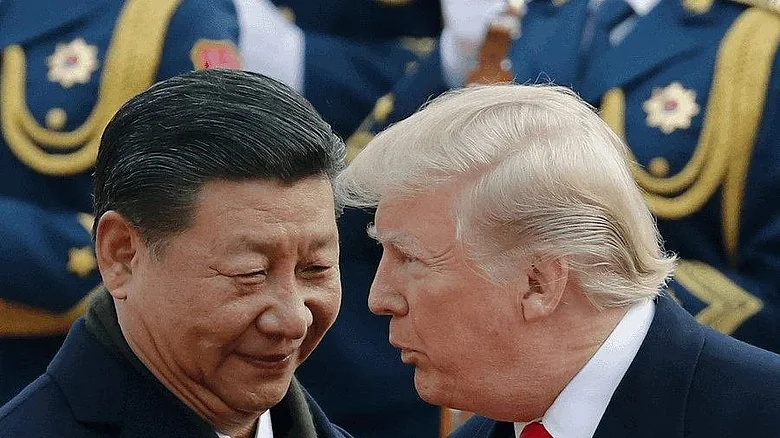

Xi Jinping invoked the 2,500-year-old Thucydides Trap at the Beijing summit to warn Trump that fear-driven decisions between rival powers lead to war.
With Taiwan hanging over every exchange, Xi's ancient Greece reference was less a history lesson and more a carefully placed diplomatic signal.
Trump pushed back on social media, rejecting any suggestion that the US was a declining power like Sparta.
Most diplomatic summits open with pleasantries. When Chinese President Xi Jinping welcomed Donald Trump to Beijing on May 14, he opened with ancient Greece and the story of how two great powers stumbled into a war neither fully wanted.
The reference was to the Peloponnesian War, fought between Athens and Sparta in 431 BC. Athens was rising fast, richer, more powerful, more ambitious than before. Sparta, the established power, watched nervously. The tension did not stay tension for long. It became war.

1 October 2026
Get the latest issue of Outlook Business

Thucydides, the Greek historian who documented the conflict, drew a sharp conclusion: it was Athens' rise and the fear it created in Sparta that made war inevitable. Centuries later, Harvard political scientist Graham Allison turned that observation into a theory he called the "Thucydides Trap", the idea that when a rising power threatens an established one, the structural stress between them makes conflict not just likely but often unavoidable.

Advertisement
Allison studied 16 historical cases where an emerging power challenged a dominant one. Twelve ended in war.
Why Xi Brought It Up
Xi's invocation of the theory was deliberate and layered. By raising it, he cast China in the role of Athens — the rising power — and implicitly positioned the United States as Sparta, the anxious incumbent. The point he was making was hard to miss. Great powers that react out of fear more often than not end up making their worst decisions.
Xi used the reference to argue that the US and China should consciously choose a different path. He urged both sides to build what he called "a new type of major power relations" grounded in mutual respect rather than suspicion. He also suggested that the modern world is "vast enough" for both nations to thrive, framing peaceful coexistence not as idealism but as a practical alternative to a war neither side should want.
Advertisement
A Warning With Taiwan Underneath It
Xi has invoked the concept before, but the timing of this particular deployment was significant. Shortly after the Thucydides reference, he turned directly to Taiwan.
"The Taiwan question is the most important issue in China-US relations," Xi had said. "If mishandled, the two nations could collide or even come into conflict, pushing the entire China-US relationship into a highly perilous situation."
Read alongside the Thucydides framing, the message was clear. Xi was not just offering a history lesson. He was signalling that Taiwan is precisely the kind of flashpoint where fear-driven miscalculation could trigger the trap he had just described. The classical reference was, in effect, a prelude to a very modern warning.
Trump's Rebuttal
By the evening, the mood had softened. At a state banquet, Xi struck a warmer note, saying that China's national rejuvenation and America's goal of being great again could "totally go hand in hand" and benefit the world.
Trump, however, had already clocked the subtext. Responding on social media, he noted that Xi had "very elegantly referred to the United States as perhaps being a declining nation." He was quick to push back. "Two years ago, we were, in fact, a Nation in decline," Trump posted. "Now, the United States is the hottest Nation anywhere in the world, and hopefully our relationship with China will be stronger and better than ever before."
Why It Matters
The Thucydides Trap is not just an academic theory. It is a framework that shapes how strategists, diplomats and leaders think about great power competition. When Xi raises it in a room with the American president, he is not being philosophical. He is defining the terms of the relationship, and making the case that avoiding war requires both sides to recognise the trap before they fall into it.
This was not the first time Xi has brought up the Thucydides Trap. But doing it with Trump sitting across from him, and Taiwan quietly looming over the entire meeting, made it land differently this time.