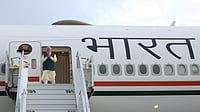
When Italian Prime Minister Giorgia Meloni posted a photograph from the Colosseum with PM Narendra Modi on Wednesday early morning with the caption "Welcome to Rome, my friend," it was not just really about being warm but she was doing what she has done at COP28, at the G7 in Puglia, and at the G20 in Rio de Janeiro — leaning into a friendship that has, slowly and somewhat understatedly, become one of India's more consequential diplomatic relationships.
The hashtag is #Melodi. It trends every time the two leaders appear together. But beneath the social media puns, memes and fan cams, something more substantive has been building as well.

1 September 2026
Get the latest issue of Outlook Business


How This Actually Started
It was Meloni's state visit to India in March 2023, during which bilateral relations were formally raised to the level of a Strategic Partnership. That visit set the template. Later that year, Meloni attended the G20 Summit in New Delhi, where Italy joined two key Indian initiatives — the India-Middle East-Europe Economic Corridor (IMEC) and the Global Biofuels Alliance, making itself invested into India's connectivity ambitions.
Since then, the two leaders have met at nearly every major multilateral forum. At the G20 in Johannesburg, their talks centred around deepening ties in trade, investment, technology, AI, defence and security, space, research, innovation and culture, according to MEA spokesperson Randhir Jaiswal. By that point, the relationship had its own working architecture — a Joint Strategic Action Plan running from 2025 to 2029.
Advertisement
Modi’s Rome Visit
Modi's arrival in Rome marks his first bilateral visit to Italy, distinct from his earlier attendance at the G7 summit in June 2024 and a G20 meeting three years prior. A bilateral visit signals intent in a way that sideline meetings at multilateral forums do not.
According to Reuters, Modi and Meloni are expected to adopt a joint declaration to further strengthen bilateral ties, including annual heads-of-government summits and a target of €20bn in trade by 2029. Bilateral trade between India and Italy stood at $16.77bn in 2025, with total Italian FDI into India reaching $3.66bn between April 2000 and September 2025. The target is ambitious but not unrealistic.
Advertisement
The IMEC is a major focal point of this visit. It aims to develop integrated trade routes connecting India to the Arabian Gulf and onwards to Europe. Italy's ports — particularly in the south — give it a natural role as a terminus for that corridor, and that is not lost on either side.

The Substance Underneath the Chemistry
In a joint article published in the Times of India, Modi and Meloni described the relationship as having reached a "decisive stage." They wrote that "Made in Italy" has always been synonymous with excellence and finds a natural synergy with the goals of "Make in India," pointing to over 1,000 companies from both sides with a presence in each other's markets as a positive sign that would strengthen supply chain integration.
On AI, the two leaders said their approach combines India's digital scale with Italy's ethical and industrial expertise, and that by sharing best practices in secure digital cooperation and resilient cyber infrastructure, the two countries aim to create an open and equitable digital space. They described this as forming the core of Italy's G7 presidency and the outcomes of the AI Impact Summit 2026 held in New Delhi.
On trade, both leaders said they want to reach and exceed the €20bn target by 2029, with a focus on defence and aerospace, clean technologies, machinery, automotive components, pharmaceuticals, textiles, agri-food and tourism.

Italy is rarely the first country that comes to mind when India's European partnerships are discussed. But the consistency with which Modi and Meloni have kept showing up for each other, at summit after summit, and are now formalising it with a bilateral visit and annual summits, suggests Rome has quietly moved much closer to the centre of India's European strategy.