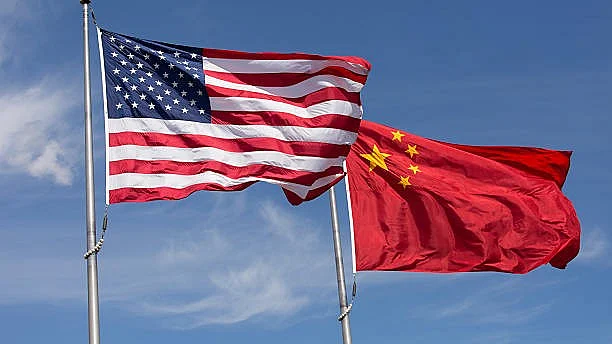

Donald Trump and Xi Jinping will meet in Beijing on May 14-15 amid rising geopolitical tensions.
The summit is expected to focus on Iran, Taiwan, trade disputes, AI competition and China’s control over rare earth minerals.
Washington hopes Beijing can help ease the West Asia conflict, while China may seek concessions on Taiwan and US technology restrictions.
US President Donald Trump and Chinese President Xi Jinping are set to meet at a two-day summit in Beijing on May 14-15. The meeting comes amid the backdrop of global trade disruptions and repeated failed attempts to stem the conflict in West Asia.
Trade, Taiwan, the US-Iran conflict, artificial intelligence and rare earth export controls are going to be at the top of the agenda in one of the most significant diplomatic meetings in recent times. Let’s take a closer look at what’s at stake.

1 September 2026
Get the latest issue of Outlook Business

US-China Ties
Since the beginning of the second trump administration US-China ties have been strained to say the least. Issues such as a US tariffs, Taiwan, AI, and Chinese ties to Russia have made positive relations difficult. The two heads of states were scheduled to meet in March earlier this year but US involvement in the war against Iran delayed those plans.
China was one of the only countries to retaliate against tariffs applied by President Trump. This led to a protracted trade war with back-and-forth tariffs being applied by each nation. The conflict came to a halt after a Trump-Xi meet at the APEC summit in Busan, South Korea where they agreed to a slight normalization in trade ties.
Advertisement
Trump has also signaled a possible Xi visit to Washington later this year in what would be the first US visit for the Chinese Premier in a decade.

The West Asia Conflict
Beijing is one of Iran’s top diplomatic backers as well as an important business partner. China has been one of the top buyers of Iranian crude, a move that has long frustrated the US administration.
Recently, the US Treasury sanctioned five Chinese oil refineries for processing oil bought from Iran. The Chinese government publicly asked the companies to defy the US sanctions.
Advertisement
But the Trump administration hopes that they can convince their Chinese counterparts to use their standing with the Iranian regime to bring an end to the conflict in the region. After all the disruptions to trade due to the blockade of the Strait of Hormuz also affects the Chinese economy.
But the Chinese position, of solidarity with the Iranian cause, may not be changed so easily.
According to the NYT, Xi recently criticized what he described as a “return to the law of the jungle". Comments widely interpreted as criticism of US military actions in Iran.
The Iranian foreign minister Abbas Arragchi also met Chinese Foreign Minister Wang Yi in Beijing recently, signaling to the US the close diplomatic relations the two countries still have.
The Taiwan Conundrum
Taiwan is expected to be among the issues at the top of the agenda at the summit.
China has claimed Taiwan as its territory since both countries came into existence after the Chinese Civil War. While the US is Taiwan’s top diplomatic backer and biggest arms supplier, something that China has repeatedly warned against.
Xi is likely to try and press Trump for some concessions in the form of reduced backing to Taiwan. Any form of overture to China over Taiwan could carry serious consequences. But US officials have indicated that US policy on Taiwan would not change.
The Rare Earth Problem
Chinese dominance in the rare earth mineral supply chain, which is crucial in multiple key industries like electronics, electric vehicles, semiconductors and defense, is one of the biggest leverage points in the US-China relationship.
The US delegation would be keen to prolong the truce that both countries reached in their trade war in South Korea last year. Though the US is still concerned over long term dependence on China for such a key resource.
Beijing on the other hand could use this position as leverage to reduce US export controls on advanced semiconductors and technology key for AI development.
What Will China Get Out of This Meet?
Though there aren’t expected to be any sweeping changes announced at the meeting continuing normalcy might still prove to be a positive outcome for China.
Continuing lower tariff rates for Chinese goods in the US would ensure their dominance over South Asian competitors such as Vietnam. While a positive solution to the conflict in West Asia is also to the benefit of Beijing.
A communication channel regarding AI technology could also be under discussion according to officials quoted in a Reuters report. This could signal towards a slight loosening in the US policy to exclude China from global AI development conversations, another positive that Beijing could take away from this summit.