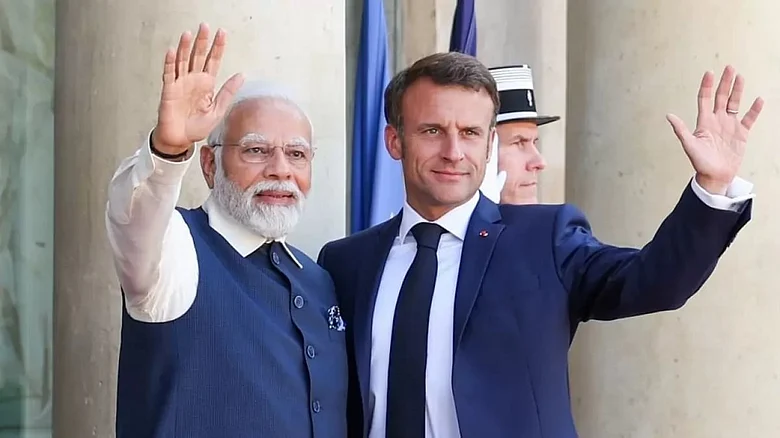

India and France renewed defence cooperation for 10 years, signalling a deeper strategic alignment.
The proposed $40 billion Rafale deal includes high indigenous content and expanded local manufacturing.
Missile co-production and private-sector assembly lines mark a structural shift in India’s defence ecosystem.
French President Emmanuel Macron is in India for a three-day visit, his fourth visit to the country at the invitation of Prime Minister Narendra Modi. On Tuesday, Modi and Macron held bilateral talks and announced major initiatives in crucial sectors such as defence, artificial intelligence (AI), and trade.
Both countries also announced an elevation of their relationship to a ‘Special Global Strategic Partnership,’ signalling deepening ties between New Delhi and Paris.

1 October 2026
Get the latest issue of Outlook Business

New Delhi has been accelerating its global relationships across regions, including strengthened ties with Oman, renewal of defence deals with the US, boosting defence collaboration in the Pacific region, as well as maintaining its strong ties with Russia despite mounting criticism from the West.
What makes the Special Global Strategic Partnership truly special is the chord the two countries struck in the defence sector. Ties between New Delhi and Paris date back to 1998, with both countries seen as major ‘middle powers’ in a multipolar world.
Amid heightened regional threats and global uncertainty, the India-France relationship signals a call for greater global stability. France now enters a small fraternity alongside the US and Russia to have the label of a ‘special’ or ‘privileged’ partner.
Advertisement
What Are the Major Defence Deals Announced?
Union Minister of Defence Rajnath Singh and his French counterpart, Catherine Vautrin, co-chaired the 6th India-France Annual Defence Dialogue held in Bengaluru on Tuesday.
Both sides signed major agreements, including the renewal of Industrial Collaboration and Co-production for the next 10 years.
A defence cooperation pact and a joint venture between state-owned Bharat Electronics Ltd (BEL) and Safran to produce Hammer air-to-ground missiles in India were also announced. The JV will accelerate the Make in India initiative as it pushes India’s defence assembly into more sophisticated manufacturing.
France is one of India’s most important defence suppliers, and a key element in this partnership is the behemoth deal worth $40 billion for India to buy 114 Rafale fighter jets. As per reports, the two countries are expected to ink the pact in the next few months.
Advertisement
Why Do Rafale Aircraft Matter to Us?
Last week, the Defence Acquisition Council (DAC) approved the procurement of 114 Rafale fighter jets, of which 90 would be manufactured in India with close to 50% indigenous content.
The move comes amid falling squadron numbers for India, which has just 29 fighter squadrons against a sanctioned strength of 42. Amid rising twin threats from Pakistan and China in the region, it becomes crucial for India to strengthen its armed forces.
To put this into context, Pakistan has 25 fighter squadrons, while China has over 60 and is increasing its fourth- and fifth-generation fighter jets each year.
The Rafale deal is also necessary owing to delays in the delivery of the homegrown LCA Tejas fighter jets built by Hindustan Aeronautics Ltd (HAL), reports said. The Indian Air Force (IAF) operates 36 Rafales, which were bought in 2016, and last year the Indian Navy purchased 26 naval variants of the Rafale for aircraft carrier INS Vikrant.
A Step Further Toward Atmanirbharta
HAL was India’s sole military aircraft maker until now. The Centre has proactively engaged in defence deals and security alliances with other strategic partners in recent months. This signals a strong shift in India’s defence policy. The government has also accelerated efforts to create a second production line in the private sector for helicopters and transport aircraft.
As per a report by India Today, Tata Advanced Systems Ltd (TASL) has started assembling C295 military transport aircraft and helicopters. The Ministry of Defence has also shortlisted TASL, Bharat Forge, and L&T to build six prototypes of the Advanced Medium Combat Aircraft (AMCA), the report said.
Why France Now?
India’s choice to elevate its relationship with France was strategic. France is one of only two countries from which India has bought fighter jets since 1998, along with Russia. The key reason is the absence of issues like end-use monitoring, which are prevalent with the US. With the partnership with France, the Rafale jet purchase will become India’s biggest defence deal ever, and New Delhi is set to become the world’s second-largest operator of Rafales by the next decade.
De-fencing Defence Sector
In the Union Budget 2026, the Centre removed basic customs duties on critical aircraft components and raw materials to boost India’s military aerospace sector. TASL and Airbus will establish India’s first private helicopter final assembly line in Karnataka to manufacture the Airbus H125 for civil and military roles. Moreover, against the backdrop of Operation Sindoor, the Union Budget also allocated an all-time high of ₹7.85 lakh crore, a 15% rise from the budget estimates (BE) of FY26.
Where Does It Position India Globally?
Amid rising geopolitical tensions in Europe, trade uncertainty from the US, and regional vulnerabilities, India’s recent moves with its strategic partners are aimed at positioning India as a rising power in a multipolar world.
Both Modi and Macron have signalled that the partnership should be seen as a response to ‘uncertainty’ and to any form of ‘hegemony.’
For India, stronger ties with France mean reduced dependency on one particular power, be it Russia or the US, providing greater room for collaboration and diversification in sectors crucial to national interest.
For France, India remains a key partner in the Indo-Pacific region and the Global South, signalling Paris’ intention to work with non-aligned partners and push back against hegemonic efforts by Washington.


However, what needs to be carefully watched is the translation of the ‘Special Global Strategic Partnership’ beyond the label.