India and the US have sealed a trade deal cutting reciprocal tariffs to 18%, improving India’s position relative to regional peers.
The deal raises risks around energy costs and imported inflation if India scales back discounted Russian oil imports.
Pressure on services exports, agriculture and dairy protections, and security trade-offs will shape who ultimately benefits.
After over nine months of negotiations and five months of tariff implementation, US President Donald Trump on Monday announced the conclusion of the much-awaited India–US trade deal. Reciprocal tariffs have been reduced to 18% from the sweeping 50% that had been in place since August. Following Trump’s announcement, Prime Minister Narendra Modi also took to social media platform X, with appreciation for both leaders coming in from around the world.
As per Trump’s announcement, New Delhi has agreed to stop purchasing oil from Russia and would diversify its crude import basket with American as well as Venezuelan crude, prompting a rollback of the 25% punitive tariff. India was facing one of the highest tariff rates among Asian economies until now. With the trade deal sealed, India is better positioned at 18%, lower than regional competitor Vietnam, which faces a 20% US tariff, and other Asian peers.

1 September 2026
Get the latest issue of Outlook Business

“The reduction in tariffs to 18% is a significant change that will reduce margin pressure on labour-intensive export segments. With this deal, Indian exporters are now at par with competitors in Southeast Asia, and trade in products such as toys and furniture that was previously being diverted to countries like Vietnam should now flow back to India,” Nomura said in a report.
Advertisement
However, experts suggest it is too early to celebrate, as an official agreement detailing the trade deal is yet to be released. The stakes for India come with a cost.
Importing US Energy…and Inflation
If Trump’s claims are true, India’s stoppage of Russian oil imports risks triggering imported inflation even amid benign global crude oil prices. India became Russia’s top importer of crude oil in 2022, after Moscow began offering energy at discounted prices. With over 85% of its energy needs met through imports, crude oil constitutes the largest component of India’s import bill and is a key driver of its trade deficit.
Advertisement
With details still unclear, market participants and economists remain divided. While many analysts have urged caution, others have welcomed the development. “India’s commitment to buy more US goods will primarily rejig its import basket. We project the current account deficit for FY27 at 0.8% of GDP, similar to FY26. As FPI and FDI inflows rise, we project a balance of payments surplus of $7 billion in FY27,” Nomura said in a research report dated February 3.
In a report published in August, SBI Research stated that stopping crude oil imports from Russia would balloon India’s import bill to $11.7 billion in FY27 from $9 billion in FY26.
Amid mounting backlash from the US and other European allies, India has reduced its dependence on Russian energy imports, with West Asia and the Americas increasingly emerging as alternative suppliers. It is also important to note that India’s import bill fell 12% year-on-year in December amid weak global crude oil prices, as per reports. It also remains unclear whether India will immediately halt imports from Russia or whether Indian refiners will be granted a wind-down period, as urged by the industry.
Without discounted Russian oil purchases, India’s import bill is likely to reverse the recent easing and could trigger imported inflation. India’s trade balance is also likely to shift between the US and the rest of the world, with Nomura projecting the current account deficit for FY27 at 0.8% of GDP, similar to the current financial year ending March 31.

IT Services- India’s Export Backbone
Beyond goods, the US market is also critical to India’s services exports, particularly to Silicon Valley, which faces fresh pressure amid the Trump administration’s tighter grip on immigration laws. There has been a surge in enforcement actions by Immigration and Customs Enforcement, H-1B visa fees have reportedly been hiked to $100,000, and approvals and registrations for H-1B visas in FY26 have fallen sharply—by 26.9% in eligible registrations and by nearly 70% in approvals for major Indian technology firms.
At a time when services exports are a key lever in financing India’s external bills, any curbs on services access risk hurting India’s urban middle class and high-skilled workforce.
Interests – Farmers, National, Global
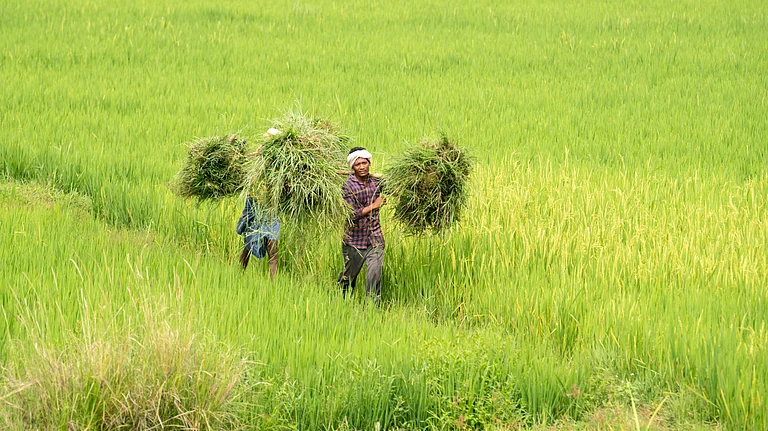
Where do India’s sensitive sectors such as agriculture and dairy stand in the deal? Union Minister of Commerce Piyush Goyal has been vocal that India will not open its agriculture and dairy sectors under any trade agreement. Farmers’ interests are often cited as a national priority, aimed at safeguarding the livelihoods of millions against the dumping of subsidised food products.
Washington has been pressing New Delhi to open its agricultural market to a wide range of US products, including dairy, poultry, soybeans, rice, wheat and ethanol. A key question that arises is whether New Delhi will ease curbs on genetically modified food crops, which are currently not allowed to be grown even in India owing to health risks. Reports suggest that, previously New Delhi has offered market access only for certain agricultural products to advance the trade deal, including the India-EU Free Trade Agreement.
According to an NDTV report, government officials said that the agriculture and dairy sector will continue to be protected. At a press conference Tuesday, Goyal reaffirmed that the agricultural and dairy sectors remain protected, but did not provide further details. A joint statement from New Delhi and Washington is expected later in the day.
Strengthening Security
India has been accelerating its strategic defence pacts with multiple partners, including agreements with the United Arab Emirates and the European Union in January. In the Union Budget for FY27, defence allocations rose 15% from a year earlier, in light of Operation Sindoor and rising threats from China. According to reports, Indian policymakers are likely to focus on strengthening the country’s military posture in the region, which the India–US trade deal could complement.
Moreover, US Ambassador to India Sergio Gor noted that beyond the trade deal, security partnerships will be in focus, particularly within the Quad corridor—an Indo-Pacific grouping comprising India, Japan, Australia and the US.
The overnight announcements brought cheer to Indian markets, ending months of uncertainty. From a rejig of the import basket to safeguarding farmers’ interests, all eyes are now on the release of the official agreement. PM Modi described the India–US trade deal as a “big decision” that would benefit the country and reiterated that his government always works in the national interest.