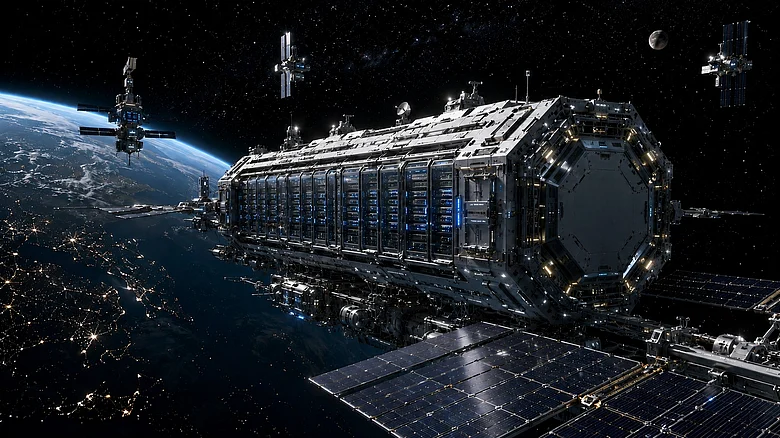

India’s startups are testing orbital computing to process satellite data directly in space.
Space-based data centres could reduce latency, bandwidth pressure and terrestrial infrastructure dependence.
Experts warn cybersecurity, regulation and launch economics remain major barriers to large-scale adoption.
Pixxel Space, a satellite imaging start-up and Sarvam AI, an artificial intelligence company developing large language models, recently collaborated to create orbital data centre satellite Pathfinder with an aim to process large volumes of space-based data in real-time using advanced AI models, enhancing data sovereignty and enabling efficient environment management.
The first major workload will be Sarvam’s AI models, analysing crops, infrastructure and weather patterns directly in orbit.

1 October 2026
Get the latest issue of Outlook Business


Drivers Behind Orbital Computing
Commenting on the drivers of orbital computing, Awais Ahmed, Founder and CEO, Pixxel Space, stated that the interest is being driven by a very real infrastructure bottleneck on Earth.
AI is scaling faster than the physical systems needed to support it.
The IEA’s Energy and AI modeling reveals that global data center electricity consumption is on track to approach 1,050 TWh, effectively matching the total annual electricity consumption of Japan.
An October 2025 Boston Consulting Group (BCG) X report revealed that 92% of Indian employees use AI at work regularly. This dramatically outpaces the already high Asia-Pacific average (78%) and leaves the global average (72%) far behind.
Advertisement
This surge in computing demand has triggered a rise in Data centres which now require enormous amounts of power, cooling, land, grid connectivity and capital. With every passing day, that demand is increasing.
Elaborating on the environment that space provides to support the infrastructure, Ahmed said, “Space offers a fundamentally different operating environment: abundant solar energy, continuous access to sunlight in certain orbits, and the ability to process data closer to where it is generated.”
He said that the case for Earth observation was even clearer, as satellites generated enormous volumes of data and sending everything back to Earth before processing was becoming increasingly inefficient. He added that orbital AI infrastructure brought compute closer to where space-based data was generated, thereby reducing latency and enabling faster, more responsive decision-making.
Advertisement
He further said that for Pixxel, this formed part of a broader shift toward building intelligent space infrastructure rather than just imaging systems.

How Space Data Centres Work
According to the IEEE Computer Society website, space-based data centres consist of compute, storage and networking systems placed onboard satellites or orbital platforms, enabling AI/ML workloads to run in orbit rather than on Earth.
By deploying high-performance hardware – like servers and GPUs – in low-Earth orbit (LEO), data can be directly processed directly onboard the satellite before being transmitted to terrestrial data centres on Earth. Some architectures also use inter-satellite links to form distributed orbital computing networks, reducing dependence on ground infrastructure and improving latency.
Ahmed said that orbital computing is not a near-term replacement for terrestrial data centres.
He said the strongest use cases today are space-native or latency-sensitive workloads such as Earth observation, autonomous satellite operations, disaster response, climate monitoring and edge AI in orbit. In these applications, data generated in space can be processed directly onboard satellites rather than being continuously transmitted in massive raw volumes back to Earth, reducing bandwidth pressure and enabling faster delivery of usable insights.
“That is what we are beginning to test with our orbital compute pathfinder,” he asserted.
Ahmed mentioned that Pixxel’s Pathfinder mission will test in practice by running datacentre-class GPUs in orbit and processing hyperspectral imagery using Sarvam’s AI models under live operating conditions.

Risks Regulation and Security
High-performance systems in orbit must operate under extreme conditions including radiation, thermal stress, power availability, hardware degradation, and reliable data transfer, all of which the Pathfinder satellite is designed to test.
Ahmed shared that commercial viability will depend on launch costs, hardware replacement cycles, insurance and sustained demand.
“If critical AI infrastructure is operating in orbit, secure command systems, access control, encryption, and data governance become foundational requirements,” he elaborated, adding that limited ability to repair or patch systems in orbit further increases vulnerability.
Kunal Bhogal, COO, IIRIS Consulting, also flagged cybersecurity risks, including signal jamming, spoofing, interception and potential command-link attacks.
On regulation, Bhogal shared, that global frameworks remain fragmented, with the Outer Space Treaty and ITU rules covering physical assets but offering little clarity on data governance.
He further elaborated that operational risks are equally serious. Hardware in orbit is exposed to radiation, single-event upsets and thermal cycling that can corrupt memory and silently degrade compute. In vacuum, heat can only be radiated, not convected — demanding large radiator panels and tight thermal budgets, one of the explicit unknowns the Pathfinder mission is designed to test.
“The hardware is launching faster than the law, and the gap is sharpest where it matters most for sovereign AI: jurisdiction over the data, not just the satellite,” he mentioned.
Global frameworks still rest on the 1967 Outer Space Treaty, the Liability and Registration Conventions, and ITU spectrum rules designed for state-operated comms and Earth-observation satellites. They handle physical jurisdiction over hardware but say little to nothing about onboard data.
Jurisdiction over space-based data remains unclear, with overlapping regimes such as GDPR and India’s DPDP Act creating unresolved legal questions.
India’s Path to Viability
India has a strong opportunity to participate early because three things are converging: a growing private space ecosystem, increasing sovereign AI ambitions, and rising demand for advanced Earth observation and data infrastructure.
Over the next decade, feasibility will emerge in stages. The first stage is not hyperscale infrastructure in orbit. It is pathfinder missions that demonstrate AI workloads in space, validate power and thermal performance, test data handling, and prove that useful inference can happen closer to the source.
That is the direction Pixxel and Sarvam AI are taking. Pixxel has already demonstrated the ability to move quickly from concept to orbit with the hyperspectral Firefly constellation, and Pathfinder is the next step in that progression.
Commercial feasibility will depend on launch costs, radiation-tolerant hardware, in-orbit power systems, communications infrastructure and whether customers see enough value in lower latency, reduced downlink requirements and sovereign data processing. India’s advantage is that it can build orbital compute as part of a broader sovereign space and AI stack rather than treating it as a standalone experiment.

Commercial Adoption and Future Viability
In the near term, over the next 2–3 years, computing will remain experimental, with demonstration missions validating AI workloads in space.
Pixxel’s orbital compute satellite is expected to launch around Q4 2026, running datacentre-class GPUs in orbit and processing data using Sarvam AI models under real operational conditions.
Over the next 5–7 years, orbital computing could support specific applications, especially Earth observation and autonomous satellite operations.
However, large-scale orbital data centres comparable to terrestrial hyperscale infrastructure are likely a longer-term prospect beyond the next decade.


Resonating similar projections, Bhogal asserted, “For now, orbital computing in India is more a strategic capability play than a near-term commercial business or profitability.”
Ahmed said orbital computing could reduce some of the infrastructure pressure on terrestrial data centres associated with large-scale AI demand but the industry is still validating the technical and operational assumptions.