




Forecasts suggest upcoming El Nino could become among strongest weather events globally recorded.
India remains vulnerable due to monsoon dependence, heatwaves, food security and labour risks.
Informal workers could face severe livelihood losses amid worsening extreme heat conditions nationwide.
The global phenomenon known as Super El Niño has raised global alarm, with early forecasts indicating the climate phenomenon could emerge faster than expected, most likely to appear from October 2026 to February 2027, according to a US National Oceanic and Atmospheric Administration’s (NOAA) Climate Prediction Centre. The event could grow into one of the strongest weather events recorded in decades, with experts concerned about widespread disruption that this extreme weather event could have globally, including in India.

1 September 2026
Get the latest issue of Outlook Business

What Is Super El Niño
El Niño is the warmer phase of the natural El Niño-Southern Oscillation (ENSO) climate cycle, a periodic shift in the waters of the tropical Pacific Ocean that supercharges global temperatures, in turn impacting weather patterns and crops worldwide.
Now, in a new ENSO forecast published May 14, US NOAA predicted that there's a 65% chance that the upcoming El Niño will be classified as strong or very strong starting in October, potentially placing it among the strongest in recorded history.
To put in perspective, a “very strong” El Niño means a 3.6-degree-Fahrenheit (2 degrees Celsius) rise in sea surface temperatures, and unofficially called a "super" El Niño — is now the most probable scenario for the October-to-February period.
Advertisement
However, there is also now an 82% chance that El Niño may arrive sooner between now and July, with the phase expected to continue till February 2027.
According to AccuWeather, if El Niño appears as per expectations, it could intensify into a “super El Niño”.
“Intensity is uncertain but there is potential for a moderate to possibly strong El Niño this fall into winter,” AccuWeather Long Range Forecaster Paul Pastelok said, as per the official website.
According to reports, the last El Niño led to record-breaking heat in 2023 and 2024. If El Niño appears in 2026 as per predictions, the year will get warmer but not as warm as 2024 since we started the year with La Nina. Zeke Hausfather, a climate scientist and energy systems analyst wrote in a post on X that global temperatures in 2027, could be pushed to record-breaking heights. "This would push up our estimate for 2026 global temperatures (though its still unlikely to surpass 2024 as the warmest year), and make 2027 very likely to be the warmest year on record given the historical lag b/w ENSO and surface temp," he added.
Advertisement

What Makes India Vulnerable
El Niño usually alters atmospheric circulation and weakens monsoon winds over the Indian subcontinent. In addition, El Niño is strongly linked to weaker monsoon, although the country has still seen average or above-average rains in at least five of 17 such events over the past seven decades. However, reports suggest that India has received below-average rains in the last six El Niño years.
According to Reuters, a weak El Niño in 2009 had led to a sharp drop in India’s rainfall to 78.2% of a long-period average, the lowest in 37 years. With the current predictions suggesting that 2026’s El Niño could be strong, it is worth wondering what the impact could be.
Historically, El Niño has been associated with a weaker southwest monsoon in India. Years such as 1987, 2002, 2009 and 2015 witnessed drought-like conditions associated with weak monsoon performance. What makes India’s case most fragile is how El Niño can impact food security in the country. The 1877 to 1879 global famine period coincided with El Niño events which led to widespread mortality in India and China due to climatic stress.
In the present day, India is already seeing elevated heatwave frequency, intensity and duration. Despite the concerning situation, heatwaves are not formally recognised as disaster under India’s central disaster framework. This obstructs formation of a response mechanism that could be implemented uniformly across the nation. In addition, the lack of recognition also hinders long-term adaptation funding and structured compensation. While states have an option to use the State Disaster Response Funds for heatwave-related relief under certain conditions, it still leaves plenty of room for chaos due to uneven and unplanned response across regions.
What It Means On Ground
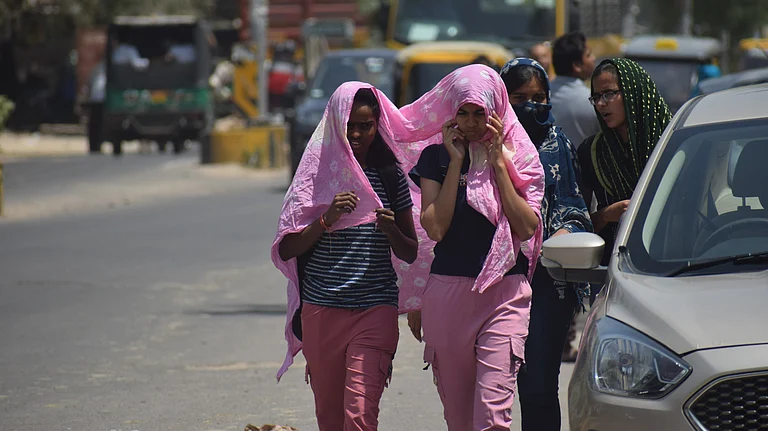
While India’s formal workforce is exposed to extreme temperatures, many still have access to relief through air conditioners, air conditioned transport and cooling products. The informal workforce such as street vendors, construction workers, delivery partners, farm labourers, etc., bear the brunt as for them, rise in temperatures translates to slashing of working hours as well as daily wages.
Similarly the households that cannot afford air conditioners, also go through the same situation. According to the Lancet Countdown on Health and Climate Change, people in India experienced an average of 19.8 heatwave days in 2024, the warmest year on record. It estimates potential income losses of about $194bn due to heat-driven labour reduction.
A March 2025 study published in the journal ScienceDirect revealed that workers often report higher thermal comfort at home because they have more control over their surroundings, including clothing adjustments, ventilation and cooling choices. “People appear to adjust their expectations of comfort to the environment and might be more ‘forgiving’ of their homes,” stated the study. As extreme heat intensifies, this raises an important question, could work-from-home become a feasible adaptive strategy for sections of the workforce that can afford stable housing, electricity and remote jobs?
However, such an option remains inaccessible for most of India’s workforce that needs to go to the site of work including construction workers, street vendors, gig workers—the foundation who continue to toil in dangerous temperatures on which others thrive on.



Organisations such as the International Labour Organization and India’s National Disaster Management Authority have laid out measures including heat action plans, shaded rest areas, altered work timings, access to hydration and strengthening occupational heat protections to reduce health risks related to climate for such vulnerable workers.









