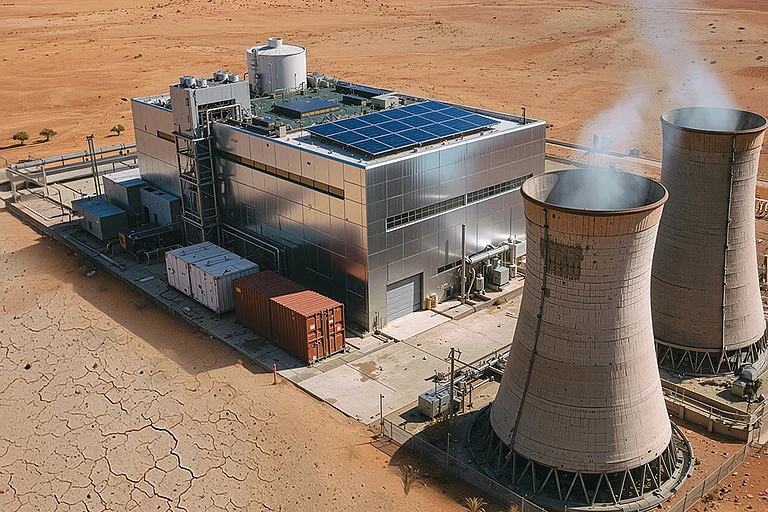
Till a few years back, data centres were the backyard of tech. They weren’t really talked about much—except the occasional gripe about their environmental impacts—although they became critical to the software industry over the past couple of decades.
But things have changed rapidly with the advent of generative artificial intelligence (AI). As data centres have suddenly become the choke point of the AI economy, tech giants like Google and Microsoft are racing to spend tens of billions of dollars in this space.
Nvidia chief executive Jensen Huang calls them “AI factories”. And those who control these factories shape the cost, speed and direction of the AI economy.

1 September 2026
Get the latest issue of Outlook Business

Obviously, India does not want to be left behind in this race. It’s no surprise then that the Indian government has made it attractive for foreign firms to set up local data centres with a 20-year tax holiday.
Meanwhile, Google has announced a $15bn project in Andhra Pradesh and Microsoft is setting up a data centre in Hyderabad and expanding three existing ones under a $17.5bn plan. A large chunk of Amazon’s $35bn investment across its India businesses through 2030 is expected to be in data centres.
Such bets by Big Tech companies are making global financial investors pause and reflect: how do they get in on the action?
India is currently at about 1.6–1.8GW of data-centre capacity, and this is expected to increase to about 10.5–11.5GW by 2035. That means adding roughly 9–10GW over the next decade.
“The opportunity is not just in building data centres but across the ecosystem. Cooling is becoming a significant area, with advancements in cooling technologies,” says Vivek Pandit, senior partner at global consulting firm McKinsey.
“Power, including captive power generation, is another important component. Water and real estate also play critical roles. We are already seeing private capital participate in different ways, including joint ventures with operating partners,” he adds.
The Layered Approach
This layered investment logic is clearest in services, where the product is compute. AI infrastructure provider E2E Networks’ stock surge in 2024 was one of the market’s early signals that investors were beginning to price the India’s AI compute stack differently.
It has offered cloud-based graphic processing units (GPUs) in India since 2018, serves e-commerce customers such as Zomato, CarDekho, 1mg, and provides access to Nvidia’s latest AI chips through its own cloud platform. Indian conglomerate Larsen &Toubro’s 21% stake purchase in E2E underlines how strategic capital is moving towards the services layer, not just the physical asset base.
Nxtra, a data-centre subsidiary of telecom company Bharti Airtel, sits in a similar zone, though with different mixes of colocation, cloud and enterprise services. These businesses offer higher growth potential and operating leverage if AI demand rises, but they also carry higher execution risk, heavier capex and a faster obsolescence cycle.
India’s AI cloud infrastructure firm Neysa’s chief product officer Karan Kirpalani points out that enterprises are no longer buying raw compute, they are buying outcomes. “The networking fabric, latency and bandwidth matter as much as the GPUs themselves,” he adds.
In India, the opportunity is likely to be driven more by inferencing than by training, say experts. Training is still concentrated globally, capital intensive and chip hungry. Inferencing, by contrast, is where models are deployed and monetised, which makes it better suited to India’s AI needs.
Nxtra’s recent $1bn fundraise announcement is a good example of how this layer is being financed with a mix of strategic intent and growth capital.
Its upcoming funding round is going to be led by new investor US-based growth equity firm Alpha Wave Global’s $435mn and US-based private-equity (PE) major and existing investor Carlyle’s $240mn with American PE firm Anchorage Capital investing $35mn and parent Airtel infusing about $290mn.
Then there is the realty layer. Blackstone’s investment in Neysa is a good example here with a commercial real estate and alternatives investor treating data centres as a digital realty asset class.
The yield logic is different, too. Indian data-centre yields are “modestly above logistics yet below prime office”, and that the spread is still anecdotal and may compress as the market deepens, says a report by investment bank Houlihan Lokey.
Within the sector itself, the structure matters a lot. Shell-and-core assets, which refer to the initial construction phase of a building, can offer the highest yields, but also the highest landlord risk.
On the other hand, fully fitted hyperscale assets, which are designed to meet the specific needs of large-scale operators, such as cloud providers or major technology companies, are described as bond-like and lowest yield. These are typically built for a single tenant under a long-term lease.


Horses for Courses
PE is backing platform plays and operating companies. Private credit and infrastructure debt are financing construction and stabilised assets. Strategic investors are entering through joint ventures to secure long-term access to infrastructure.
In India, the pattern is already visible. Digital Connexion—a joint venture between Reliance Industries, global alternative asset manager Brookfield and American data-centre company Digital Realty—is a platform structure built to attract capital at scale.
IT behemoth Tata Consultancy Services (TCS) brought in global asset manager TPG as a strategic partner to invest in its data-centre platform Hypervault. Here, the $1bn funding is a mix of equity and debt.
Indian government-owned Nat-ional Bank for Financing Infrastructure and Development’s ₹2,000cr loan to Blackstone-backed Gramercy Techpark, a company engaged in the construction and management of data centres, points to the rise of infrastructure-style credit.
Global asset-management company CapitaLand’s model, where minority stakes in built assets can later be sold to recycle capital, shows the market is becoming more financialised and more segmented.
This trend is a global one. McKinsey’s latest infrastructure report for the US says private capital is moving up the risk curve, with larger and more complex deals becoming more common, especially in energy, digital infrastructure and data centres.
The report estimates that nearly $7trn in US data-centre investment may be needed through 2030 just to keep pace with compute demand. It also says that general partners are increasingly doing multi-year partnerships around AI, data centres and power infrastructure.
Road Ahead
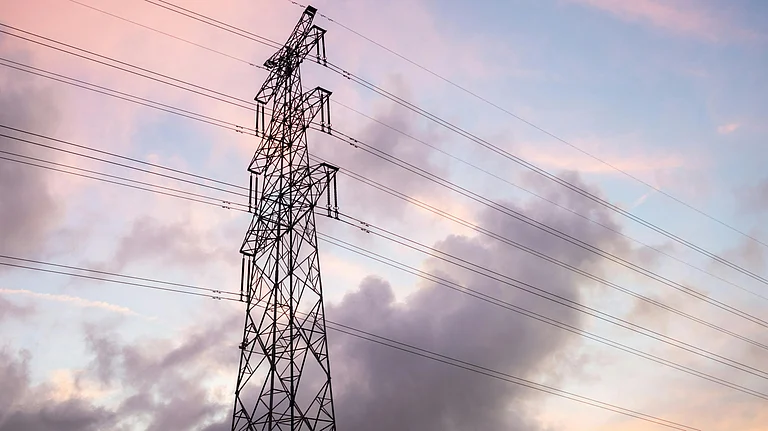
For all the capital chasing the sector, the next phase will still be determined by hard constraints. Power is the biggest one. The Union Ministry of Power has estimated that data-centre electricity demand could reach 13.56GW by 2032.
“Power is the single biggest constraint for data-centre growth in India today,” says Neysa’s Kirpalani.
But cooling and water are not softer constraints. Public-policy think tank Council on Energy, Environment and Water estimates that a 100MW hyperscale facility using water-based evaporative cooling can consume around 800,000 litres of water a day. As AI workloads become denser, liquid cooling is becoming essential, but that brings cost, geography and execution challenges into sharper focus.
Execution itself is emerging as a bottleneck. Gauri Shankar Nagabhushanam, chief executive, CapitaLand India Trust, points to long lead times for critical equipment (such as chillers and liquid-cooling systems) along with a limited vendor ecosystem in India for the same as a challenge.
While the diversity of capital provides a robust foundation, the ultimate success of these investments hinges on India’s ability to solve its bottlenecks hindering the data-centre growth story.