




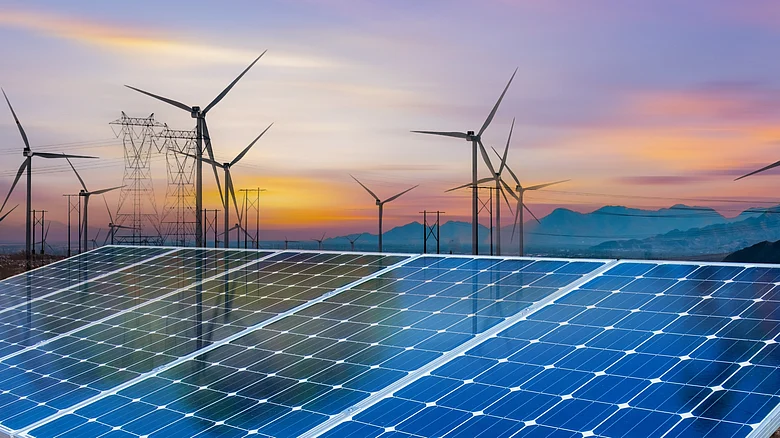

Renewables surpass coal share globally, marking historic shift in power generation mix.
Clean energy meets all new demand, limiting growth in fossil fuel output.
India’s solar-led transition gains pace, but challenges in scaling remain significant.
Clean energy is going to meet all additional demand and prevent any surge in fossil fuel generation this year, according to the Global Electricity Review 2026 by Ember. The report found that renewable climbed to nearly 34% of global generation, surpassing 33% of share of coal power for the first time in over a century. This comes at a time when fossil-based output edged down slightly. However, the slow growth of hydropower indicates that this transition will be a challenging on to balance the rapidly growing renewable energy capacity.
India’s transition from fossil fuel to clean energy reflects a broader global shift, with renewable energy emerging as a catalyst of clean energy expansion.

1 October 2026
Get the latest issue of Outlook Business

Commenting on India’s progress in achieving climate commitments, Suhas Donthi, CEO and President, Emmvee Group, said, “It is encouraging to see India making strong progress in its climate commitments, with non-fossil sources now accounting for nearly half of installed power capacity and solar leading the transition.” He added that initiatives like PM Surya Ghar are accelerating this transition, but sustaining momentum will require stronger domestic manufacturing and infrastructure to support rising renewable demand.

Advertisement
Renewable energy and Earth Day
Celebrated on April 22, Earth Day is an annual event that promotes environmental awareness and encourages actions that support the health of our planet. Earth Day was first held in 1970 in the United States, sparked by a growing awareness of pollution and environmental degradation in the 1960s. The idea was introduced by US Senator Gaylord Nelson, who wanted to create a national day focused on environmental education.
On April 22, 1970, an estimated 20mn Americans participated in events highlighting pollution and environmental issues. This first Earth Day spurred the creation of the Environmental Protection Agency (EPA) and key environmental laws like the Clean Air Act, Clean Water Act and Endangered Species Act. Today, over 190 countries recognise Earth Day.
Advertisement
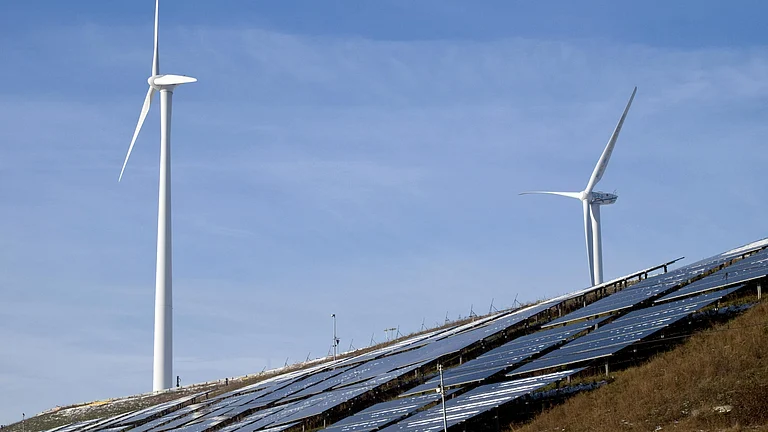
Tool for Climate Change
Energy plays a major role in environmental impact. Earth Day provides an opportunity to explore and understand the role of renewable energy in reducing emissions, supporting energy independence and building more resilient communities.
Renewable energy also helps in tackling climate change by replacing fossil fuels, which are one of the largest sources of greenhouse gas emissions. Sources like solar, wind and water produce little to no pollution, helping cut emissions and improve air quality. According to The Earth Commons website, increasing clean energy capacity also gives energy independence, economic growth and helps build resilience, especially for vulnerable communities, making it central to building a sustainable future.

Path to Net Zero Emissions
Renewable energy is considered the cornerstone for achieving net-zero emissions by 2050. By substituting fossil fuel with sources like wind, solar and hydropower, the power sector can drastically cut CO2 emissions. Achieving this requires tripling global renewable capacity by 2030 alongside increases energy efficiency and rapid electrification.
According to ScienceDirect study published in April 2026, renewable energy can help achieve net zero emissions, but it will take time. It finds the transition is economically beneficial, though reaching net zero depends on steady policy support, investment, and gradual shifts away from fossil fuels.
“The results indicate that the cost–benefit analysis yields a positive net benefit of USD 4510.3 billion, supported by a 2.1 % annual tariff escalation and a carbon price of USD 25 per ton of CO₂, confirming that the NZE pathway is economically feasible,” stated the ScienceDirect study.

Meeting Rising Power Demand
According to the ScienceDirect study published in April 2019, renewable energy helps meet electricity demand by providing a sustainable and growing source of power that can increasingly replace fossil fuels.
As demand rises globally, sources of renewable energy like solar, wind and hydro are being expanded and integrated into power systems, helping bridge the gap between supply and demand while reducing environmental impact.









