Kumar Mangalam Birla's return signals renewed promoter confidence in Vodafone Idea's revival.
Government AGR relief and fresh capital plans create a clearer path to profitability.
Vi targets network expansion, 5G rollout and EBITDA growth under its "Vi 2.0" strategy.
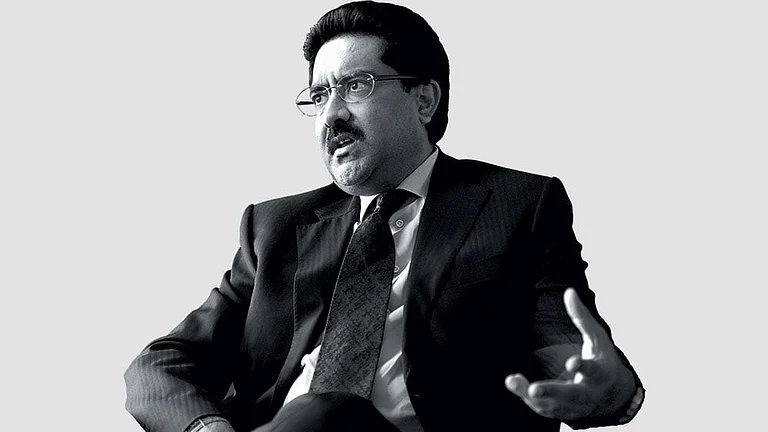
Kumar Mangalam Birla was named non-executive chairman of Vodafone Idea (Vi) on May 5, 2026. He is returning to a role he first held for four years. The company's board simultaneously accepted the resignation of Ravinder Takkar, the non-executive chairman representing Vodafone Group, though Takkar will continue as a non-executive director.
The market reacted swiftly. Shares of the telco on Wednesday, May 6, gained as much as 3.89%, touching a day's high of ₹11.22 on the BSE following the announcement.

1 September 2026
Get the latest issue of Outlook Business

But the real significance of Birla's return goes beyond a single trading session.


A Company That Has Walked Through Fire
To understand why this appointment matters, it is essential to know how far Vi has fallen, and how much ground it still needs to recover.
Vodafone Idea was formed as a joint venture between the Aditya Birla Group and Vodafone Group to counter the aggressive tariff wars triggered by Reliance Jio's entry into the Indian telecom market in 2016. The merger made strategic sense at the time, but the company soon found itself weighed down by a far larger crisis.
In 2019, the Supreme Court ruled that telecom companies owed the government Adjusted Gross Revenue (AGR) dues, a decision that landed Vi with a massive liability it struggled to absorb. The company slipped into a prolonged survival mode, losing subscribers to rivals Reliance Jio and Bharti Airtel, and watching its network investments stall.
Advertisement
Birla himself stepped back from the board in August 2021, at the height of the financial storm. He returned as a non-executive, non-independent additional director in April 2023, and has now taken the chairman's seat once again.
What Changed: The AGR Relief
Birla's return did not happen in a vacuum. It follows a significant regulatory development that has materially improved Vi's financial prospect.
Last month, the government cut Vodafone Idea's AGR dues by 27%, bringing the total liability down to ₹64,046 crore. It is to be noted that the payments have been capped at ₹1,144 crore over the next 10 years, providing the company with critical near-term cash flow relief.
Advertisement
For Birla, the relief was a signal to re-engage fully. "The fog has cleared," he indicated, suggesting that with the AGR uncertainty now behind the company, Vi can shift focus from mere survival to rebuilding and growth.
Why Birla's Return Matters Now
The most immediate impact of Birla's return is the message it sends to the market. Vi is currently seeking ₹25,000 crore in term loans and an additional ₹10,000 crore in short-term working capital.
Notably, a State Bank of India-led consortium is weighing the funding proposal, according to an earlier report by the Economic Times. This development reportedly signals a cautious but meaningful improvement in lender sentiment.
Having the Aditya Birla Group chairman personally at the helm significantly strengthens Vi's hand in these negotiations. Promoter-level commitment is often the deciding factor for lenders when evaluating high-risk borrowers.
Beyond securing loans, Vi has an ambitious capital expenditure plan of around $5 billion over the next three years, covering network expansion and a long-overdue 5G rollout. Executing a programme of this scale requires decisive leadership and the ability to coordinate across regulators, lenders, and technology partners.
"This momentum is supported by a significant capital expenditure programme of approximately $5 billion," Birla said, as quoted by the Economic Times. "I remain confident that Vodafone Idea will play a meaningful role in shaping India's telecom landscape."
Birla's involvement also carries a political dimension. The Indian government has consistently signalled its desire to preserve a three-player private telecom market, a structure that prevents a duopoly between Jio and Airtel. By stepping in as chairman, Birla might be aligning the Aditya Birla Group's public commitment with this policy objective.
Turnaround or False Dawn?
Vi's targets are ambitious. Double-digit annual revenue growth and a threefold increase in EBITDA over three years. The company currently serves nearly 200 million subscribers and employs over 10,000 people. The path will not be easy. Vi is still India's third-largest telecom operator by market share, trailing well behind Jio and Airtel. Network quality, subscriber retention and debt management remain live challenges.
But with regulatory headwinds easing, lender sentiment improving and its most prominent promoter back in the chair, Vodafone Idea is arguably better positioned today than it has been in years.
Only time and the quarters ahead can tell whether Birla's return marks a genuine turning point or simply a confident moment in a still-difficult journey.