Pizza Hut, founded in 1958 with a $600 loan, grew into the world's largest pizza chain before being sold for $2.7 billion in 2026.
Slow to adapt to delivery culture, the chain lost ground to rivals like Domino's as comparable-store sales declined and 250 US locations were shut.
While Pizza Hut struggles globally, its China business remains profitable, prompting Yum Brands to split the sale between LongRange Capital and Yum China.
Pizza Hut was built on a $600 loan in the late 1950s. In June 2026, it was sold for $2.7 billion. The story in between is one of extraordinary growth, missed turns and a business that struggled to keep pace with how the world chose to eat.
Yum Brands, which owns KFC and Taco Bell alongside Pizza Hut, announced on June 16 that it would sell the pizza chain in two separate transactions. Private equity firm LongRange Capital will acquire Pizza Hut's international business, excluding mainland China, for $1.5 billion. Yum China Holdings will buy the China business for $1.2 billion. Both deals are expected to close in the third quarter of 2026, subject to regulatory approvals.

1 September 2026
Get the latest issue of Outlook Business

"Under LongRange and Yum China, Pizza Hut will be well positioned for future growth with ownership that brings deep expertise in the restaurant industry," Yum Brands CEO Chris Turner said in a statement.




Advertisement
How It All Started
Pizza Hut was founded in 1958 when brothers Dan and Frank Carney borrowed $600 from their mother to open a small pizza restaurant near Wichita State University in Kansas. The name came from a practical limitation as the building's sign could fit only eight letters. The brothers had no formal restaurant experience but relied on word-of-mouth marketing and free pizza samples to draw in customers, particularly students. Within a year, they had opened additional locations and launched the company's first franchise.
By 1971, Pizza Hut had become the world's largest pizza chain by sales. Its red-roof restaurants, introduced in 1969, became one of the most recognisable symbols in the fast-food industry. By the end of the 1970s, it had roughly 4,000 restaurants globally.
Advertisement
Notably, PepsiCo acquired the company in 1977 for more than $300 million. In 1997, PepsiCo spun off its restaurant division into a separate company that later became Yum Brands. For years, Pizza Hut was among the most prominent brands in the portfolio, expanding globally and growing to over 15,500 restaurants across 108 countries.
Where It Lost Ground
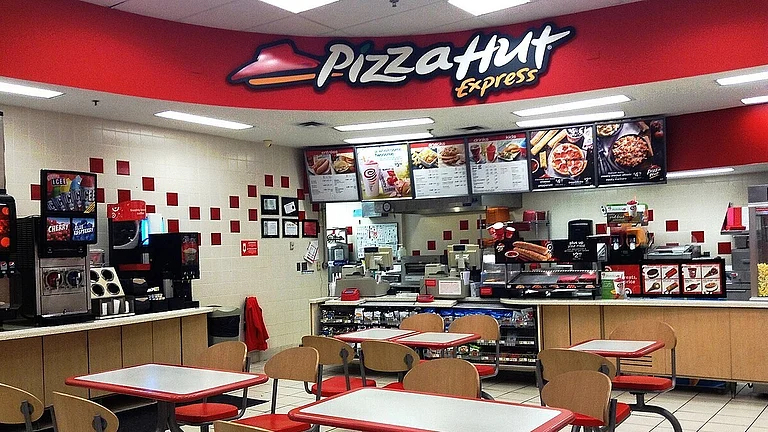
For decades, Pizza Hut's dominance seemed unshakeable. But the industry was quietly shifting around it, and the chain's decline was gradual but consistent. During the 1980s, Domino's built its business around delivery and fast service, capturing customers who increasingly preferred eating at home. Pizza Hut, by contrast, remained heavily invested in large dine-in outlets. As delivery and takeaway gained popularity, the chain found itself carrying higher operating costs while rivals operated leaner models.
The rise of food-delivery platforms such as DoorDash and Uber Eats compounded the pressure. Pizza was no longer competing only against other pizza chains.
The financial results reflected the strain. Last year, Pizza Hut's sales fell 2% even as Yum Brands' overall sales rose 5%, according to the company. In the United States, comparable-store sales declined for several consecutive quarters, and Yum announced plans earlier this year to close 250 underperforming US locations. Inflation, rising commodity costs and changing consumer preferences added further pressure.
Yum began exploring strategic alternatives for Pizza Hut in November 2025 before entering exclusive discussions with LongRange Capital in May 2026.
China vs the Rest
The sale structure reflects the starkly different performance of Pizza Hut across markets. In China, the brand has continued to grow. Pizza Hut is the largest casual dining restaurant brand in mainland China, according to Yum China, and reported segment revenue of $2.3 billion and segment operating profit of $183 million in 2025. In the first quarter of 2026, it delivered its 13th consecutive quarter of same-store transaction growth.
Outside China, the picture is more difficult. The chain has struggled to compete in markets where delivery-first rivals have established a stronger hold.
In India, Pizza Hut entered the market in 1996 as one of the early international restaurant chains in the country. But as app-based food delivery expanded, Domino's, through franchise partner Jubilant FoodWorks, built a dominant position around fast delivery, smaller neighbourhood outlets and value pricing. Pizza Hut was slower to shift away from its dine-in model.
As of FY26, Devyani International operated more than 600 Pizza Hut restaurants across India, Nigeria and Nepal, while Sapphire Foods runs over 300 outlets across India and Sri Lanka. Together, the two franchise partners account for the majority of Pizza Hut's presence in the country.