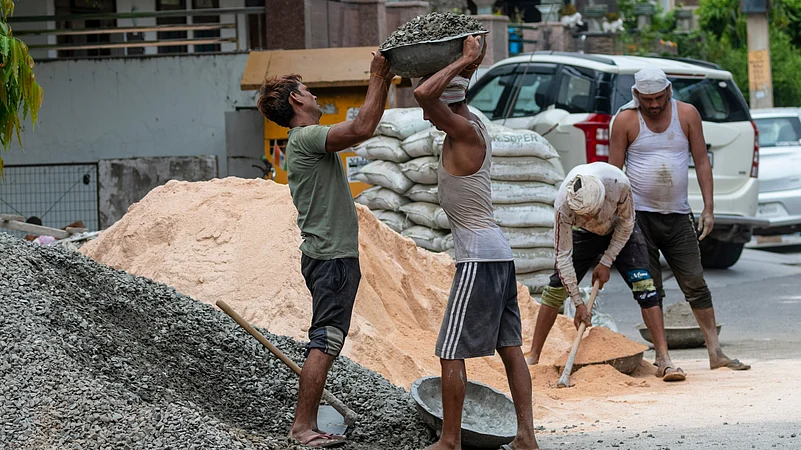

The VB-G RAM-G Act introduces a national wage floor of ₹300 and extends guaranteed rural employment to 125 days, replacing MGNREGA
Wage hikes are most pronounced in states like Uttar Pradesh, Bihar and Assam, while southern states see smaller jumps
The government argues the reform enhances transparency, resource conservation and agricultural productivity for rural workers
The Centre has officially rolled out the Viksit Bharat–Guarantee for Rozgar and Aajeevika Mission (Gramin) (VB-G RAM-G) Act, 2025 on Wednesday, replacing the two-decade-old Mahatma Gandhi National Rural Employment Guarantee Act (MGNREGA).
The new law guarantees 125 days of wage employment for eligible rural households, up from 100 days under the previous legislation, according to the Ministry of Rural Development.

1 September 2026
Get the latest issue of Outlook Business

The government has also introduced revised wage rates, ensuring that no worker covered under the scheme receives less than ₹300 per day.



What Is The New ₹300 Daily Wage Rule?
According to the Ministry of Rural Development, the revised wage structure under the VB-G RAM-G Act sets a nationwide minimum daily wage of ₹300 for unskilled manual work.
The Ministry said the national average notified wage has risen from ₹298.8 to ₹327.4 per day, reflecting an average increase of more than 10%.

The government also announced an interim allocation of ₹95,692.31 crore to states and Union Territories (UTs) to support implementation of the new law, ensure timely wage payments and fund development works.
Advertisement
State-Wise Wage Rates Under VB-G RAM-G
A daily wage of ₹300 has been notified for 21 states and UTs, including Uttar Pradesh, Bihar, Jharkhand, West Bengal, Assam, Rajasthan, Odisha, Gujarat, Madhya Pradesh, Chhattisgarh, Uttarakhand, Arunachal Pradesh and Nagaland, as per a report by The Indian Express (IE).
Among higher-paying states, Haryana will offer the country's highest notified wage at ₹409 per day, followed by Goa (₹406), Kerala (₹401), Karnataka (₹382), Himachal Pradesh's scheduled areas (₹375) and Punjab (₹360).
Three gram panchayats in Sikkim — Gnathang, Lachung and Lachen — will receive a special wage rate of ₹450 per day, according to the notification.
Advertisement
Which States Benefit The Most?
Government data shows that several northern and northeastern states have recorded the sharpest percentage increases.

According to the Ministry, Uttar Pradesh, Bihar, Jharkhand, West Bengal, Assam, Arunachal Pradesh and Himachal Pradesh have seen wage revisions ranging between 15-25%.
However, southern states such as Andhra Pradesh, Telangana, Tamil Nadu and Karnataka registered comparatively smaller percentage increases, largely because their existing MGNREGA wages were already relatively higher, as per the IE report.
How Much More Will Workers Earn Compared To MGNREGA?
The apparent jump in wages should be viewed in context. The Centre did not revise MGNREGA wages for 2026-27 and continued with the rates notified for 2025-26 during the first quarter of the current financial year.
As a result, the newly notified VB-G RAM-G wages appear significantly higher than the prevailing MGNREGA rates.
Had the MGNREGA wages been revised this year, the difference would have been narrower, as per IE.
Why The Govt Introduced A National Wage Floor
The Ministry of Rural Development said the new legislation is intended to strengthen livelihood security while improving transparency, creating durable rural assets, conserving natural resources and boosting agricultural productivity.

Union Rural Development Minister Shivraj Singh Chouhan described the rollout as "A historic day for rural India".
"The VB-G RAM G Act is not merely a new law but a transformative initiative that ushers in a new era of dignity, self-respect and livelihood security for millions of rural workers," he remarked.