India is grouped with major economies handling large volumes of China-linked goods and operating US-bound exports
White House alleges that goods can be routed through third countries and subjected to minimal processing to disguise their true origin
The classification does not mean all Indian exports are suspected of tariff evasion
India has been placed among the highest-risk jurisdictions in a new White House report 'The Great Transshipment Scam' examining the alleged rerouting of China-linked goods through third countries to avoid higher US tariffs.
But the designation does not amount to an India-specific tariff action or a finding that Indian exports, as a whole, are involved in customs fraud.

1 September 2026
Get the latest issue of Outlook Business

According to the assessment, India is part of Tier 1, alongside Canada, the European Union, Israel, Japan, Mexico, South Korea and Taiwan. All of these countries are major trading partners of the US.



The category comprises what the report calls "Diversified Scale Leaders" — large economies and trading blocs with substantial volumes of China-linked goods, diversified industrial bases and major US-bound export platforms.
What's The Transshipment Scam?
The White House described illegal transshipment as the movement of goods through another country to obtain tariff treatment that would not apply if their true economic origin were declared.
Advertisement
Such practices can involve relabelling, repackaging, re-invoicing, limited processing or false country-of-origin claims.
The report said that differentiated US tariff rates create an incentive for exporters in higher-tariff jurisdictions to route goods through countries facing lower duties.
It traces the growth of the problem largely to the tariffs imposed on China under Section 301 in 2018. As direct imports of some tariffed Chinese goods into the US declined, Chinese exporters increasingly used third-country production and logistics networks, it alleges.
However, the White House itself acknowledged that a shift in sourcing does not, by itself, prove illegal transshipment, as some changes reflect legitimate investment, manufacturing and supply-chain diversification.
Advertisement
Why Is India In Tier 1 Risk Category?
Tier 1 countries account for large absolute volumes of China-linked goods while also having broad and diversified industrial bases, the report said.
In such markets, potential transshipment risks are embedded within far larger volumes of legitimate trade, it added.

India is therefore grouped with some of America’s largest trading partners and export platforms, rather than being placed in the category of smaller jurisdictions identified for specific "weak-link" advantages such as limited customs capacity, free-zone rules or low-cost assembly.
The report defines "China-linked goods" broadly. These may contain China-origin inputs or components, have Chinese ownership or financing links, relationships with Chinese suppliers, China-based production stages or routing histories suggesting possible origin-shifting schemes.
This does not necessarily mean that the goods are declared as Chinese-origin when entering the US.
The issue could gain significance as India and the US work towards an interim reciprocal trade agreement, particularly around rules designed to ensure that preferential trade benefits accrue mainly to the two countries rather than third-country exporters.
What Are Concerns About India?
The White House made a specific reference to an India production belt spanning Pune, Gujarat and Chennai. It identified this corridor as a potential route involving China-linked pumps and compressors classified under HS codes 8413 and 8414.
The report paired this Indian manufacturing belt with industrial corridors in Cincinnati, Dayton and Columbus, arguing that imports of such goods could potentially put competing US manufacturing activity under pressure.
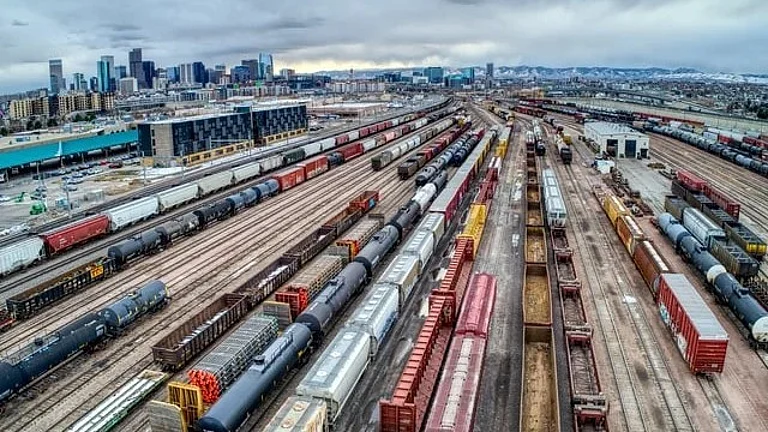
However, the report presented these so-called "Ugly Sister City" comparisons as illustrative rather than exhaustive. It does not name any Indian company, provide a value for allegedly illegal shipments routed through India, or establish that all trade in these product categories violates US customs or origin rules.
The pairings are based on product-to-industry comparisons and potential exposure rather than findings of wrongdoing by specific companies.
How Big Is The Transshipment Problem?
The report identified more than 40 countries associated with elevated transshipment risk and cited five estimates of annual potential illegal transshipment or related trade-transfer exposure.
These range from $40 billion, based on Goldman Sachs’ narrower rerouting estimate, to $303 billion, Altana’s broader upper-bound exposure measure, the report said.
The White House said that these estimates are not additive and cannot be directly compared because they use different definitions and methodologies.
The report used a central estimate of about $75 billion based on Exiger’s analysis, while separately noting a Commerce Department estimate of approximately $67 billion in 2025 transshipment through Mexico, India and Vietnam under a narrower transaction-level methodology.

What Happens Next?
The Trump administration said it is strengthening enforcement, including through an AI-enabled system described in the report as the "Detective Border".
The proposed system would analyse shipment histories, product classifications, ownership links, production capacity and other indicators to identify high-risk cargo and distinguish genuine manufacturing from pass-through trade.
The report also said that it is too early to measure whether the administration’s wider tariff and anti-transshipment measures are reducing such activity.
For India, the immediate significance of the Tier 1 classification appears to be greater scrutiny of origin claims rather than an automatic new tariff or penalty.