
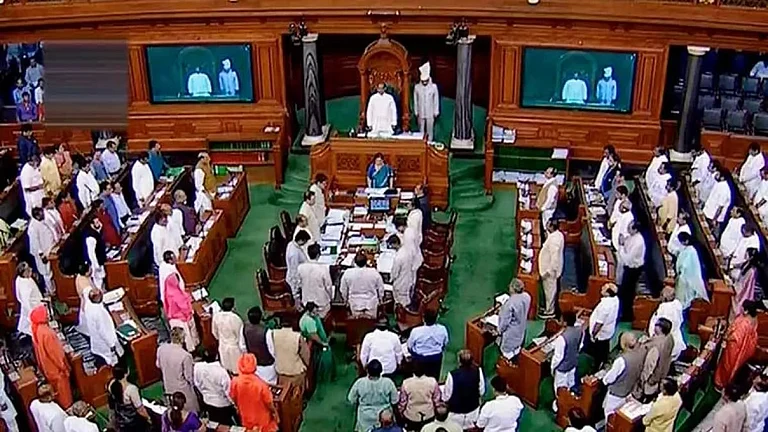
Lok Sabha cleared the VB-G RAM G Bill, replacing MGNREGA.
The government says the new framework improves transparency and rural assets.
A shift from demand-driven to supply-driven funding and a 60:40 Centre–state split has raised fiscal concerns among states.
The Lok Sabha cleared the Viksit Bharat Guarantee for Rozgar and Ajeevika Mission (Gramin) Bill (VB-G RAM G) on Thursday, albeit amid strong resistance from the Opposition. The Bill seeks to replace the decades-old Mahatma Gandhi National Rural Employment Guarantee Act (MGNREGA) and raises the number of days of wage employment to 125 days from 100 for unskilled workers in rural areas. The legislation also aims to strengthen gram panchayats and gram sabhas to plan and identify works to be undertaken.
Minister Shivraj Singh Chouhan introduced the Bill and said the proposed legislation would lead to the “comprehensive development of villages,” be inclusive of socio-economically weaker communities, and uphold their dignity.

1 September 2026
Get the latest issue of Outlook Business

What Are the Objectives of the Bill?
According to the government, the Bill aims to boost rural employment and introduce stronger transparency and accountability provisions. Under the VB-G RAM G Bill, the rural economy is expected to benefit through improved water security, rural infrastructure, livelihood assets, climate resilience, higher employment, and increased consumption. The Bill also aims to reduce migration distress.
For farmers, the Bill mandates 60 days of no work during peak sowing and harvesting periods to prevent labour shortages during critical farm operations. On the transparency front, the Bill proposes AI-based fraud detection, central and state-level steering panels for supervision, and a focus on key rural development verticals, including enhanced monitoring roles for panchayats, weekly disclosures, and stronger social audits.
Advertisement
What Does the Opposition Say?
However, the Opposition opposed the Bill amid strong uproar, questioning its intent and alleging that it is an attempt to remove Mahatma Gandhi’s name while diluting the effectiveness of the employment scheme. Congress MP Priyanka Gandhi Vadra flagged that core issues such as implementation gaps and unpaid wages remain unaddressed, and argued that the new Bill would place a greater financial burden on state governments.
Key Differences Between MGNREGA and the VB-G RAM G Bill
Apart from increasing the number of days of wage employment, the new Bill introduces a 60:40 fund-sharing pattern between the Centre and the states. Himalayan States, Union Territories, and North-Eastern States will bear 10% of the costs. Under MGNREGA, the Centre bore the entire cost of wage payments.
Advertisement
The Centre has also alleged that the existing scheme was plagued by corruption under previous regimes and that allocated funds were not always used for designated works.
The VB-G RAM G scheme will be supervised by a Central Gramin Rozgar Guarantee Council, unlike MGNREGA, which operates under the Ministry of Rural Development. Moreover, the new Bill does not guarantee wage employment throughout the year and imposes a mandatory 60-day ban during peak farming seasons.
As per reports, MGNREGA was a demand-driven programme based on worker availability, while the new scheme follows a supply-driven framework, with capped allocations. The Centre has capped funding at ₹95,000 crore, and any expenditure beyond this limit will have to be borne by the respective states.

Challenges and Criticism
States such as Tamil Nadu and Kerala have opposed the Bill, claiming it undermines states’ interests. While supporters of the government have welcomed the increase in guaranteed workdays, a report by The Hindu noted that only 9.5% of workers under MGNREGA managed to complete the full 100 days of employment. Over the past two years, only around 7% of households received the full quota of work.
According to a Moneycontrol report, less-developed states such as Bihar could face significant fiscal stress due to the 60:40 Centre–state funding structure. Bihar would need to mobilise nearly ₹2,576 crore, or 0.23% of its GSDP, to fund its share, at a time when its fiscal deficit stands at 9.2% of GSDP in the current financial year. Other vulnerable states include Chhattisgarh and Jharkhand, the report said.
States such as Uttar Pradesh are expected to be relatively cushioned due to the size of their economies, with the impact estimated at 0.13% of GSDP. States including Gujarat, Haryana, and Maharashtra are likely to face minimal additional burden, with an estimated impact of around 0.05% of GSDP, according to the report.