
The Department of Homeland Security issued a final rule replacing open-ended visa durations with fixed time limits
Student and exchange visas will face a strict maximum cap of four years under the updated regulations
Standard media visas will be restricted to 240 days, with Chinese journalists limited to a maximum stay of 90 days
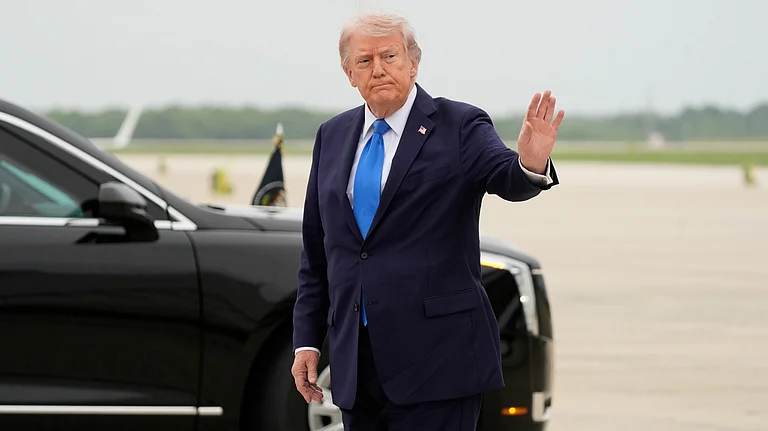
The US President Donald Trump's administration took action on Thursday to strictly limit visa durations for international students, cultural exchange participants and foreign journalists, according to a Reuters report.
The Department of Homeland Security issued a final rule replacing the current open-ended duration of stay with fixed time limits. The new policy directly targets F visas for academic students, J visas for cultural exchange participants and I visas for media personnel.

1 October 2026
Get the latest issue of Outlook Business

This policy will become effective 60 days after its publication in the Federal Register. The move remains subject to congressional review before implementation. Trump began a broad crackdown on immigration after taking office in January 2025.
His administration rapidly intensified scrutiny of legal immigration channels. It previously revoked student visas and green cards held by university students based on their ideological views and stripped legal status from hundreds of thousands of migrants.
What are the new US visa rules?
The rule eliminates what DHS calls the "duration of status" (D/S) framework, the policy that has allowed F visa students, J visa exchange participants and I visa media representatives to stay in the US for as long as their program continued, without a specific end date on their immigration paperwork.
Advertisement
Student and exchange visa durations will face a strict maximum cap of four years under the updated regulations. Media visas, which currently can last for years, will face severe restrictions, limiting standard journalist stays to just 240 days.
Anyone needing more time beyond that fixed date will have to file a formal Extension of Stay (EOS) application with US Citizenship and Immigration Services (USCIS), shifting oversight of these visa categories from individual universities and institutions to federal immigration authorities directly
The regulations single out Chinese nationals holding media visas (I visas), restricting their maximum stay to just 90 days. Individuals holding these visas must apply to the Department of Homeland Security for extensions to prolong their stay.
Advertisement
China's foreign ministry strongly opposed the proposed media visa limits in August, labelling the policy discriminatory.
Which visa categories are affected?
Three non-immigrant categories are covered by the final rule. F visas for academic students and J visas for cultural and academic exchange participants are capped at four years of admission.
While I visas for foreign media representatives and journalists, face a far tighter limit of a maximum initial stay of 240 days, except Chinese nationals who are capped at a maximum stay of just 90 days.
Why has the US changed the system?
According to DHS, the move marks closing a loophole rather than tightening legitimate access. International students who had been admitted for an unspecified period since 1978 enabled thousands to become "forever students" by continuously enrolling in courses to avoid leaving the country.
In a statement announcing the rule, DHS Secretary Markwayne Mullin said the "duration of status" system had compromised national security and created conditions for immigration fraud over nearly five decades.
The department has also pointed to volume as a justification, it recorded over 1.8 million student visa admissions in 2024, an increase of more than 11% year-on-year, alongside more than 500,000 exchange visitors and 37,300 media personnel admitted in the same fiscal year.
DHS has said this rising volume makes it harder for the department to monitor and oversee non-immigrants while they remain in the country, and that it has documented cases of students and exchange visitors staying in the US for decades under their existing status.
How will Indian students be affected?
India is the largest source country for F-1 students in the US, which means Indian students will be among the groups most exposed to the practical mechanics of this shift.
Under the new rule:
Fixed four-year cap: Student and exchange visas will now carry a strict maximum of four years, after which an extension must be formally approved by USCIS rather than assumed to continue automatically.
Shorter departure window: The grace period for students to leave the US, transfer schools or change status after completing their degree has been cut from 60 days to 30 days.
No mid-course pivots: Graduate students can no longer change their stated educational objective at any point in their program, and cannot transfer to another academic institution without securing prior authorisation, reversing the flexibility that let students switch majors or schools without federal sign-off.
Indian students already in the US on a D/S basis, the transition into the new fixed-period system will happen automatically, with their authorised stay capped at four years from the rule's effective date rather than requiring fresh paperwork immediately.
"Most Americans understand the value of welcoming international students and getting rid of needless red tape," Doug Rand, a former Department of Homeland Security (DHS) official, said.
"This rule would do the opposite." David J. Bier, director of immigration studies at the Cato Institute, said the study and transfer restrictions lack any legal foundation.
"International students, many of whom will have spent years in the USA, will now have just 30 days to find an employer to sponsor them or immediately be turned into illegal immigrants. Have these people no understanding of how life works?" Bier added.
What changes for foreign journalists?
Foreign correspondents and media personnel, including many Indian journalists posted to US bureaus, face the sharpest cut of any category. I visas, which previously could run for years without a fixed end date, will now be capped at 240 days for most nationalities, with Chinese nationals restricted further to just 90 days.
To stay beyond that window, journalists holding I visas will need to formally apply to DHS for an extension, rather than relying on continued accreditation or assignment status to justify their presence, as under the old system.
Alternatively, journalists can seek readmission by leaving the US and re-entering, an option DHS's rule explicitly preserves, though it adds a travel burden that the D/S system didn't require.
Can visa holders extend their stay?
Visa holders can extend their stay, but the process now runs through federal authorities rather than being managed informally through the visa holder's own institution or program.
Anyone needing to stay past their fixed "admit until" date will have to file a Mandatory Federal Extension request directly with USCIS, which brings applicants through biometric vetting, background checks and fraud screening before an extension is approved.
This is the central design change in the rule: oversight that used to sit with universities, exchange sponsors and media organisations now sits with USCIS and DHS directly. The Student and Exchange Visitor Program (SEVP), run by Immigration and Customs Enforcement, continues to track F and M visa holders through the Student and Exchange Visitor Information System, but extensions beyond the fixed period now require a formal federal filing rather than continued program enrolment alone.