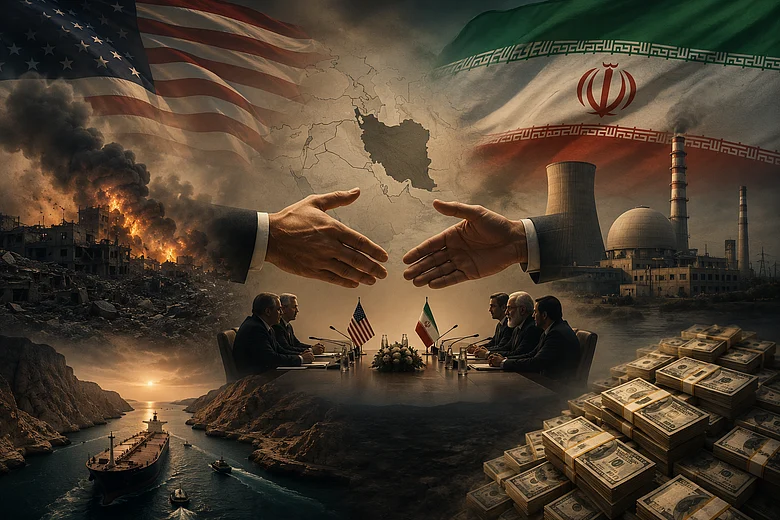

Iran and the US are considering a 60-day truce framework that would reopen the Strait of Hormuz and restart broader negotiations over Tehran's nuclear programme.
The draft proposal includes a Lebanon clause aimed at ending hostilities involving Hezbollah, an issue that has strained ties between Donald Trump and Israeli Prime Minister Benjamin Netanyahu.
A proposed $300 billion reconstruction and investment fund for Iran could become one of the biggest economic incentives offered as part of the negotiations.
The Iran-US conflict has entered its third month. An energy crisis, supply chain disruption, regional instability, and global anxiety over an economic slowdown and recession followed immediately in the aftermath of the war.
On February 28, the US and Israel launched a joint military attack against Iran, citing concerns that its nuclear programme posed a threat to West Asia. Iran’s response? Shutting down the Strait of Hormuz, a critical waterway that carries nearly 20% of global energy trade.

1 October 2026
Get the latest issue of Outlook Business

Global crude oil prices soared to multi-year highs and have struggled to settle below $100 a barrel ever since.
The energy crisis and the closure of the strait led to an immediate need for negotiations between the US and Iran.
The Initial Talks
After multiple military attacks and retaliatory strikes, Washington and Tehran sat down for a round of peace talks on April 11.
Advertisement
The negotiations lasted more than 22 hours but failed to yield any concrete results. US President Donald Trump subsequently announced a naval blockade of the strait, further complicating maritime traffic.
Though a temporary ceasefire was announced with the mediation of Pakistan, and Trump later extended the truce indefinitely, the failure to achieve a long-term agreement has fuelled global uncertainty and anxiety.
Analysts and economists have warned that any further prolongation of the war could push the world into recession territory and send crude prices soaring.
Why Did the Initial Talks Fail?
The initial talks were led by US Vice President JD Vance and Trump’s son-in-law, Jared Kushner. The US demanded that Iran halt its entire nuclear programme, surrender its enriched uranium, and agree to a 20-year moratorium on uranium enrichment.
Advertisement
Iranian officials, led by Parliament Speaker Mohammad Baqer Ghalibaf, rejected the proposal, describing the demands as “excessive” and arguing that Tehran had every right to pursue a nuclear programme for peaceful purposes.
Iran had demanded transit tolls from vessels passing through the strait, the return of frozen assets, and the lifting of US economic sanctions.
Following the initial talks, both countries exchanged multiple proposals aimed at reaching a deal, with Tehran at times reluctant to return to the negotiating table unless Washington agreed to its demands.
Iran has also reiterated that it prefers an immediate truce, with concerns over its nuclear programme to be discussed later within a broader framework. The US, however, maintains that no agreement can be reached without addressing the nuclear issue.
Where Does the Truce Stand Now?
Despite attacks targeting certain military bases and retaliatory strikes by Iran in recent days, the truce is still expected to be announced, raising hopes of avoiding immediate military escalation.
According to reports citing Axios, the White House is yet to receive final approval from Trump for the memorandum of understanding (MoU). The report also stated that Tehran has not formally accepted the proposed framework.
“This is an agreement to get everybody to the table. We will work out the details in the negotiations,” one US official said.
What Does the New Proposal Say?
According to reports, the two sides have agreed on an MoU to extend the ceasefire for 60 days and resume broader negotiations over Iran’s nuclear programme.
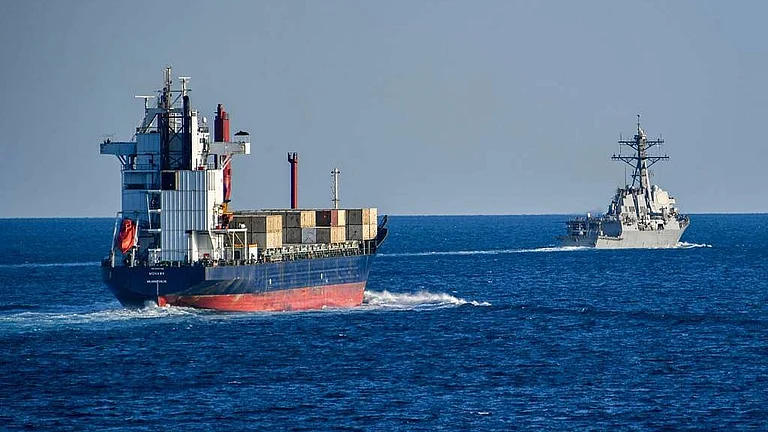
The proposed 60-day MoU is expected to ensure that maritime traffic through the Strait of Hormuz remains “unrestricted”.
This would mean Iran cannot charge tolls or attack vessels and would require Tehran to remove all sea mines from the strait within 30 days. The US, meanwhile, would lift the naval blockade, and commercial shipping activity would gradually be restored.
Reports also suggest that the US would issue limited sanctions waivers, allowing Iran to resume oil sales.
On the nuclear issue, the MoU requires Iran to commit to not pursuing a nuclear weapon and prioritises negotiations over its highly enriched uranium stockpile and enrichment programme during the 60-day period.
Washington is also expected to discuss broader sanctions relief and the release of frozen Iranian assets as part of the negotiations.
Addressing the Lebanon Issue
West Asia has witnessed increasing militant activity and civil unrest spilling across borders. Israel is not only at war with Iran but is also fighting the Iran-backed militant group Hezbollah in Lebanon.
The initial ceasefire stipulated that the truce would also apply to the conflict in Lebanon. However, Tel Aviv stated that the Iran-US truce does not cover the Lebanon issue.
The proposed new deal, however, includes a clause aimed at ending the conflict, an issue that has caused friction between Israeli Prime Minister Benjamin Netanyahu and Trump in recent weeks.

A Billion-Dollar Investment Plan
One of the more surprising elements of the proposal is an investment fund for Iran.
According to reports, the US is expected to support the creation of a $300 billion reconstruction programme. Iranian officials have said the promised funds would be released if a final agreement is signed.
US diplomats, meanwhile, have referred to it as an “international investment fund” in their draft proposal.
The New York Times also reported, citing Iranian officials, that major US oil and energy companies would invest in Iran’s energy sector and enter into joint ventures as part of the agreement.

Whether these promises will be delivered remains as uncertain as the fragile truce itself. Conflicting reports continue to emerge, with little clarity over who is involved in the negotiations.
On the US side, the preliminary agreement is intended to end hostilities for a period of 60 days. Iran, however, has described the arrangement as a “declaration of the end of war” on all fronts, including Lebanon.
Questions also remain over maritime access through the strait. According to reports citing US officials, the blockade would remain in place but be lifted in stages depending on how much pre-war shipping traffic Iran restores. Iranian officials, however, claim the agreement would require the US to lift the blockade within 30 days.
Experts say that if the deal is signed, it would mark the most significant breakthrough in the Iran-US conflict, potentially calming global markets and paving the way for a fresh round of negotiations aimed at restoring peace and stability in West Asia.