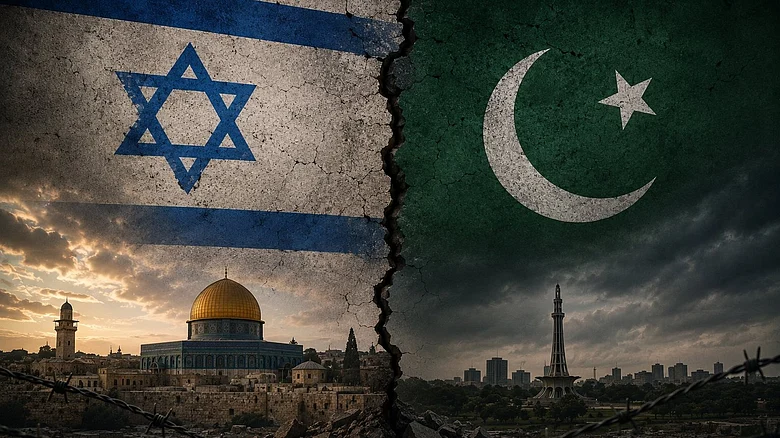

Trump urged countries including Pakistan, Saudi Arabia, Turkey, and Qatar to join the Abraham Accords as part of a broader West Asia peace framework.
Pakistan rejected the proposal, reiterating that it will not recognise Israel without the establishment of a Palestinian state.
Analysts warn that forcing countries into an “all-or-nothing” regional alignment could deepen geopolitical divisions instead of stabilising West Asia.
As tensions intensify in West Asia amid peace negotiations between the US and Iran, US President Donald Trump on Monday called for a sweeping expansion of the Abraham Accords.
Trump urged several Islamic nations, including Pakistan and Turkey, to sign the framework if they wish to be part of any future settlement in West Asia.

1 October 2026
Get the latest issue of Outlook Business

He also said he had discussed the issue on Saturday with leaders from Saudi Arabia, the UAE, Qatar, Pakistan, Turkey, Egypt, Jordan, and Bahrain as part of efforts to address broader regional issues involving Iran.
“It should start with the immediate signing by Saudi Arabia and Qatar, and everybody else should follow suit,” Trump wrote on Truth Social, adding that countries unwilling to sign “should not be part of this deal, as it shows bad intentions.”
However, for Islamabad, signing the agreement could become a double-edged sword, forcing it to balance domestic political realities with Washington’s strategic demands.
To understand why the proposal caught Pakistan off guard, it is important to understand the framework Trump is trying to expand.
Advertisement
What Are the Abraham Accords?
Signed in 2020 during Trump’s first presidential term, the Abraham Accords are a series of agreements mediated by Washington between Israel and several Arab countries, including the UAE, Bahrain, Morocco, and Sudan.
The agreements aimed to improve diplomatic, economic, and security ties in the region. They also marked the first formal normalisation of relations between Arab nations and Israel since the 1994 Jordan-Israel treaty.
The political dilemma lies in the fact that the accords require formal recognition of Israel as a state and the establishment of formal diplomatic relations.
Trump is now pushing for broader recognition, even as many of the countries he mentioned continue to support a two-state solution and Palestinian statehood.
Advertisement
While the UAE and Bahrain are already part of the accords, and Egypt and Jordan already recognise Israel, the pressure now falls on countries such as Pakistan, Saudi Arabia, Turkey, and Qatar.
For many Islamic nations, recognising Israel without a concrete framework for Palestinian statehood remains politically and diplomatically sensitive.
This is especially true at a time when the Gaza conflict continues to dominate political discourse across West Asia and the wider Muslim world. Trump’s renewed push therefore comes at a particularly delicate geopolitical moment.
Two-State Solution and Pakistan’s Position
Pakistan has consistently maintained that it will not recognise Israel without the establishment of a Palestinian state, a stance shared by several Islamic nations, including Saudi Arabia.
Pakistan, which is also playing a mediating role in the ongoing US-Iran peace talks, now finds itself in a difficult diplomatic position as Trump seeks to link broader regional peace efforts with the expansion of the Abraham Accords.
Domestically, the demand is politically sensitive. Pakistan’s public opinion remains overwhelmingly pro-Palestine, and any move toward recognising Israel could trigger major political backlash and unrest.
Islamabad also maintains strong diplomatic and economic ties with several West Asian countries that continue to support Palestinian statehood.
The issue is further complicated by Pakistan’s own ideological positioning. Support for Palestine has long remained a central part of Pakistan’s foreign policy narrative, and successive governments have publicly maintained that there can be no recognition of Israel without a viable Palestinian state.
Any sudden shift in that position would likely be viewed domestically as political surrender under foreign pressure.
At the same time, Islamabad cannot afford to entirely alienate Washington. Pakistan’s fragile economy continues to depend on external financial support, international lending institutions, and security cooperation with the United States.
This creates a difficult balancing act between managing domestic political sentiment and maintaining strategic international relationships.

Washington’s Pressure and Regional Stability
Trump’s proposal also places Pakistan in a strategic dilemma. While Islamabad wants stability in West Asia, it also depends heavily on US financial and military assistance at a time when its economy continues to struggle with slowing growth and external pressures.
Pakistan has officially rejected the proposal, becoming the first country among those listed by Trump to publicly push back. Defence Minister Khwaja Muhammad Asif said Islamabad would not support any agreement that contradicted the country’s ideological position on Israel.
“Personally, I don't think we should join any such accord that clashes with our fundamental ideologies,” Asif said, while also questioning Israel’s credibility in negotiations.
He further pointed out that Pakistan remains one of the few countries whose passports do not recognise Israel.




Saudi Arabia continues to maintain a similar position, insisting on Palestinian statehood before normalising ties with Israel.
Qatar has also repeatedly rejected joining the accords and remains a key backchannel for Gaza negotiations. Turkey, meanwhile, has sharply criticised Israel’s actions in Gaza despite having formally recognised Israel decades ago.
The wider concern for regional stability is that Trump’s push could deepen divisions within the Islamic world instead of resolving tensions.
While some countries may view normalisation with Israel as strategically beneficial, others continue to see Palestinian statehood as a non-negotiable prerequisite. This divide creates competing geopolitical priorities across West Asia.
By framing refusal to join the accords as a sign of “bad intention,” Trump is attempting to simplify a decades-old geopolitical and ideological conflict into an “all-or-nothing” choice for regional powers.