The rupee hit a record low near 96 against the dollar as Brent crude surged above $100 amid the ongoing Iran war.
Rising oil prices, widening trade deficit, and foreign investor outflows are intensifying pressure on India’s external sector.
Analysts warn that prolonged geopolitical tensions and sustained elevated crude prices could push the rupee closer toward the psychological 100-per-dollar level.
The rupee has been in what can be interpreted as a “free fall” since last year. It emerged as the worst-performing Asian currency in 2025, only to depreciate at a faster pace five months into 2026.
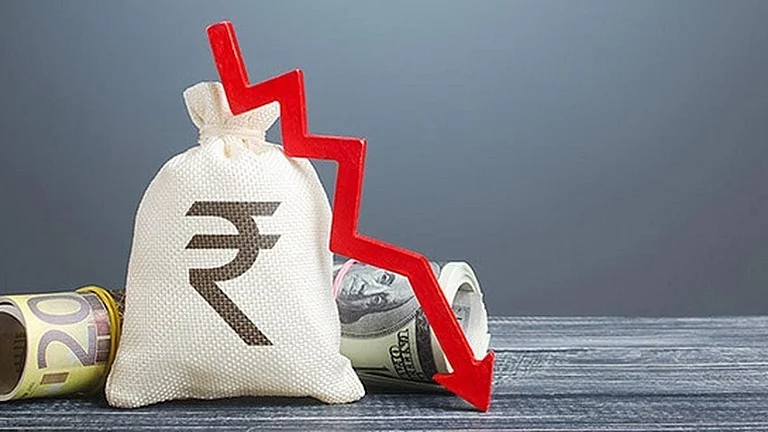
The rupee depreciated nearly 10% last year and has already declined nearly 6.5% against the greenback so far in 2026. It posted consecutive record lows in May and fell to a lifetime low of 96.14 against the dollar on Friday.

1 September 2026
Get the latest issue of Outlook Business

If tariff flip-flops by US President Donald Trump and a stronger dollar weighed on the rupee last year, it is the West Asia crisis and global energy market volatility that are dragging the currency down this year.
The rupee has entered a “self-reinforcing” cycle — a phenomenon where geopolitical tensions trigger foreign investor outflows, leading to a fall in the rupee, which in turn reinforces the need to exit Indian markets.
“Rupee falls past 96 as dollar index rises to 99.30 and Brent oil rises to $109 per barrel. India’s trade deficit comes at $28.38 billion, and Asian currencies fall, some to their lowest levels, after hawkish comments from US policymakers, better data from the US, and nothing achieved on the Iran war from the Trump-Xi summit,” Anil Kumar Bhansali, Head of Treasury at Finrex Treasury Advisors, said.
Advertisement
How Is Crude Driving Rupee Depreciation?
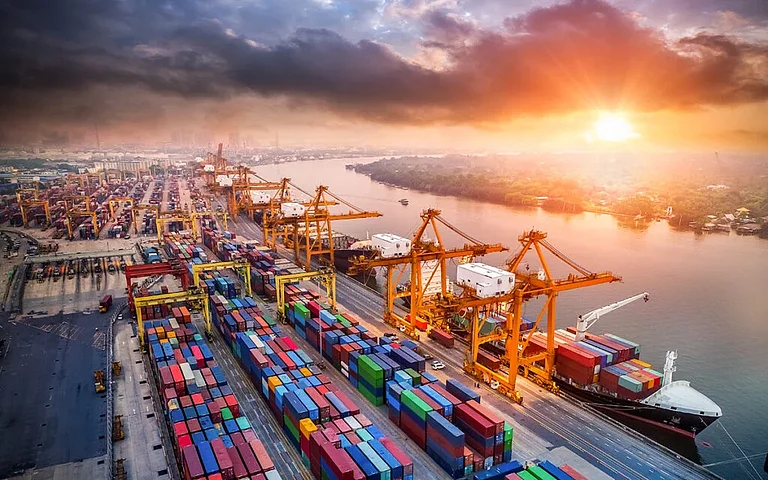
India imports nearly 90% of its crude oil requirements. Owing to geopolitical tensions in West Asia, the closure of the Strait of Hormuz — through which 20% of global trade passes — and production and export cuts from the region, benchmark Brent crude has surged to multi-year highs.
Brent crude, which traded around $65-$70 per barrel before the war, soared as high as $126 per barrel and has not settled below $100 since the onset of the conflict.
Rising crude prices are also raising concerns over global economic growth and the risk of recession among economists and analysts.
Advertisement
The International Energy Agency had to release its largest reserve of crude oil stocks, while the US eased some sanctions on Russia to prevent global crude prices from crossing $150 per barrel, a level that could severely damage the post-Covid global economic recovery.
Higher crude prices increase India’s import bill, thereby raising demand for dollars and weakening the rupee further.
According to a Morgan Stanley report, India’s heavy reliance on energy imports makes the economy particularly “vulnerable to commodity price hikes and supply disruptions arising from geopolitical conflict.”
How Does a Weak Rupee Impact the Economy?
Due to the persistent weakening of the domestic currency, India is likely to post a third consecutive year of balance of payments deficit, further cementing expectations of sustained weakness in the rupee.
The Reserve Bank of India has also intervened in the foreign exchange market through dollar sales and by making changes to non-deliverable forward (NDF) dollar positions of banks to limit the rupee’s fall.
Prime Minister Narendra Modi last week urged citizens to limit gold purchases and reduce international travel, citing stress on India’s foreign exchange reserves.
According to a Nomura report, policymakers expect regulatory measures to manage the deficit but noted that it reflects “a more volatile global environment” and requires “a deeper rethink on how India should manage the external sector in the coming years.”
“Market participants remain cautious amid fears that elevated crude prices may persist for a longer duration despite government measures to control volatility,” Jateen Trivedi, VP Research Analyst – Commodity and Currency at LKP Securities, said in a note.
Analysts expect the rupee to fall as low as 96.26 per dollar and trade in the 95.55–96.00 range in the near term.
How Will Sectors Be Impacted?
But shouldn’t a weaker rupee help exporters? It does, to an extent. However, India remains a net-importing country, meaning currency weakness has a larger negative impact than positive impact on its current account balance, stock market, and inflation outlook. Moreover, the impact differs across sectors.
While export-oriented sectors such as IT and pharmaceuticals may gain some competitive advantage, import-dependent sectors like crude oil, chemicals, and electronics face higher costs, increasing the risk of “imported inflation.”
At a time when the economy is already facing growth concerns, upside risks to inflation could complicate policymaking for both the RBI and the Centre.


The RBI has a mandate to maintain inflation at 4%, with a tolerance band of +/- 2%. A sustained rise in inflation may complicate interest rate decisions and could even force the central bank to hike rates, potentially slowing economic growth further.
A free-falling rupee is also raising questions about whether the RBI’s medium-term focus may increasingly shift toward currency management rather than inflation or growth support.
As per reports, a prolonged West Asia war and sustained crude prices above $100–$120 per barrel could push the rupee closer toward the psychologically crucial 100-per-dollar mark.
While the ₹100-per-dollar level still remains a psychological threshold rather than a base-case forecast, markets are increasingly beginning to price in the possibility if geopolitical tensions and crude prices remain elevated.
Much will now depend on the trajectory of the Iran war, global oil supply, and the RBI’s ability to stabilise the currency amid mounting external pressures.