




Maharashtra onion farmers protested after produce remained unsold despite waiting entire day.
Retail vegetable prices stayed elevated even as mandi prices crashed across states.
Middlemen, transport costs and supply disruptions widened farm-to-retail price gap significantly.
Maharashtra’s Nashik district witnessed protests by farmers over not getting their dues after waiting the entire day without their produce being put up for auction. Angered by the negligence, the farmer dumped over 2,500 kg of onions outside the Nandgaon Agricultural Produce Market Committee (APMC) building after waiting the entire day without his produce being put up for auction.
The incident led to a protest outside the Nandgaon AMPC, with farmers shouting slogans against the administration and traders and demanding the dissolution of the market committee, which farmers accused of being non-functional.

1 September 2026
Get the latest issue of Outlook Business

As reported by The Indian Express, the protest comes amid a sharp decline in onion prices across several market yards in Maharashtra. Farmers say average-quality onions are currently fetching ₹800 to ₹1,000 per quintal, while smaller varieties are being sold for as little as ₹1 to ₹4 per kg – well below input and transportation costs.

Farm Distress Deepens Further
In another incident, farmers in Uttar Pradesh ran tractors over standing crops as they could not secure a fair price for their crops. Similarly, farmers in Karnataka emptied a truck loaded with tomatoes into an enclosure for sheep and goats.
Advertisement
Retail Prices Stay Elevated
Citing a report from the Price Monitoring Cell of the Department of Consumer Affairs, Down to Earth reported that the all-India average retail price of onion on May 12 was ₹25.36 per kg, up from ₹23.63 a month before. On the same day in 2025, the retail price was ₹27.07 per kg.
The retail price of potato on May 12, 2026 was reportedly ₹20.86 per kg, compared with ₹19.06 per kg a month earlier. The price of tomato was reported as ₹34.85 per kg on May 12, compared with ₹25.28 per kg a month earlier.
In mandis, however, farmers are being forced to sell onions at ₹5 to ₹7 per kg.
Advertisement
Middlemen Squeeze Farmer Earnings
What further adds to the existing problem is the cut taken by aggregators (or middlemen). The aggregators occupy a central space in the supply chain and buy produce in large quantities depending on their risk appetite, to reap the benefits of economies of scale. The farmers earn only a small profit after paying transportation costs and taking the produce to wholesale markets near the city.
According to the study published by ScienceDirect on December 2025, food inflation in India is mainly caused by erratic weather, supply chain disruptions, rising fuel and transport costs and higher prices of vegetables and other essentials, which push up the cost of food across markets.
“Food inflation poses a significant challenge for monetary policy, especially in emerging and developing economies where food has a large weight in the consumption basket and directly influences headline inflation. Since food prices are often driven by supply shocks—such as weather disturbances, global commodity volatility, or trade disruptions—they tend to be less responsive to monetary tightening, thereby complicating the task of inflation targeting,” stated the ScienceDirect study.
As reported by Down to Earth, the average wholesale price of onions in the second week of May was Rs 933.30 per quintal. According to the Department of Consumer Affairs data, the average retail price of onions on May 14 was ₹25.47 per kg.
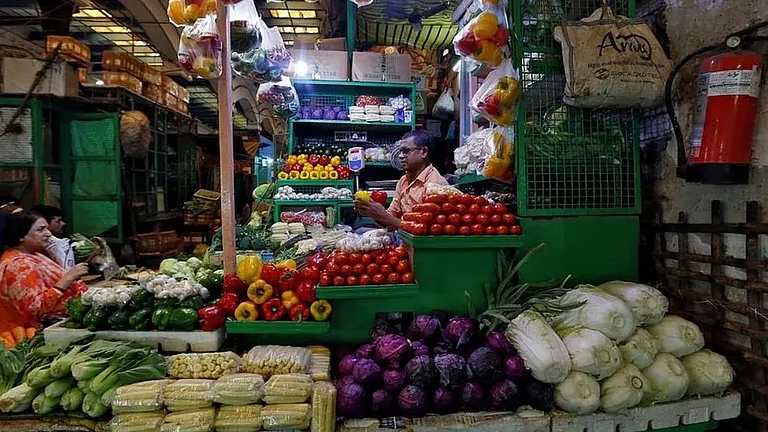
This means farmers received only around 37% of the retail price on May 14.








