Govt absorbed West Asia energy shock at the fiscal level, shielding retail consumers from price impact, says Hardeep Singh Puri
He noted that global disruptions pushed up freight, insurance and caused delays, forcing tough choices for countries
Despite 60 days of disruption, India remains resilient, Puri said at Vibrant Gujarat South Gujarat meet
The government has "shielded" retail consumers from the energy crisis triggered by the West Asia conflict by absorbing "the shock at the fiscal system level rather than passing it immediately on to the consumer’s wallet," Petroleum and Natural Gas Minister Hardeep Singh Puri said on Friday in Surat.
"Freight costs rise, insurance costs rise, cargoes are delayed, and every important country is forced to make hard choices. Yet, 60 days into the disruption, India is standing strong," Puri said while speaking at the Vibrant Gujarat regional conference for South Gujarat.

1 September 2026
Get the latest issue of Outlook Business

He detailed the government’s response to the crisis in the Gulf region, which has led to the halting of trade through the strategically crucial Strait of Hormuz. The narrow passage is a key global energy trade route and has been blocked by Iran since early March in retaliation for US and Israel’s bombing of its cities.

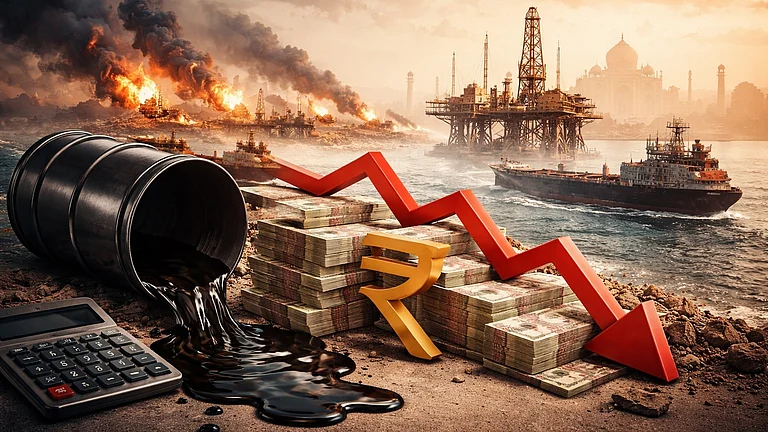
Before the conflict began, India imported roughly 40% of its crude oil from West Asian nations, while a majority of its natural gas also came from the region.
“During the last 60 days, I have been actively monitoring, on a daily basis along with my colleagues in the central and state governments, the supply situation for crude, LNG, LPG, petrol, diesel and aviation fuel… Let me be plain: when a global supply chain faces disruption of 20–30% on important routes and products, no country can be insulated from the shock,” the minister said.
Advertisement
“Yet, 60 days into the disruption, India is standing strong… We have not revised retail petrol and diesel prices. We have not allowed panic to become policy. In many other markets, citizens have seen queues, emergency revisions, rationing concerns, curtailed retail hours and odd-even working hours,” he added.
He also compared the situation with neighbouring countries like Pakistan, Nepal, Maldives, without naming them.
“One country towards our west…announced a petrol emergency revision on April 2. Petrol prices went up by 42.7% and diesel prices by 54.9%. In another country in India’s immediate neighbourhood, petrol prices rose by 39.5% and diesel by 66.9%. Another country to the south, one of our smaller island neighbours, saw petrol prices rise by 35.8% and diesel by 35.9%,” Puri said, adding that even global economies such as the United States, United Kingdom, Germany and the European Union have seen fuel prices surge.
Advertisement
The minister, however, acknowledged the challenges faced by commercial LPG users, where supply has been curtailed. The government’s gas allocation framework, issued under the Essential Commodities Act via the Natural Gas (Supply Regulation) Order, 2026 in March, prioritised domestic LPG needs while curtailing supply for commercial users.
At the top of the priority list, sectors such as household PNG, CNG transport and LPG production are assured 100% of their historical consumption. This is followed by the fertiliser sector, which receives around 70% allocation, while other industries are placed lower in priority with reduced supplies. At the bottom, commercial and non-essential users—including petrochemicals, power and industrial consumers—faced the sharpest curbs, with supplies cut or diverted altogether.
“The sequence was unavoidable,” the ministry said, adding that “this is what kept the flame on in 33 crore Indian homes,” while still providing industry with a transparent channel to raise genuine requirements.
For commercial and industrial users, a three-member committee of executive directors from Indian Oil, Bharat Petroleum and Hindustan Petroleum was constituted to review allocations to restaurants, hotels, industrial canteens and other users.
“State civil supplies departments and industry associations dealt with this committee directly. Today, commercial LPG is at about 70% of pre-crisis levels, with priority given to steel, automobiles, textiles, dyeing, chemicals and plastics—precisely the labour-intensive sectors that South Gujarat depends on. Morbi, which had access to LPG and propane as fuels, faced challenges, but the industry is now back in full steam,” he said.
Puri’s remarks coincide with reports that the Centre has increased the price of 19 kg commercial LPG cylinders by ₹993 across the country. Indian Oil Corporation said retail prices of petrol, diesel and 14.2 kg domestic LPG cylinders remain unchanged, while aviation turbine fuel (ATF) for domestic airlines has also been kept steady.
However, prices of bulk and commercial LPG (less than 1% of consumption), bulk diesel and ATF for international airline operations have been raised, while roughly 4% of products have seen price cuts. The company said this reflects a calibrated approach under the guidance of the Ministry of Petroleum and Natural Gas to balance global market trends with domestic economic stability.