


Silver crashes 53% from January’s record high as dollar strength and rising yields pressure bullion
Middle East tensions fuel inflation fears, strengthening expectations of tighter US monetary policy
Analysts flag $50 as critical support, with recovery hinging on crude prices and Fed signals
Silver prices are facing a crucial test after surrendering more than half their value from January’s record high, with a combination of inflation concerns, a stronger US dollar and expectations of tighter monetary policy weighing on the precious metal. The correction has also exposed silver’s vulnerability to changing investor sentiment, as its industrial demand and relatively higher price volatility make it more sensitive to shifts in economic expectations than gold.
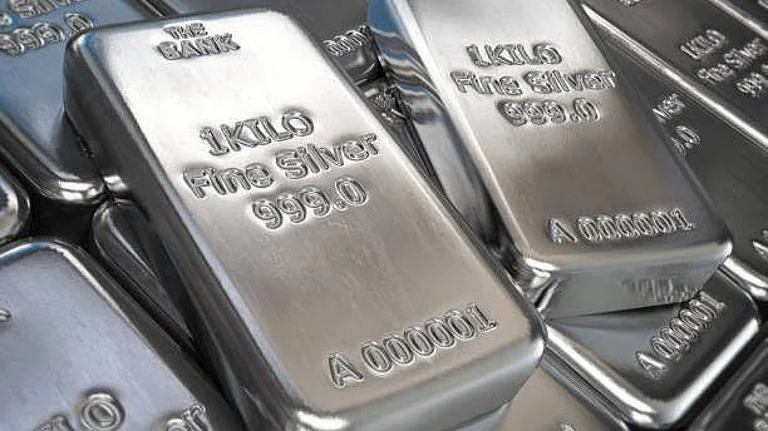
International spot silver touched a record high of nearly $117 per ounce on January 28, 2026. By October 27, it had fallen more than 53% to trade just above $53 per ounce. The decline has been similarly sharp in India, where silver prices on the Multi Commodity Exchange (MCX) have retreated significantly from their January peak.

1 October 2026
Get the latest issue of Outlook Business

Domestic spot silver on the MCX climbed to ₹3,79,983 per kilogram on January 29 before falling to ₹1,94,170 on October 23. The metal had previously touched a low of ₹2,04,383 on March 23. In the futures market, December 4 delivery silver was trading at ₹1,95,500 per kilogram on October 26 at 9:48 am IST.



Advertisement
The scale of the correction raises a key question: why is silver falling so sharply despite persistent geopolitical tensions in the Middle East, which would ordinarily support demand for safe-haven assets?
The answer lies in how these tensions are affecting energy prices, inflation expectations and interest-rate forecasts. Rather than supporting bullion, the resulting concerns about monetary tightening have strengthened some of the forces working against silver.
Why Is Silver Falling?
The correction is being driven by a combination of macroeconomic pressures and investor positioning. Expectations that the US Federal Reserve will maintain a restrictive monetary stance have supported the dollar and pushed bond yields higher, reducing the relative appeal of precious metals that do not generate interest income.
Advertisement
Renisha Chainani, Chief Research Officer at Augmont, identified a firmer dollar, elevated US Treasury yields and a more hawkish Federal Reserve outlook as the key factors behind silver’s weakness. She also pointed to the metal’s greater volatility compared with gold, which has made leveraged long positions more vulnerable to rapid liquidation.
Silver is trading at around $53 per ounce, while the US dollar index has risen about 4% this year, according to Chainani. US 10-year Treasury yields are also hovering near 5%, increasing the opportunity cost of holding non-yielding assets.
Daniel Munday, Principal Analyst at VT Markets, said the pressures were interconnected rather than independent. Middle East tensions have pushed up crude oil prices, elevated energy costs have sustained inflation concerns, and those concerns have strengthened expectations that the Federal Reserve may keep interest rates higher for longer or tighten policy further.
Higher interest rates can weigh on silver through two channels. They increase the appeal of interest-bearing investments relative to bullion, while a stronger dollar makes dollar-denominated commodities more expensive for buyers using other currencies.
Silver’s market structure adds to the pressure. Unlike gold, which is primarily treated as a monetary and defensive asset, silver has substantial industrial applications. This exposes it to both changes in investment sentiment and expectations for economic growth.
Vikas Prakash Singh, Professor of Economics at Great Lakes Institute of Management, Gurgaon, said silver’s industrial demand makes it more price-sensitive than gold. He also pointed to the impact of higher margin requirements at COMEX and MCX in February and March, alongside a stronger dollar and weaker global growth expectations.
“The increase in margin money requirement at COMEX and MCX in February and March had already dampened the sentiments and now the strengthening dollar, weaker global GDP growth and easing of crude oil prices has collectively caused the silver to drop sharply,” Singh said.
Why Oil And Fed Policy Matter
Geopolitical uncertainty generally supports precious metals because investors seek assets perceived as stores of value during periods of instability. The current episode, however, has produced a different outcome because the tensions have also heightened concerns about oil supply and inflation.
Chainani said attacks on Saudi energy sites by the Houthis, along with reports of possible new strikes on Iran, pushed Brent crude close to $116 per barrel before it eased to around $110. Higher energy costs can feed into transport, manufacturing and other operating expenses, keeping inflation elevated.
That complicates the outlook for monetary policy. If inflation remains persistent, the Federal Reserve may have less room to reduce interest rates, and markets may instead price in the possibility of further tightening.
Chainani said markets were assigning around a 72% probability to another US rate hike in December, based on CME FedWatch at the time of her assessment. Munday also placed the probability in the 70-80% range.
Each increase in expected interest rates can lift Treasury yields and support the dollar, putting additional pressure on silver. In this environment, the negative impact of tighter monetary policy can outweigh the support bullion might otherwise receive from geopolitical uncertainty.
Singh described the result as a double setback for silver: the metal has lost part of its safe-haven premium while concerns about weaker global growth have also weighed on industrial demand.
The distinction matters because silver's price is influenced by both investment demand and its use in manufacturing. If geopolitical tensions push energy prices higher but simultaneously weaken expectations for economic activity and delay monetary easing, the metal can come under pressure from both sides.
Why Has Silver Fallen More Than Gold?
Silver's sharper correction reflects its dual role as an investment asset and an industrial commodity. Gold tends to benefit more directly from defensive demand during periods of uncertainty, while silver is more exposed to changes in manufacturing activity, economic growth and speculative positioning.
Chainani said the gold-silver ratio had returned to around 75, indicating that investors were showing a stronger preference for gold's defensive characteristics relative to silver's more speculative appeal.
Silver is used in solar panels, electric vehicles and electronics, making industrial demand an important part of its longer-term investment case. However, this also means that concerns about slowing growth can weigh on the metal even when geopolitical risks remain elevated.
The recent sell-off in technology stocks has added another source of pressure, according to Munday. As investors reduce exposure to riskier assets or unwind leveraged positions, silver can experience sharper price swings than gold because its market is smaller and more sensitive to changes in positioning.
The correction does not necessarily mean that silver's industrial demand story has disappeared. Chainani pointed to continued demand from solar, electric vehicles and electronics, while noting that copper prices had risen around 15% this year. But these longer-term factors have so far failed to offset the immediate impact of the dollar, bond yields and expectations for US monetary policy.
Can Silver Recover, Or Is $50 The Next Key Level?
In the near term, analysts remain cautious, although oversold conditions could leave room for a rebound if selling pressure eases.
Chainani said silver was trading near 11-month lows, with resistance levels around $56.60-$58 per ounce and a further hurdle near $61.75. If the price breaks below $52.60, the psychological $50 level could come into focus. She estimated that such a move could correspond to around ₹1,80,000-₹1,85,000 per kilogram on the MCX.
Munday also identified $50 as a critical level, describing it as the point from which the broader rally began last November. A hold at that level could allow prices to recover, while a daily close below it could expose silver to further downside.
For a sustained recovery, both analysts said the outlook for energy prices and US monetary policy would be crucial. A cooling in crude oil prices or a less hawkish Federal Reserve could ease pressure on yields and the dollar, allowing silver to regain some ground.
Chainani said a recovery towards $60-$65 per ounce over the next two to three months was possible if oil prices eased or the Federal Reserve signalled a pause. Munday, however, cautioned that rallies could face resistance around $60-$64 while the current downward trend persists.
The longer-term outlook will also depend on industrial demand and the broader economic environment. Silver's use in solar power, electric vehicles and electronics continues to underpin its industrial relevance, but those fundamentals may take time to outweigh near-term macroeconomic pressures.
For investors, the key distinction is between a short-term technical rebound and a durable recovery. Oversold conditions can trigger sharp rallies, but a sustained improvement is likely to require easing inflation concerns, a softer dollar and clearer signals that US monetary policy is no longer moving towards tighter conditions.
Until those factors turn more supportive, silver could remain vulnerable to further volatility, with the $50 per ounce mark emerging as an important test for the market.