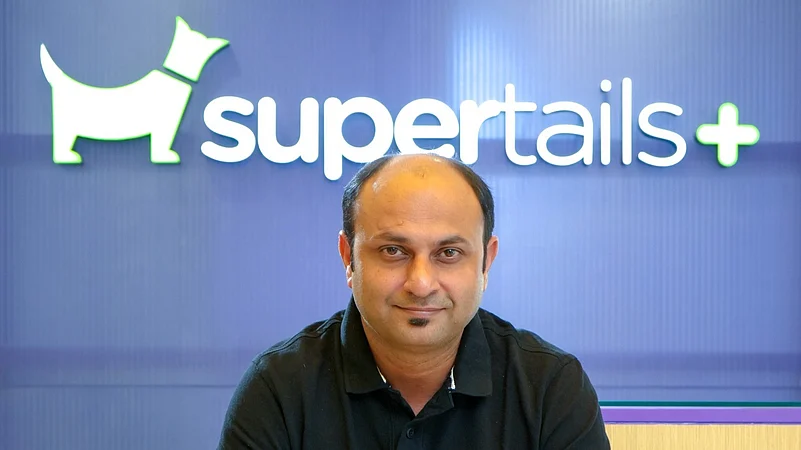

Supertails is evolving from a pet supplies platform into a full-stack, healthcare-led pet care ecosystem spanning products, services and clinics.
Growth is driven by deeper trust and higher lifetime value, with healthcare and services becoming key contributors.
The company is focused on disciplined, long-term scaling to build a sustainable, IPO-ready business.
Supertails is positioning itself as a full-stack, healthcare-led pet care platform, expanding well beyond its origins as a pet supplies marketplace. The company now operates across medicines, at-home veterinary services, fresh meals, quick delivery and offline clinics, aiming to serve every pet parent need within a single ecosystem.
Healthcare already contributes a significant share of the business, while newer service-led offerings are expected to drive the next phase of expansion by deepening trust and increasing customer lifetime value.

1 September 2026
Get the latest issue of Outlook Business

The broader opportunity, co-founder Vineet Khanna tells Outlook Business, is being fuelled by rising pet adoption, greater awareness around pet wellness and a shift from ownership to “pet parenting,” which is increasing emotional and financial commitment to care. Rather than chasing rapid, discount-led scale, Supertails is focused on operational depth, quality healthcare infrastructure and disciplined growth. Its long-term goal is to build a sustainable, profitable company that can stand independently and eventually go public.
Edited Excerpts:
Let’s start with the bigger picture. How do you see the pet care industry evolving in India?
It wouldn’t be wrong to call this one of the most exciting sectors in the country right now. The category is undergoing a structural shift, from pet ownership to true pet parenting.
Three major factors are driving this growth. First, adoption. India continues to see double-digit growth in pet adoption year after year, and that momentum is only accelerating. Given the lifecycle of pets, this results in a steady net addition of new pets annually.
Second is information. Historically, pet care has been an information-starved category. As awareness improves, pet parents are expanding their spending into healthcare, preventive care, nutrition and overall wellness.
Third is involvement. The mindset has evolved from ownership to parenting.
That naturally increases emotional investment and makes spending far less discretionary.
When numbers, knowledge and involvement grow together, the category reaches an inflection point and that’s exactly what we’re witnessing today.
We started building Supertails about five years ago largely on conviction. Today, the data is validating that belief.
Advertisement
With legacy players like Nestlé and Reliance entering the segment, do you see Supertails eventually being acquired or remaining independent?
These developments actually validate the opportunity. When large, established players enter the space, it signals that the category is maturing.
Our aim is to build a company which is worth going public on its own. That said, if there are strategic synergies that strengthen the ecosystem, we’ll always evaluate them.
But the goal is to build a single, independent pet care platform.
Every company wants to go public quickly, but first you need to earn the right to demonstrate growth at scale, profitable growth and a long runway ahead.
We’re building category by category and integrating everything into one ecosystem, which takes patience. We haven’t set a fixed timeline yet, but ideally within the next four to five years.
Advertisement
You reported around ₹67 crore earlier and are targeting ₹500 crore Annualised Recurring Revenue (ARR) by 2026. How is revenue shaping up now?
At the moment, we’re operating at a run rate of about ₹250 crore ARR, with consistent month-on-month and year-on-year growth.
We’ve built the business one pet parent needs at a time. What began in 2021 as a pet food platform has now evolved into a healthcare-led, full-stack pet care ecosystem.
Today, we cover the entire journey, from supplies and medicines to quick doorstep delivery, at-home services and offline clinics. Whether it’s through your phone, at home, or inside a clinic, every pet need can be addressed within the Supertails ecosystem.
As we continue adding services, trust deepens, customer lifetime value rises and growth compounds naturally.
Over the next two to three years, we expect to add another digit to our revenue and scale into a ₹1,500–₹2,000 crore company.

What new products or categories are you introducing to differentiate the ecosystem?
Every few quarters, we expand by addressing new pet parent needs.
About six months ago, we launched at-home veterinary services. More recently, we introduced fresh, home-style pet meals delivered within 30 minutes, designed especially for younger pet parents who want healthier alternatives to packaged food but don’t have the time to cook.
We’ve also moved into lifestyle categories for pet parents apparel, jewellery, plants, and even twinning outfits where pets and parents can match.
This isn’t just about adding more products; it’s about building a complete lifestyle ecosystem. The most successful platforms grow by solving more needs for the same customer, rather than constantly chasing new ones.
Are these products customised?
No product customization yet. We focus on customer customisation.
Because we know the pet, not just the buyer. We personalise recommendations. We track pet names, birthdays, vaccination schedules and life stages. That allows us to communicate meaningfully.
For instance, if a cat is eight to twelve months old and due for neutering, and we have a clinic nearby, we can send a timely, relevant reminder rather than generic discounts.
What share do private labels and services contribute today?
Private labels currently contribute about 6–8% of our revenue. Services are a more recent addition and account for close to 5% at this stage, having been introduced only in the last three quarters.
Healthcare, however, including medicines, which we’ve been building for over two and a half years, already contributes nearly one-fourth of our overall business.
In terms of growth, services are a particularly exciting opportunity for us. Because we launched them at a different stage in our journey, our current mix doesn’t yet reflect the broader category. Typically, healthcare and services together make up 30–35% of the market, with supplies accounting for the remaining two-thirds.
Over time, we expect our business mix to move closer to that structure as these segments scale.

Who do you see as competitors?
In terms of a truly integrated ecosystem, there isn’t one.
Several players do parts of the journey well. But we deliver the entire stack, products in 30 minutes, clinics within four kilometres, and at-home services just as fast.
That’s what we mean by a true ecosystem.
Globally, Chewy in the US is a good benchmark. We’re building the Chewy for India, healthcare-led, deeply integrated and trust-driven.
You currently operate clinics in Bengaluru. What’s the expansion plan?
We have four clinics now, and that number will double shortly. Bengaluru is our playbook city.
We already offer 30-minute deliveries and at-home services across the city. Once the model is perfected, we’ll replicate it in Mumbai and NCR. Quick delivery has already started in parts of Mumbai.
In the next 24 to 36 months, we plan to scale to 70–100 clinics across the top six cities.
This is a high-emotion, high-involvement category. Rapid expansion without quality doesn’t work. Healthcare requires patience, learning and operational depth, not just capital.
How will the recent $30 million funding be deployed?
This marks our transition from an experimental, venture-stage business to a growth-stage company.
Capital will be deployed across three priorities: Increasing access and convenience through faster deliveries, building high-quality healthcare infrastructure by scaling clinics, and strengthening data and technology capabilities for deeper personalisation.
The focus is long-term category building, not short-term wins.

You mentioned scaling the clinic network to 70-100. What does the physical expansion look like from here?
We’re also becoming a deeply data-led care ecosystem. Technology will play a critical role in delivering long-term, continuous care. We’re investing heavily in personalisation, customer journeys and detailed pet profiles.
The idea is simple that a pet parent should have every piece of information about their pet in one place: medical history, vaccinations, consultations, treatments. When that history is fragmented or lost, care quality drops. Centralising it helps us deliver better outcomes.
From an infrastructure standpoint, are you opening stores or only clinics?
It’s a clinic-first model.
Our centres range from about 2,000–2,500 sq ft to 3,500 sq ft multi-speciality hospitals. Each location typically has three parts.
The front of the clinic handles retail, grooming and vaccinations. Lower-order, high-frequency interactions that serve as entry points.
The middle covers consultations, OPDs and minor procedures.
The back handles surgeries and more complex, specialised care.
So it’s not just a clinic, nor just retail. It’s an integrated centre, but healthcare is always the lead hook. Products we can deliver in 30 minutes anyway. The offline presence is about trust and comprehensive care.
With expansion, hiring must also be critical, especially veterinarians. What do you think about talent?
We’ve invested early in building our veterinary ecosystem. Even before scaling clinics, we already had vets working across online consultations and home services.
Today, we have more than 100 veterinarians working with us across clinics, at-home care and tele-consults.
Demand for vets is rising while supply is tight, so our focus is on quality, not just numbers. We emphasise hiring the best talent and continuously upskilling them.
There’s also a clear growth path. A vet can start with tele-consultations, move to at-home services, and eventually transition into complex clinical procedures and surgeries. That progression makes Supertails a long-term career platform, not just a workplace.
What’s the current split between online and offline revenue?
Since clinics and at-home services are relatively new, offline contributes less than 5% today.
But over time, that will mirror the category. Healthcare and services typically account for 30–35% of the pet care market, and much of that is delivered offline. As we scale infrastructure, our mix will gradually reflect that.
Offline will also strengthen trust, which in turn accelerates growth across online and other segments.
What does your advertising strategy look like?
We’re digital-first and largely target younger, Gen Z pet parents. They’re more curious, more informed and more engaged.
Our communication positions us as a partner in pet parenting, not just a transactional seller. We fulfil both practical needs and emotional, informational support.
As the business has evolved offline, our marketing has too. You’ll now see us on bus shelters or auto backs in Bengaluru, for example. As we become omni-channel operationally, our marketing also becomes omni-channel.
You’ve been doubling revenue year on year. How do you see growth ahead?
Given the number of categories, service and geography expansions still ahead, we don’t see a reason to slow down. We would not aim for anything lesser than doubling ourselves year on year or at least a couple of more years.
As scale increases, trust improves and marketing efficiency improves, which further accelerates growth.
At the same time, losses will narrow. There’s no point building a business that isn’t self-sustaining. Culturally, we aim to be one of the fastest ecosystems to turn profitable.