
Centre increasing capital expenditure by not allowing any bloating or sudden expansion on the revenue expenditure side
States’ 41% share of divisible tax remains, but the pool is set to nearly double to ₹90 lakh crore, benefiting all
Urban Challenge Fund, Employment Linked Incentives, and RDI Fund are expected to take off
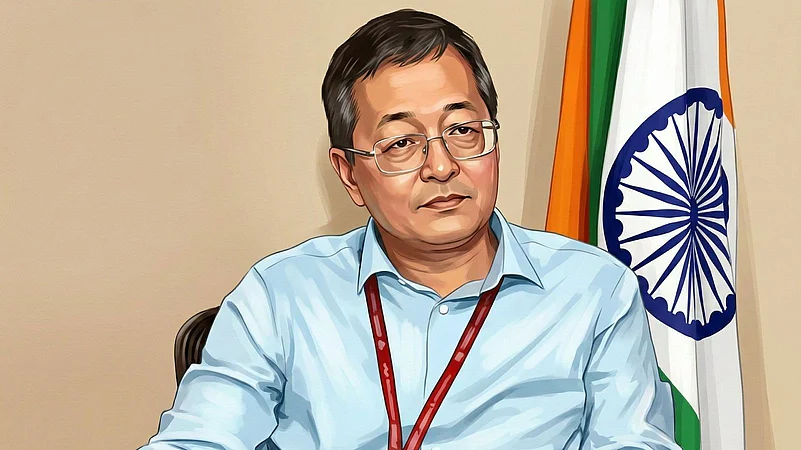
The divisible tax pool is projected to reach around ₹90 lakh crore during the 16th Finance Commission period, up from ₹55 lakh crore during the 15th Commission, which will serve the states well even with a 41% vertical share, says Vumlunmang Vualnam, Secretary of Expenditure, Ministry of Finance.
Over 22 states had requested the 16th Finance Commission to raise their share of the divisible tax pool from 41% to 50%, Commission Chairman Arvind Panagariya had said last year. The Commission, however, has kept the share unchanged.

1 September 2026
Get the latest issue of Outlook Business

Some economists have sided with the states, arguing that they bear two-thirds of the country’s expenditure commitments, making their demand justified. “We can keep debating,” says Vualnam in a post-Budget interview with Outlook Business, referring to the Centre’s big-ticket spending priorities like defence, and noting that a growing divisible pool will ultimately benefit everyone.
In this interview, Vualnam, responsible for the Centre’s allocations across sectors, also discusses the rise in overall capital and defence expenditure announced in the 2026 Budget, the future of centrally sponsored schemes, and why some previously announced schemes have yet to take off. Edited excerpts:
Advertisement
You are targeting higher capital expenditure and lower debt simultaneously. Could slower revenue growth and reliance on central bank dividends be a problem?
The pressure or the constraints in budget-making are always there. It is never that there is lots of free money available somewhere. But within that, for example, on the revenue expenditure side, we are taking care that there is no bloating or sudden expansion. So that provides us a good framework within which we are able to give priority to the CapEx side.
The economic growth projections also have been made in a very realistic manner. With all those, after calculating the details, we have found that we are able to support that kind of CapEx and remain fully committed to the debt-to-GDP ratio glide path that the honourable finance minister has announced. We are able to match everything together.
Advertisement
Salaries and pensions take up a significant share of the defence budget, even as current realities demand greater investment in technology. Do you think a stronger push is needed on the capital expenditure front?
If you get into the details of defence CapEx, in the current financial year 2025–26 it was ₹1.8 lakh crore. That specific defence CapEx has been increased to ₹2.19 lakh crore in FY 2026–27. So in that way, while salaries or some other components that you mentioned may have increased, on defence CapEx specifically and clearly we have increased the allocation by about 20–21%.
The Pradhan Mantri Garib Kalyan Anna Yojana or PMGKAY has helped reduce poverty, but there are concerns it is now benefiting people who may not require such support. In the interest of better resource efficiency, is the government considering a review or evaluation of the scheme?
I agree with you to the point that over the last decade or so, we have managed to reduce the poverty percentage to quite an extent, and that is something that we are all very happy about.
Within that, which of the centrally sponsored schemes should continue and which need to be discontinued? We are going through an evaluation process of all the schemes through third-party agencies, independent in nature. The reports have reached the concerned ministries. They are examining them and, based on the recommendations and the assessment of the ministries, along with their other inputs; we will then be taking up an appraisal exercise.
For that, they will come to the Department of Expenditure. At that time, we will see how to streamline the centrally sponsored schemes.
Could PMGKAY also be part of this streamlining exercise?
It could be one of them. We will have a look when the ministry brings it.
About 22 states have demanded raising their share in divisible tax revenue to 50% from 41%, with many economists backing them, citing higher expenditure burdens. How do you respond?
First of all, if you go back 10 years, it was only 32%. Then it jumped to 41%, and the central government accepted whatever recommendations were there. So from 32%, we have jumped quite a bit.
How much exactly are the expenditure responsibilities of the state government and the central government—we can keep debating. We just spoke about defence and all, which are very big-ticket items. One defence system or platform will cost a lot. So let us not get into that.
But the Finance Commission, after looking at all the details, has reached this conclusion and we are accepting it. Within that, what we must recognise is that while the Commission has stuck to 41%, the divisible pool is growing. In fact, the size of the pie is increasing. During the 15th Finance Commission period, the divisible pool was somewhere around ₹55 lakh crore. It is our estimate that during the period of the 16th Finance Commission, it will reach almost double—maybe ₹90–91 lakh crore.
So everyone is going to benefit. Just as the central government is keeping a firm check on its revenue expenditure, the states are also doing so. I am confident that the recommendations, once implemented, will serve the states very well.
Why has there been no progress on the Urban Challenge Fund announced in last year’s Budget?
It is because it is a very innovative approach that is being looked at and is quite ambitious as well. So the scheme design has taken some time, but I understand that the concerned ministry has now made quite good progress. In a very short time, it should be reaching final approval and implementation will start.
When the Employment Linked Incentive or ELI schemes were announced, there were arguments that firms hire based on demand and incentives may have limited impact. These schemes have also not taken off.
Hirings by an industry or company will definitely be based on their needs. But the idea is that the government works with the private sector and with industry so that, wherever there is a requirement—and perhaps even a little more—something can be worked out.
I think they are having a lot of meetings to resolve the issues, and I think it will come up very nicely.
Is the issue that the incentives are not sufficient?
Not in that way. It is more about coordination with the private sector or the industry.
How is the Research, Development and Innovation (RDI) Fund progressing?
That scheme has been approved and the guidelines have also been approved. Second-level fund managers will be identified. The Department of Science and Technology, through their Anusandhan Research Foundation, will do that.
They have issued out the EOI (Expression of Interest), and various AIFs (Alternative Investment Funds) and other such agencies will then get empanelled and selected. Funds at very concessional rates will be provided from that RDI fund to these AIFs and similar entities. They will then independently, and with autonomy, pick up research projects—startup-type projects, innovations and inventions.
So it has now started to move. And we will see good results. I am quite confident.