The energy transition cannot be achieved in silos. It requires an integrated, collaborative approach where both government and private sector work in synergy, said Jitendra Singh, Minister of State in the Department of Atomic Energy of India on Friday.
Speaking at Outlook Planet C3 event the minister said, “India must scale up not just its ambitions, but also the pace at which it executes them.”
“The transition to green energy will demand vast quantities of critical materials, permanent magnets, lithium, and other rare earth elements that are essential across sectors, from electric vehicles and electronics to space technologies, defence equipment, and renewable energy systems like wind power.”

1 September 2026
Get the latest issue of Outlook Business


He highlighted that despite this growing demand, India continues to depend on imports for over 80% of its permanent magnet requirements.
“This highlights a dual challenge, building indigenous capacity while simultaneously accelerating the pace of development. Time is a critical factor and we cannot afford to wait,” the minister said.
If the world is moving decisively towards a greener future, India must position itself as a credible and central driver of that transition, the minister said, underlining that this priority has shaped a series of government initiatives over the past two years.
Advertisement
At the core of this push is the Nuclear Energy Mission, which targets 100 GW of nuclear capacity by 2047. This is not merely an aspirational goal but a structured, time-bound roadmap, with interim milestones of 13 GW by 2030 and 22.5 GW by 2032, reflecting a scientific and phased approach to scaling up, he said.
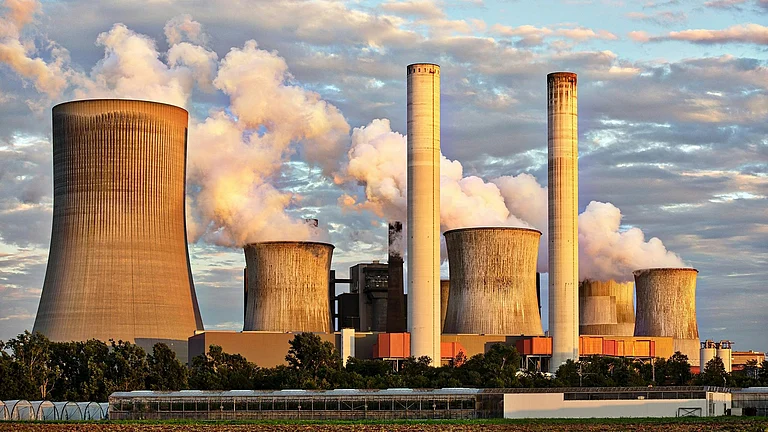


He further highlighted that the latest budget has introduced enabling measures such as duty-free exports of nuclear components until 2035, while also opening nuclear medicine research to private players, steps that signal a clear intent to incentivise and expand the role of the non-government sector.