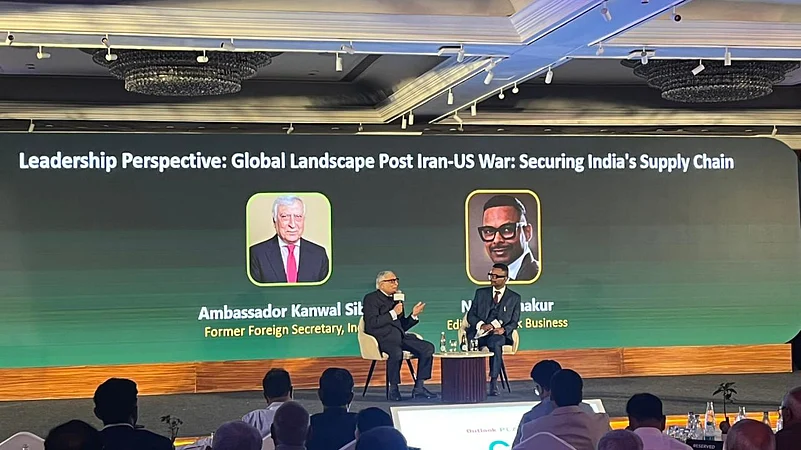

Ambassador Kanwal Sibal highlights how digital narratives on social media now shape modern warfare
The West Asia conflict threatens India's energy security and 10 million overseas citizens
Sibal defends India’s strategic autonomy, prioritizing pragmatic relationships
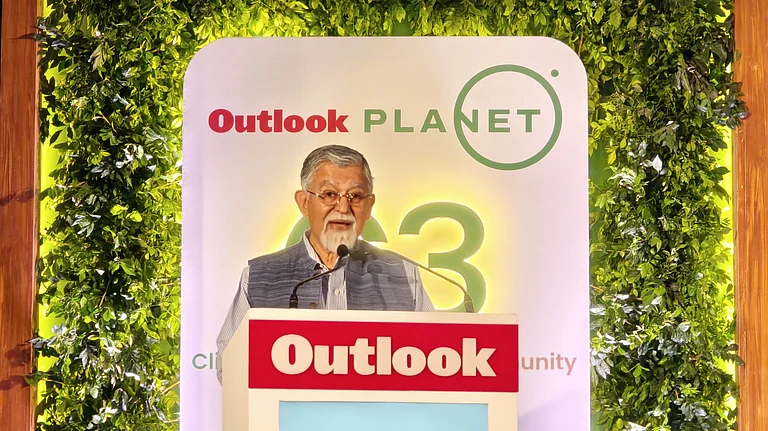
As geopolitics evolves, warfare is no longer confined to the battlefield, it now extends to the digital sphere, where narratives on social media can shape outcomes, said Ambassador Kanwal Sibal, Former Foreign Secretary of India at a C3 event organised by Outlook Business on Friday.
“Earlier, governments communicated through controlled channels briefings and calibrated leaks to credible media like The New York Times or The Washington Post. Now, leaders speak directly and frequently, often contradicting themselves,” said Sibal

1 September 2026
Get the latest issue of Outlook Business

The former Foreign Secretary also said that this creates pressure on all governments to remain constantly visible online, even if the communication adds little substance.



Ambassador Kanwal Sibal, who has served as India’s envoy to several countries, said the ongoing US–Israel–Iran tensions reflect enduring geopolitical patterns rather than a fundamental shift.

He argued that the region’s instability has long been shaped by the role of the United States, pointing to episodes such as the Iraq war, the Kuwait crisis, the Iran–Iraq war, NATO interventions, and conflicts in Afghanistan, Libya, and Syria.
Advertisement
“I don’t think things have changed as much as one might assume,” Sibal noted.
He also mentioned that the current situation involving Iran is far more significant as a country Iran is not like Iraq or Libya, it is a major country with nearly 100 million people and despite decades of sanctions, it has developed substantial indigenous capabilities, including military strength.
Amid these geopolitical developments, Ambassador Kanwal Sibal underscored that India’s stakes in West Asia remain exceptionally high.
He noted that two of India’s closest partners, the United States and Israel are central to the current situation, while nearly 10 million Indians live and work in the region. India also depends heavily on West Asia for its energy needs and receives substantial remittances from there, making stability in the region a critical national interest.
Advertisement
Responding to a question from Neeraj Thakur, Editor of Outlook Business, on whether India is shifting towards alignment with countries such as the United States and Israel, Sibal addressed concerns over New Delhi’s evolving strategic posture.
“A sensible government must act pragmatically, not ideologically. India pursues value-based relationships, not values-based alignments. That means engaging with all countries where there is mutual benefit. Critics say India is ‘sitting on the fence’, but that’s incorrect. Strategic autonomy is a strength,”highlighted Sibal.