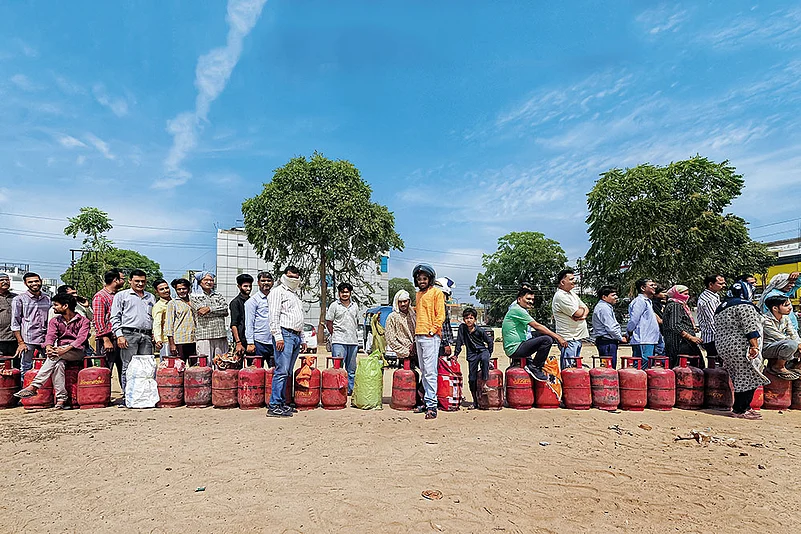
On March 6, Kawaljeet Singh opened a new outlet of his popular ‘Khadak Singh Da Dhaba’ in Bengaluru. Only six days later, he had to shut down the outlet due to shortage of liquefied petroleum gas (LPG) cylinders. “We have to remain closed temporarily. My heart is broken but the spirits are alive,” Singh said in a post on X.
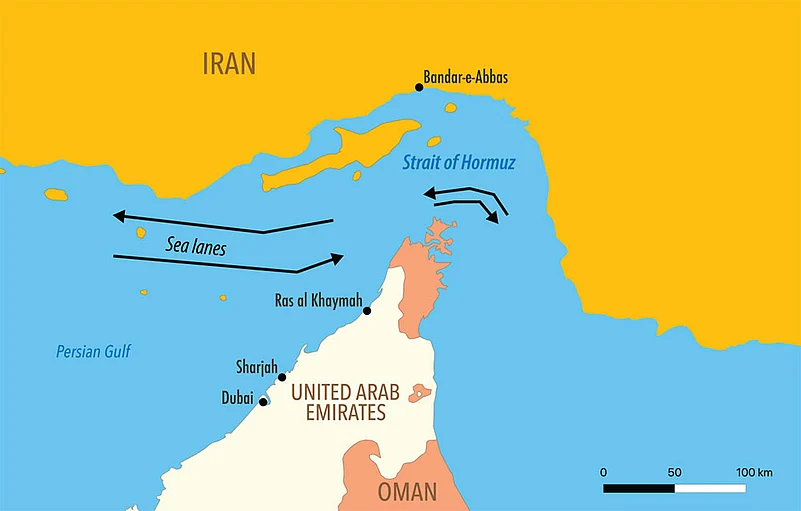
Several restaurants across India have shut down their outlets due to a shortage of commercial LPG, while many others have slashed their menus. This disruption is the direct result of the closure of the Strait of Hormuz, a critical energy shipping route, following the US-Israeli attack on Iran on February 28.
India relies heavily on this key shipping route as nearly 60% of the country’s LPG consumption is met through imports and 90% of these shipments pass through this narrow strait. Similarly, around 40–50% of India’s crude oil imports also transit through this vital shipping lane.

1 September 2026
Get the latest issue of Outlook Business

This reliance puts India at risk. The potential impact of crude price volatility could be significant. Brent Crude was trading at around $109.11 per barrel on March 18.
Goldman Sachs, a global investment bank, has warned that global oil prices could cross $100 per barrel within days and rise to $150 by this month end if disruptions continue.
In a severe stress scenario, where oil prices surge to $150 per barrel, inflation in country could rise by about 1.2 percentage points and economic growth may slow by around 1 percentage point, according to Barclays India, a bank.
Though India does maintain a modest buffer of critical fuels, is it enough? Why did India not build adequate strategic reserves despite 90% of its imports moving through a single 33km choke point?
Strategic Reserves Gap
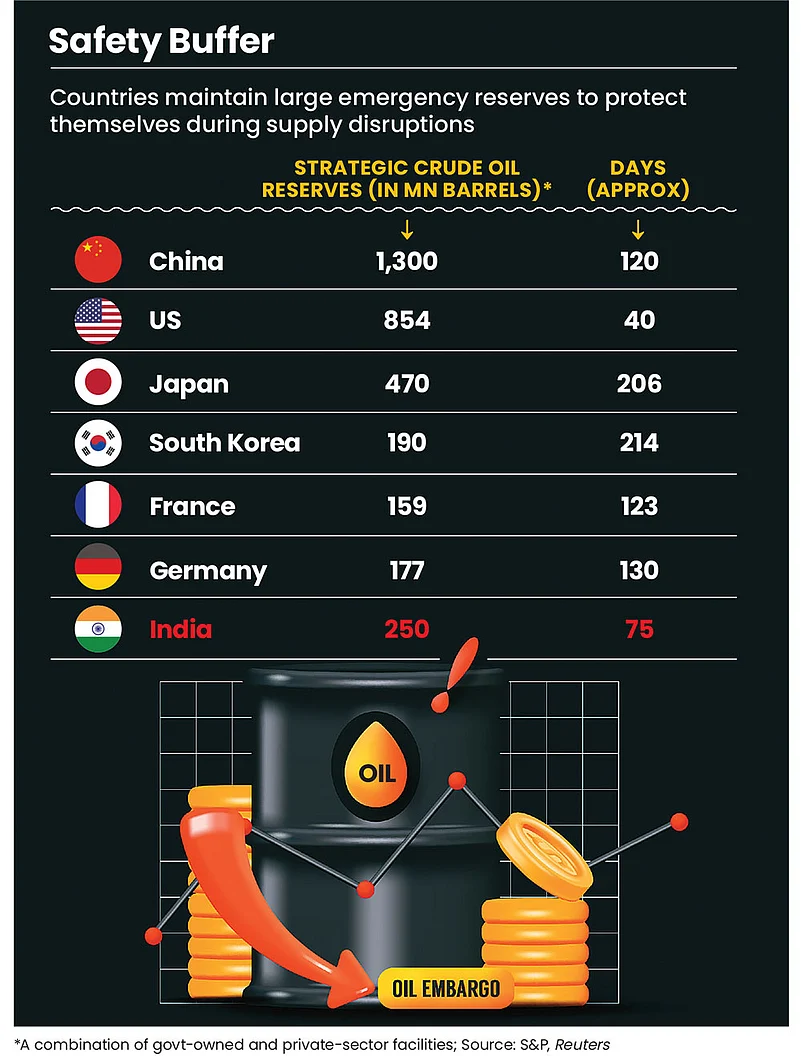
Globally, strategic petroleum reserves are maintained by governments to safe-guard against sudden supply disruptions caused by wars and geopolitical tensions. The US has one of the world’s largest government-owned reserves of around 415.4mn barrels, stored in underground salt caverns along the Gulf Coast. China’s stockpiles are at a massive 1.3bn barrels. Other major reserve holders include Japan, Germany, France and South Korea.
India effectively maintains two types of oil reserves. The first is the strategic petroleum reserve, which consists of underground storage facilities at various locations across the country. This buffer is relatively small, covering roughly 6–7 days of consumption, with a capacity of about 5.3mn tonnes across three locations—Visakhapatnam, Mangaluru and Padur.

The second is operational reserves: stocks held by refineries and oil companies with storage at refinery sites and floating storage at ports. Together, the two account for around 74 days of consumption. “Ideally, the benchmark should be about 90 days, but even with 74 days, the situation is considered reasonably secure for now,” petroleum minister Hardeep Singh Puri told Parliament recently.
However, India had filled up only 67%, or 3.61mn tonnes, of the total capacity of its three strategic caverns, according to a report by the Lok Sabha Standing Committee on petroleum and natural gas in 2024.
The committee also noted that the government had allocated ₹5,000cr in the Budget estimates 2023–24 for filling up crude oil reserves, but no expenditure was incurred. No amount was allocated for the financial year 2024–25. The Committee had in fact urged the government to maintain the optimum level of reserves.
But storing gas, whether liquefied natural gas (LNG) or LPG, is difficult. Obtained from crude oil during refining, LPG is critical to India as it is used by around 33cr households. Here, supplies can still be buffered to some extent. The situation is vastly different for natural gas. LNG has to be stored in specialised high-pressure or cryogenic facilities, making large-scale, long-term storage both technologically demanding and costly.
Moreover, discussions around energy security in India have largely centred on crude oil and fluctuations in oil prices, while gas has received comparatively less attention.
“Only recently have gas supply and gas prices begun to feature more prominently in policy debates. Yet natural gas plays a critical role across several sectors of the economy,” says Robinder Nath Sachdev, a foreign-affairs expert. “Beyond household consumption, it is essential for power generation, fertiliser production and various industrial processes, including steel manufacturing.”
In the case of nitrogen-based fertilisers, LNG accounts for nearly 70–80% of the cost component because it serves both as a key raw material and the primary energy source in fertiliser plants. Methane derived from LNG is used in the production process, while the heating and energy requirements of these facilities are also met through this critical fuel source.
Storage Issues
India’s efforts to build strategic reserves have progressed slowly due to land acquisition difficulties, bureaucratic complexities and cost constraints. The cost of building and maintaining large storage facilities is extremely high.
For instance, the proposed reserve facility in Chandikhol in Odisha was delayed by nearly seven years due to land acquisition issues.
Two years ago, Puri had underscored India’s proactive strategy to diversify its oil and energy sourcing. He highlighted that the supplier base has been broadened to include countries like Russia, the US and African and Latin American producers.
“Because of this diversification, there was an assumption that geopolitical risks affecting one region could be balanced by supplies from another,” says Vibhuti Garg, director, South Asia at the Institute for Energy Economics and Financial Analysis.
“The current situation has shown that disruptions can occur simultaneously across multiple supply sources,” she adds.
Though diversification has mitigated risks associated with overdependence on any single region or route, supply chain diversity cannot substitute for proper reserve planning. “India imports nearly 91% of the oil it consumes. With such a high level of dependence on external supplies, building larger reserves becomes a sensible and necessary step,” says Prashant Vashisht, senior vice-president and co-group head, corporate ratings, Icra, a rating agency.
In hindsight, India could have considered building larger storage capacity. Going forward, this situation may push India to rethink its strategy, not just relying on daily supply flows but also creating greater storage capacity.