




Merchants collecting UPI payments will soon be watched more closely to ensure they aren't quietly billing customers for a charge that is supposed to come out of their own pocket, according to a report by ANI. The Indian Banks' Association is developing a system specifically to catch and stop such practices.
At the centre of this is the Merchant Discount Rate, a processing fee applied to UPI merchant transactions above ₹2,000, which the government wants absorbed entirely by merchants rather than trickling down to buyers.
Talks Planned With Banks, Traders
The Finance Ministry is set to sit down with the IBA to iron out how the MDR rules will actually be enforced on the ground, and what safeguards can keep merchants from tacking the fee onto customer bills, the report said. The report added that separate conversations are also lined up with merchant groups, including the Confederation of All India Traders, to work through concerns from their end.

1 September 2026
Get the latest issue of Outlook Business

On the consumer side, the IBA intends to run an awareness campaign in multiple regional languages, spelling out how the MDR system works and reassuring users that no extra payment is required from them for UPI transactions. Meanwhile, the GST Council could soon weigh in on how this fee should be taxed.


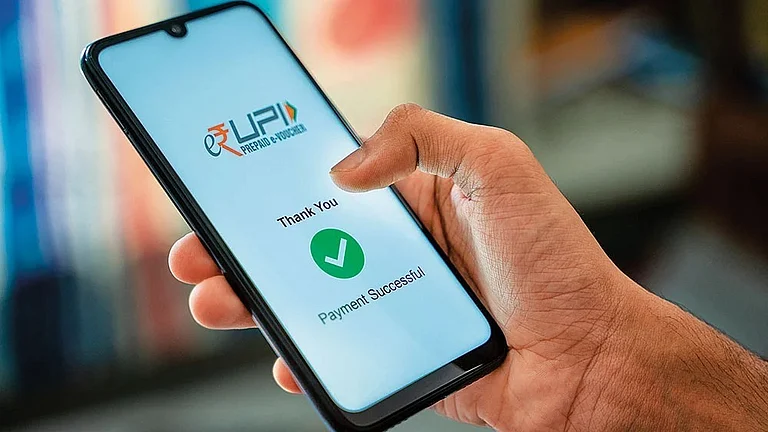
Who Actually Pays, And How Much?
The rules currently in place set a 0.4% MDR on specified merchant transactions crossing ₹2,000, with the charge topping out at ₹300 once the transaction hits ₹75,000 or beyond. Nothing changes for peer-to-peer UPI transfers, which stay free no matter the size, and merchant payments under ₹2,000 also draw no fee at all.
Advertisement
Smaller merchants are shielded too. Anyone collecting up to ₹1 lakh monthly through UPI QR codes is exempt from MDR entirely, and government figures cited in the report show that this exemption, combined with the ₹2,000 threshold, keeps roughly 96% of all UPI merchant transactions untouched by the charge. Sectors treated as essential, among them railways, telecom, insurance, fuel and agricultural inputs, get a further concession, paying a flat ₹5 on transactions above ₹2,000 instead of the standard rate.
Officials have been at pains to clarify that this fee is neither a tax nor something the government pockets, the report added. It is a processing cost, split between the banks, merchant acquirers and UPI app providers that keep the payment rails running, and the government does not take a cut.
Advertisement
The broader rationale, as the government has framed it, is to keep UPI financially viable over the long haul, funding the infrastructure, fraud prevention, cybersecurity and continued rollout of digital payments across the country.









