




Intensified FSSAI and FDA scrutiny is making small eateries and home-based food businesses worry about compliance costs and possible shutdowns
Experts say the bigger burden lies beyond licence fees, covering testing, hygiene, sanitation, documentation and other safety measures
While some fear businesses could move towards informal vending, experts say consistent enforcement and easier compliance could instead drive formalisation
Every day, Vijay (name changed on request) sends out 40-45 meals from his home-tiffin service in Delhi. Until recently, he thought of his business simply as a small operation run from home. He did not know that even a business of his size needed FSSAI registration.
But that changed as food safety authorities stepped up inspections and enforcement action across the country. Vijay is now looking at the possibility that something he did not even know was a requirement could put his livelihood under scrutiny.

1 September 2026
Get the latest issue of Outlook Business

He wants to register. But that, too, comes with its own uncertainty. Vijay has little idea about the process and does not have the money to hire a lawyer or consultant to help him navigate it.


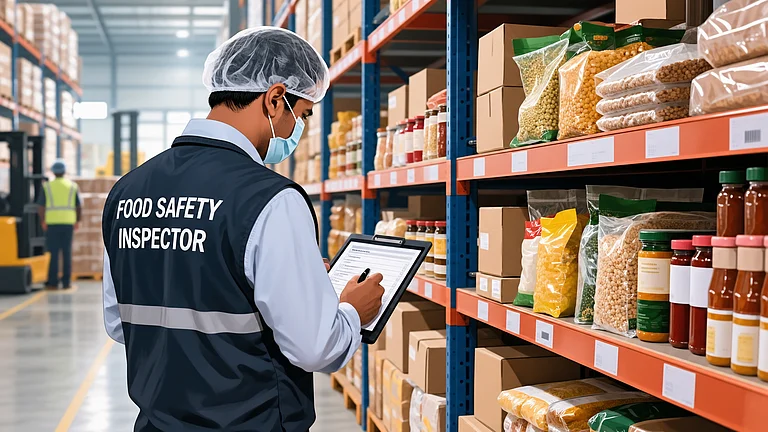

He is not alone. A small restaurant owner in Karnataka, who already holds an FSSAI licence, said the prospect of regulatory action remains a source of anxiety. The owner, who declined to be identified, told Outlook Business that the business is too small to absorb a shutdown.
Advertisement
For small food businesses, the tightening scrutiny is therefore creating a difficult balancing act. They have to meet food-safety requirements, but the cost and complexity of compliance can be difficult to absorb for businesses operating on thin margins.
The question is no longer just whether small eateries should comply with food-safety rules. It is whether a regulatory push meant to make India's food businesses safer could, if compliance becomes too costly or difficult, push some of the smallest operators towards shutting down or slipping into the informal economy.
Advertisement
Compliance Costs Go Beyond Licence Fees
The Food Safety and Standards Authority of India’s (FSSAI) revised framework, effective April 1, 2026, raised the registration threshold to ₹1.5 crore. Businesses above ₹1.5 crore and up to ₹50 crore require a State licence, while those above ₹50 crore require a Central licence.
For restaurants, the prescribed annual fees are ₹100 for registration, ₹5,000 for a State licence and ₹7,500 for a Central licence. FSSAI has also introduced perpetual validity, subject to compliance and applicable annual fees.
Lawyers and food-industry experts believe that an FSSAI registration is only one part of the burden.
Businesses also have to maintain hygiene, sanitation, safe water and food storage, waste disposal, testing and documentation. And the bigger burden can come from recurring expenditure needed to meet food-safety standards, said Fatema Kachwalla, Partner at JSA Advocates & Solicitors.
“The real burden on small businesses is often not the licence fee itself, but the cumulative cost of meeting multiple regulatory requirements,” Kachwalla told Outlook Business.
“For a small outlet operating on narrow margins, these recurring expenses can be significant,” she added.

Food Businesses Now Tightening Standards
The intensifying scrutiny by FSSAI and state food and drug administrations is also prompting food businesses to tighten their own safety and quality-control practices. For companies that are scaling production, this means higher spending on testing, plant upgrades, hygiene systems and internal quality checks as they seek to ensure that compliance keeps pace with growth.
Akash Agrawalla, Co-founder of ZOFF Foods, said the company’s spending on food-safety compliance has increased as its manufacturing operations have expanded.
“Our spending on testing and food-safety compliance has increased over the past year as manufacturing has ramped up. The key areas of investment have been testing, plant upgrades and strengthening our quality-control processes,” Agrawalla told Outlook Business.
He added that the company is also trying to make its processes more stringent and transparent, with additional checks and upgrades at its plant to strengthen safety and purity controls.
“For me, scaling a food business means taking greater responsibility with every additional packet we sell. The systems protecting quality have to grow alongside production. Food safety should be in the budget well before an inspector arrives at the factory,” he remarked.
It highlights a broader issue for smaller food businesses: compliance is not limited to obtaining an FSSAI registration or licence. As scrutiny increases, businesses may also have to spend on testing, sanitation, pest control, safe storage, documentation and other processes required to maintain food-safety standards.

Food Safety Cannot Be Negotiated
As the debate over compliance costs grows, food and consumer experts say the discussion cannot lose sight of why the regulations exist in the first place: to prevent unsafe and adulterated food from reaching consumers.
While compliance costs may be a concern for smaller businesses, experts said they cannot become a reason to dilute basic food-safety standards.
Ankur Bisen, Senior Partner at The Knowledge Company, said food businesses have a “moral and legal responsibility” to ensure that what they sell is safe for consumption.
“Compliance cost is an essential part of the business,” Bisen told Outlook Business, adding, “If it is edible food, if it impacts the health of consumers, and if it is something that is adversely going to impact their health, it is the moral and legal duty of the company, the food business or the brand owners selling that food item to make sure that it is safe.”
Bisen argued that the potential impact of unsafe food makes it difficult to justify lower standards for smaller businesses. “Are you ready to allow small eateries to sell poison because the compliance costs will go up?” he remarked.
He also pointed to concerns around adulterated food, including fake paneer and fake milk made from fertiliser, adding that the consumption of such adulterated food has various adverse impacts on health, such as kidney stones, gastrointestinal problems and even cancer.
The point, Bisen said, is not that smaller businesses should face the same expenditure as large restaurants, but that basic safety standards must apply regardless of the size of the establishment.
A food and consumer expert, who spoke on condition of anonymity, similarly said compliance requirements should reflect the scale and nature of a business. The cost of maintaining hygiene and safety standards would differ significantly between a roadside vendor and a high-end restaurant, but the underlying requirement cannot be waived.
“Even a hawker or a vendor who is running a roadside eatery will also ensure or has to ensure minimum key unit standards. But his investment in that clean unit standards may not be that high as would be for a 5-star or for a high end restaurant,” the food expert said.
This distinction is central to the compliance debate: smaller businesses may need simpler and more affordable ways to meet regulatory requirements, but the basic expectation that food sold to consumers must be safe remains applicable across the sector.
To ensure that, the food regulator should not only identify violations but also “seek to embed compliance within the day-to-day systems” of the food business operator (FBO), JSA’s Kachwalla said, adding that regulators should also focus on education, accessible compliance guidance, periodic awareness programmes and practical assistance for small food businesses, as this would improve compliance without diluting enforcement.
“Where there is a genuine or continuing threat to food safety, strong action must follow. But regulation should ideally ‘create a culture of compliance’ rather than merely punish non-compliance,” she said.
Formalisation May Be The Larger Shift
The fear among small eateries is that rising compliance requirements and the risk of regulatory action could force some businesses to scale back, shut down or move towards informal channels such as street vending and hawking.
Experts, however, said the opposite could happen if enforcement is consistent and the process of entering the formal system remains accessible.
Karun Mehta, Partner at Khaitan & Co, said recent FSSAI reforms have already reduced some of the procedural burden on smaller food businesses.
“Recent FSSAI reforms have reduced the regulatory burden on small food businesses. The enhanced ₹1.5 crore threshold for basic FSSAI registration, perpetual validity of licences, deemed registration for eligible street vendors and risk-based inspections substantially reduce procedural compliance,” he said.
Mehta said the possibility of businesses moving into the informal economy should not be viewed as a reason to weaken enforcement. Even street vendors and hawkers remain subject to food-safety requirements, including applicable hygiene and sanitary standards.
The food and consumer expert, who spoke on condition of anonymity, said the focus should instead be on ensuring that compliance is proportionate to the scale of the business. The expert said the regulatory framework already differentiates between businesses based on their size and operations, while basic safety requirements remain applicable across the sector.
Bisen said consistent enforcement could, over time, encourage businesses to formalise rather than operate outside the regulatory framework. “As long as compliance is uniform, as long as enforcement is uniform and regular, you have to stay put on this.”
He said regular enforcement would gradually make compliance part of normal business operations, raising the baseline standards across the food-services industry. “The overall standard of excellence of the industry will increase.”
For small businesses, therefore, the challenge may be less about choosing between compliance and informality and more about whether they can access a regulatory system that is clear, proportionate and affordable.
Making that system easier to navigate, while maintaining consistent enforcement, could allow smaller businesses to formalise without compromising consumer safety, ZOFF's Agrawalla said.
“Consistent enforcement can play a constructive role here by creating a more level playing field for businesses that invest in the right processes and standards. Over time, this can encourage greater focus on quality, transparency and responsible practices,” he said.
Therefore, for small businesses like Vijay’s, the challenge is understanding what is required and finding the resources to comply. For regulators, the task is to ensure stronger enforcement improves food safety without pushing legitimate businesses towards the informal economy.









