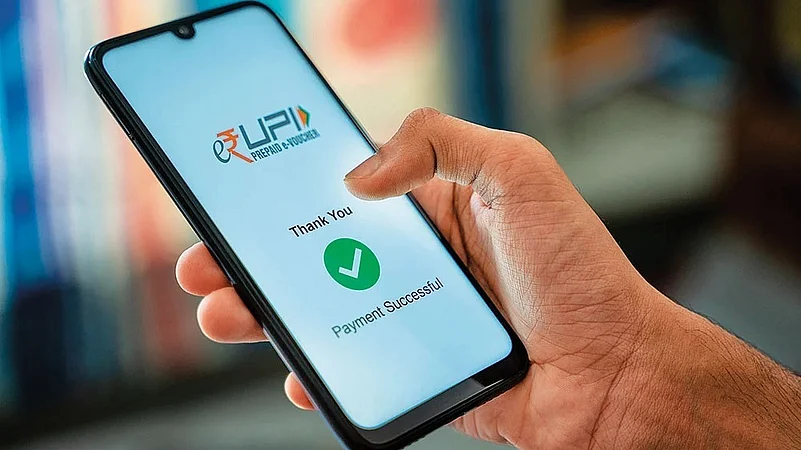

The Department of Financial Services is expected to issue a gazette notification defining the payment channels that will retain statutory exemptions.
Merchant UPI transactions of ₹2,000 and above could face MDR, with the final rate and structure to be determined by an NPCI-led Services Steering Committee.
Finance Minister Nirmala Sitharaman said merchants will not be allowed to pass the MDR on to customers, while P2P transfers and low-value retail transactions will remain free.
Unified Payments Interface (UPI) merchant transactions of ₹2,000 and above could attract a Merchant Discount Rate (MDR) within the next fortnight, marking a major shift in India's digital payments framework.
The Department of Financial Services (DFS) is expected to issue an official gazette notification specifying the payment channels that will continue to remain exempt from MDR, Financial Express reported.

1 October 2026
Get the latest issue of Outlook Business

Following the notification, a dedicated Services Steering Committee led by the National Payments Corporation of India (NPCI) will determine the final scope, rates and tiered structure of the proposed charges.
MDR is a processing fee charged by acquiring banks and payment service providers (PSPs) to merchants for handling digital transactions. The revenue helps support payments infrastructure, network operations and security.
Consumers To Remain Protected
Finance Minister Nirmala Sitharaman has said businesses will not be permitted to pass the MDR directly on to consumers. Person-to-person (P2P) payments and low-value retail transactions will continue to remain free, according to the framework.
Advertisement
The legal basis for the change was created through Parliament's passage of the Taxation and Other Laws (Amendment) Bill, 2026. The legislation amended provisions of the Payment and Settlement Systems Act, 2007, giving the government the authority to designate digital payment modes that must remain free while allowing MDR to be applied to specified commercial transactions.
Why Is UPI MDR Coming Back?
UPI transactions previously carried charges of up to 0.3% before the government introduced a blanket Zero MDR regime in January 2020. The policy was designed to accelerate digital payments, reduce transaction friction and encourage merchants to shift away from cash.
Advertisement
UPI subsequently became India's dominant retail digital payment platform. However, banks and fintech companies have continued to argue that the absence of MDR makes it difficult to recover the rising costs of operating payment infrastructure, preventing fraud and investing in technology upgrades.
The proposed framework seeks to address those concerns while protecting consumers and preserving the affordability of everyday digital payments.
"The more important question for the ecosystem is not whether MDR is introduced, but how it is implemented without placing undue pressure on merchants, particularly smaller businesses operating on thin margins," Kunal Jhunjhunwala, founder of Airpay said. "The Industry needs to approach this conversation with clarity and foresight," he added.