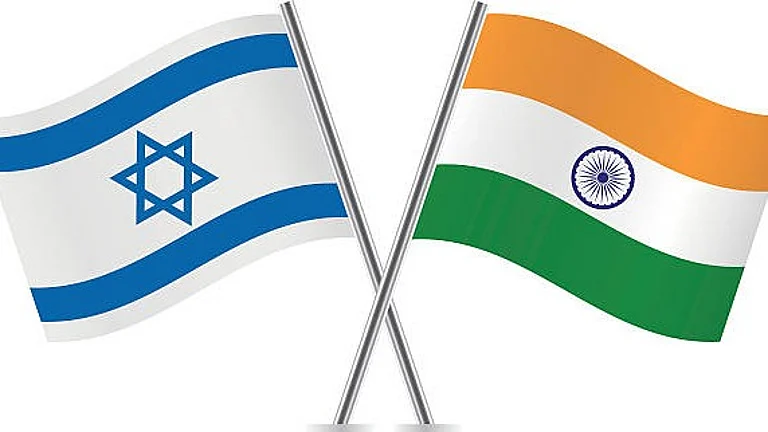
India–Israel ties deepen as Narendra Modi visits Tel Aviv amid regional tensions.
Bilateral trade has grown from $200mn (1992) to $6.5bn (2024).
Defence partnership strong, with India taking 34% of Israel’s military exports (2020–24).
Visit signals India’s strategic engagement despite Gaza conflict and West Asia volatility.
In 1977, former Israeli foreign minister Moshe Dayan slipped into India under a false name. He was hosted quietly by his Indian counterpart, Atal Bihari Vajpayee, as the two sides attempted—unsuccessfully—to forge diplomatic ties. The secrecy of the encounter reflected the tone of the relationship for decades that followed.
For much of the post-Independence period, India kept Israel at arm’s length. Congress-led government normalised ties and maintained limited engagement, but Israeli diplomats often remarked privately that India treated Israel “like a mistress”—willing to cooperate behind closed doors while avoiding public acknowledgement.

1 October 2026
Get the latest issue of Outlook Business

However, things have changed today. Since India normalised relations with Israel in 1992, the partnership has steadily developed. After the Narendra Modi-led government came into power in 2014, India has engaged with Israel more openly. In fact, Modi is the first Indian head of government to visit Israel.
India is now the second-largest Asian trading partner for Israel, after China. Figures from the Ministry of External Affairs show that bilateral trade has grown sharply — from about $200mn in 1992 to $6.5bn in 2024.
Prime Minister Narendra Modi will pay a State visit to Israel on February 25-26 at the invitation of his Israeli counterpart Benjamin Netanyahu. This will be Modi's second visit to the country. He will also call on President Isaac Herzog.
Advertisement

Purpose of the Visit
The two leaders will review the significant progress made in India - Israel Strategic Partnership, and discuss further opportunities in various areas of cooperation, including science and technology, innovation, defence and security, agriculture, water management, trade and economy, and people-to-people exchanges. The leaders are also expected to exchange perspectives on regional and global issues of mutual interest.
"I am confident that my State Visit will further consolidate the enduring bonds between the two countries, set new goals for the Strategic Partnership, and advance our shared vision for a resilient, innovative and prosperous future," said Modi before his departure today.
Advertisement
Between the Lines
The visit is as much about its timing as its agenda. India’s earlier hesitation with Israel stemmed from its longstanding support for Palestinian statehood—a position New Delhi continues to reiterate.
The diplomatic landscape has changed sharply since Israel’s attack on Gaza. Many developing countries have distanced themselves from Tel Aviv or criticised it openly.
For India, the broader instability in West Asia is troubling. The Israel–Iran confrontation has added to tensions. Security in the Red Sea remains fragile, threatening shipping lanes critical to India’s trade. Energy markets are volatile, and any prolonged disruption carries direct economic consequences for a country heavily dependent on Gulf oil.
Against this backdrop, Modi’s visit signals that India is willing to be seen engaging Israel even while also condemning Tel Aviv’s de facto expansion into the West Bank.


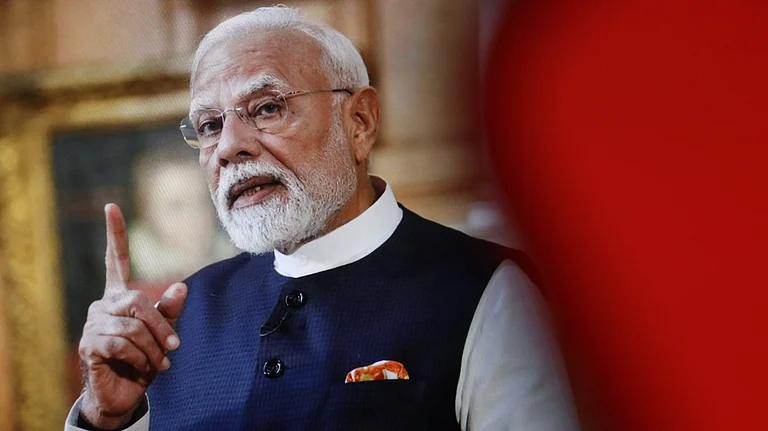
The relationship has continued to institutionalise. In September 2025, the two sides signed a new Bilateral Investment Treaty, replacing the 1996 agreement and offering updated provisions for investor protection.
Netanyahu, meanwhile, has spoken of building a new regional grouping—a “hexagon” alliance—designed to counter what he describes as “radical” Sunni and Shia powers. He suggested the framework could include Israel, India, Greece and Cyprus, along with unnamed Arab, African and Asian countries. None of the governments mentioned, including India, has endorsed the idea publicly.
Defence cooperation continues to anchor the relationship between India and Israel. Tel Aviv remains a key source of cutting-edge military technology for New Delhi — supplying air-defence systems, drones, precision-guided weapons and surveillance equipment worth around $2.9bn over the past decade. India is also Israel’s leading destination for defence exports, accounting for roughly 34% of its total overseas military sales between 2020 and 2024.
Modi’s visit is expected to include announcements on recently concluded procurements or new co-development projects, continuing a pattern of steady, security-driven engagement.