

Ola Electric’s stock plummeted 64% from its IPO price, reaching an all-time low of ₹27.36
Market share collapsed from 35% to 5.87%, dragging the company to fourth place by early 2026
Q3 FY26 revenue dropped 55% year-on-year, resulting in a significant net loss of ₹487 crore
Ola Electric was listed on stock exchanges in August 2024 at ₹76 per share, the upper end of its IPO price band. At the time, the Bhavish Aggarwal-led company was the market leader in India’s electric two-wheeler segment, holding a 35% market share, according to Vahan portal data.
Following the IPO, most analysts gave the stock a “buy” rating, and the company delivered 98,619 vehicles in that same quarter.

1 October 2026
Get the latest issue of Outlook Business

However, about a year and a half later, the stock has fallen sharply and is now trading near its all-time low of ₹27.36, a decline of 64% from its IPO price. The company has also lost its leadership position in the EV two-wheeler market, dropping to fourth place with a market share of 5.87% as of January 27, 2026.



Most analysts have now downgraded the stock to a “sell” rating, citing weak quarterly performance. Vehicle deliveries have also dropped significantly, falling 66.8% to 32,680 units.

What Went Wrong?
The company was once seen as India’s strongest prospect in the electric two-wheeler segment, but frequent strategy changes, weak financial performance, and concerns about product quality have gradually reduced investor confidence.
Advertisement
The company’s third-quarter (Q3 FY26) earnings, released on February 13, 2026, reflected this slowdown. Ola Electric reported a 31.9% sequential decline in revenue and a net loss of ₹487 crore. Revenue from operations stood at ₹470 crore, down from ₹690 crore in the previous quarter and 55% lower than ₹1,045 crore in the same quarter last year.
The adjusted operating EBITDA loss widened 25% compared to the previous quarter, reaching ₹323 crore from ₹258 crore, although it improved 34.6% compared to ₹494 crore a year earlier. The EBITDA margin also worsened, falling to negative 68.7% from negative 37.4% in the previous quarter. Total operating expenses increased slightly by 3.8% quarter-on-quarter to ₹432 crore but declined 34% compared to the year-ago period.
Advertisement
In the automotive segment alone (excluding the cell business), revenue fell 55% year-on-year to ₹467 crore and dropped 32% sequentially.
Constant Change in Strategies
Aggarwal had initially planned to expand the company’s gigafactory capacity to 20 GWh by mid-2026. However, this plan was revised multiple times.
During the Q1 FY26 earnings, the expansion plan was paused due to slower-than-expected EV market growth. In Q2 FY26, after launching the Ola Shakti battery energy storage system (BESS), the company again said it would expand capacity to 20 GWh to meet expected demand.
But in the latest Q3 shareholder letter, Aggarwal stated that the gigafactory would reach only 6 GWh capacity by March 2026.
Similarly, the company has also repeatedly lowered its break-even target. In Q3 FY25, Aggarwal said Ola would break even after selling 50,000 vehicles. This target was reduced to 25,000 units in the next quarter as part of cost-cutting efforts and has now been further lowered to 15,000 units, according to the latest results.
Investor confidence has also weakened. SoftBank has reduced its stake in Ola Electric from over 17% at the time of the IPO to 13.53% as of January 2026, selling more than 94 million shares between September 2025 and January 2026. Other major investors, including Tiger Global Management and Alpha Wave Ventures, have also reduced their holdings to less than 1% each.
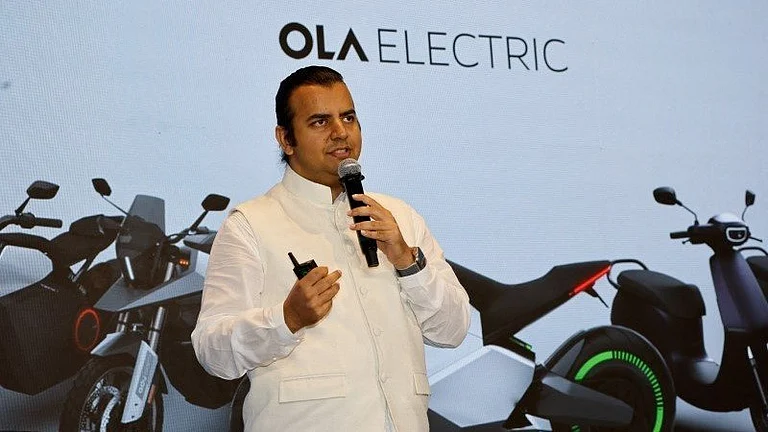
Rivals Run Ahead
At the same time, competition has intensified. Rivals such as TVS Motor Company, Bajaj Auto, Ather Energy, and Hero MotoCorp have gained market share.
TVS Motor is the market leader as of early 2026, while Bajaj Auto and Ather Energy are competing for the next positions, with Hero MotoCorp also expanding its presence.
While Ola Electric has struggled, Ather Energy has reported strong performance.
In Q3 FY26, Ather’s revenue rose 50% year-on-year to ₹953.6 crore, supported by record sales of 67,851 units. Its net loss also narrowed significantly by 57% to ₹84.6 crore from ₹197.5 crore a year earlier, indicating improving efficiency despite continued losses.