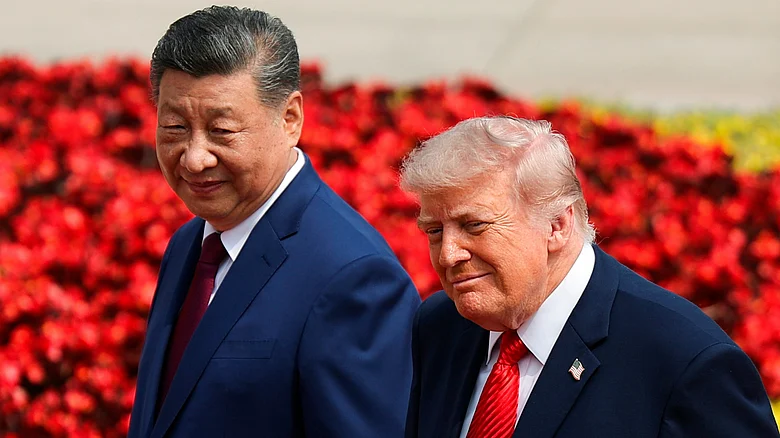
US President Donald Trump left Beijing after two-day summit acknowledging that he had struck “fantastic trade deals, great for both countries", however, there is no clear available information yet about what exactly they agreed on.
Trump arrived Wednesday for a high-stakes summit with Chinese leader Xi Jinping, with a host of CEOs in tow. It is a high-profile business delegation that includes agriculture, aviation, electric vehicles and artificial intelligence (AI) chips.
Trade was high on the agenda despite recent tensions over the Iran war and businesses hoped for key deals, as well as an extension of the tariff truce which is due to expire in November.

1 October 2026
Get the latest issue of Outlook Business


Global Economic Significance
Citing International Monetary Fund (IMF) on May 14, Reuters reported that a positive dialogue between US President Donald Trump and Chinese President Xi Jinping would reduce tension and uncertainty between the world’s two largest economies, adding that it is “good for the world”.
"It's very important, of course, that the world's two largest economies are engaging at the highest level," IMF spokesperson Julie Kozack told a news briefing when asked about the Trump-Xi summit's initial outcomes in Beijing, reported Reuters.
In Beijing on May 14, Xi launched the two-day summit with a warning to Trump that a mishandling of the countries' disagreements over Taiwan could push US-China relations to a "very dangerous place".
Advertisement
However, Reuters reported that a year after Trump's steep tariffs on Chinese goods and Xi's retaliation nearly collapsed all US-China trade, the two leaders' discussions on trade and investment were more positive.

Inflation And Growth Risks
Easing geopolitical tensions “is arriving at a critical juncture for the global economy, which is already grappling with multiple external shocks,” the International Monetary Fund has warned, Reuters reported. It said it was closely monitoring the impact of high energy prices caused by West Asia instability, including disruptions related to Iran-related tensions and risks to key shipping routes. Brent crude remained elevated, adding to inflationary pressures in import-dependent economies.
Advertisement
The IMF’s scenario analysis suggests the global economy is on a more adverse growth path if shocks continue, Reuters reported. While baseline global growth remains above 3%, it could fall closer to the mid-2% range under stress conditions involving sustained high oil prices, tighter financial conditions, and rising geopolitical risks. The IMF said, however, that medium-term inflation expectations remain anchored in most major economies even as short-term price pressures are rising amid energy volatility.