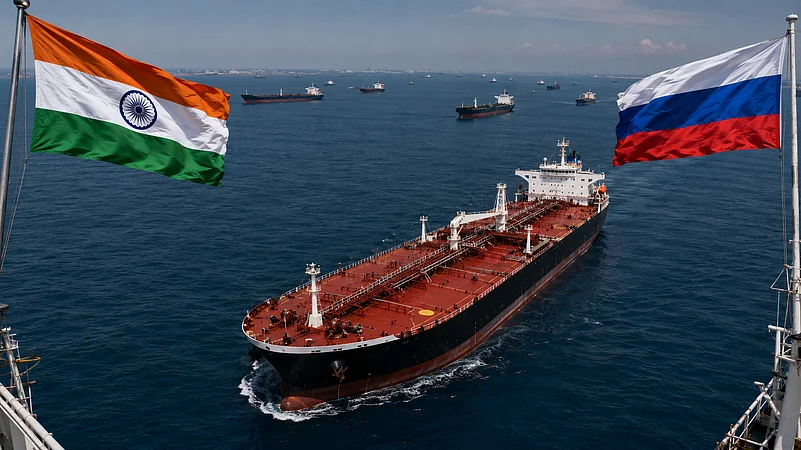

India's petrol exports surged in June, led by shipments to 'unknown' destinations.
The export spike coincided with reports of petrol shipments reaching Russia.
The Centre said any Indian fuel reaching Russia likely moved through intermediaries.
Indian petrol exports saw a huge spike in the month of June 2026, especially to unknown destination, trade data showed. This comes amid a report by news agency Reuters, which claimed that Indian refineries have dispatched large shipments of petrol to Russia.
However, Petroleum Minister Hardeep Singh Puri pushed back on the claim. He noted that if any Indian-origin fuel is reaching Russia, it may have passed through intermediaries rather than being sold directly by Indian companies.

1 October 2026
Get the latest issue of Outlook Business

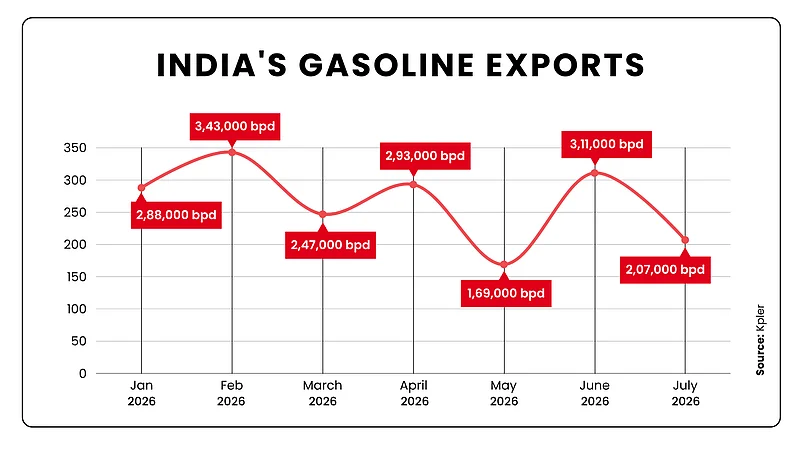
Data shared by global data and analytics firm, Kpler, with Outlook Business showed that last month New Delhi shipped 311,000 barrels per day (bpd) of gasoline globally. It was 84% more compared to its May exports of 169,000 bpd. The spike was on account of 90,700 bpd of petrol sent to "unknown destinations", data showed.


Point to note: Kpler designates some shipments in its unknown destinations category when its tracking system is unable to determine where the cargoes are heading.
Kpler's Lead Analyst-Refining, Nikhil Dubey, told Outlook Business that India has never in the past exported gasoline to Russia. He further said, "We are not seeing any gasoline cargoes loaded from India signalling Russia as their discharge destination."
Advertisement
When asked which Indian refiners currently have any spare capacity to export petrol, Dubey said refiners can export around 300,000 barrels per day of petrol, with these volumes mainly coming from Reliance and Mangalore Refinery and Petrochemicals Limited (MRPL) and occasionally from Nayara, Indian Oil Corporation (IOC) and Bharat Petroleum Corporation Limited (BPCL).
What Data Shows
Looking at the overall picture, Indian refineries have been exporting petrol to multiple destinations for a long time now. In January, petrol exports stood at 288,000 bpd, climbing to 343,000 bpd in February, the highest point in the data set provided by Kpler. They then fell to 247,000 bpd in March, rose again to 293,000 bpd in April, dropped to a low of 169,000 bpd in May, and rebounded to 311,000 bpd in June. In July, exports settled at 207,000 bpd.
Advertisement
Among key destinations, the United Arab Emirates received the most in February, at 104,380 bpd. Oman's biggest month was January, at 52,600 bpd, while Singapore's peak came in March, at 61,510 bpd. Exports to South Africa rose sharply to 207,250 bpd in July, according to Kpler data, the highest country-wise volume recorded in the dataset. Both Kenya and Tanzania saw their highest volumes in June, at 52,610 and 45,990 bpd respectively.
As for the "unknown destinations" specifically, the volumes were 10,530 bpd in January, nil in February, 2,650 bpd in March, 11,290 bpd in April, just 410 bpd in May, and then a sudden spike to 90,700 bpd in June.
The data comes at a time when India is abuzz with a report claiming Russia, one of the largest oil-producing nations, has started bringing in seaborne shipments of petrol from India, in an effort to make up for fuel shortages. These are caused by Ukrainian attacks on its energy infrastructure.
On July 1, news agency Reuters reported that at least 60,000 metric tons of gasoline was dispatched from India to Russia. Citing a source, the news agency reported that two tankers, with parcels of 30,000 to 40,000 tons each, were also sent.
Which Indian refiner is behind these shipments remains unclear. However, Reuters reported on Thursday that traders had sold petrol made by Nayara Energy, India's largest private fuel retailer, to Russia. The report came days after Nayara cut petrol prices in India by ₹5 a litre and diesel prices by ₹3 a litre at its nearly 7,000 fuel stations, effective July 1.

Why Russia is Running Short
Across Russia's 11 time zones, petrol pumps are running dry. Drivers are queuing for hours, prices are climbing to record highs and fuel is being rationed in several regions. To ease this crunch, Russia has reportedly turned to an unlikely source: India.
Russia sits on one of the world's largest refining networks, with an installed capacity of around 7.5 million barrels per day, according to Kpler analyst Nikhil Dubey. On paper, that should be more than enough to meet domestic demand. But sustained Ukrainian drone strikes have knocked out key parts of this network, particularly the catalytic cracking and hydrocracking units that turn crude oil into usable petrol and diesel.
"These units are highly sophisticated and typically require lengthy repairs when damaged. Consequently, although Russia's overall installed refining capacity remains sufficient to meet domestic demand, the loss of these key processing units has constrained the production of transportation fuels, contributing to the current fuel shortages," Dubey said.
President Vladimir Putin acknowledged the problem on Sunday, telling government ministers and other officials that Ukrainian drone strikes on oil refineries had triggered fuel shortages in some regions, though he said Russia was managing the situation.
The Kremlin said on Tuesday that Russia was in talks with other countries to import fuel at acceptable prices.
In summer, when demand peaks, Russia burns through at least 110,000 tons of petrol every day. To bridge the gap, the country plans to import 400,000 tons of petrol a month from various countries, including neighbouring Belarus, which has already been shipping fuel across the border. Belarus almost tripled its petrol rail supplies to Russia in the first half of June, sending more than 70,000 tons compared with the first half of May, according to Reuters calculations.
Russia's parliament has also stepped in, approving tax code amendments last week aimed at tackling the shortage, alongside subsidies on fuel imports pegged to Indian delivery costs and prices.